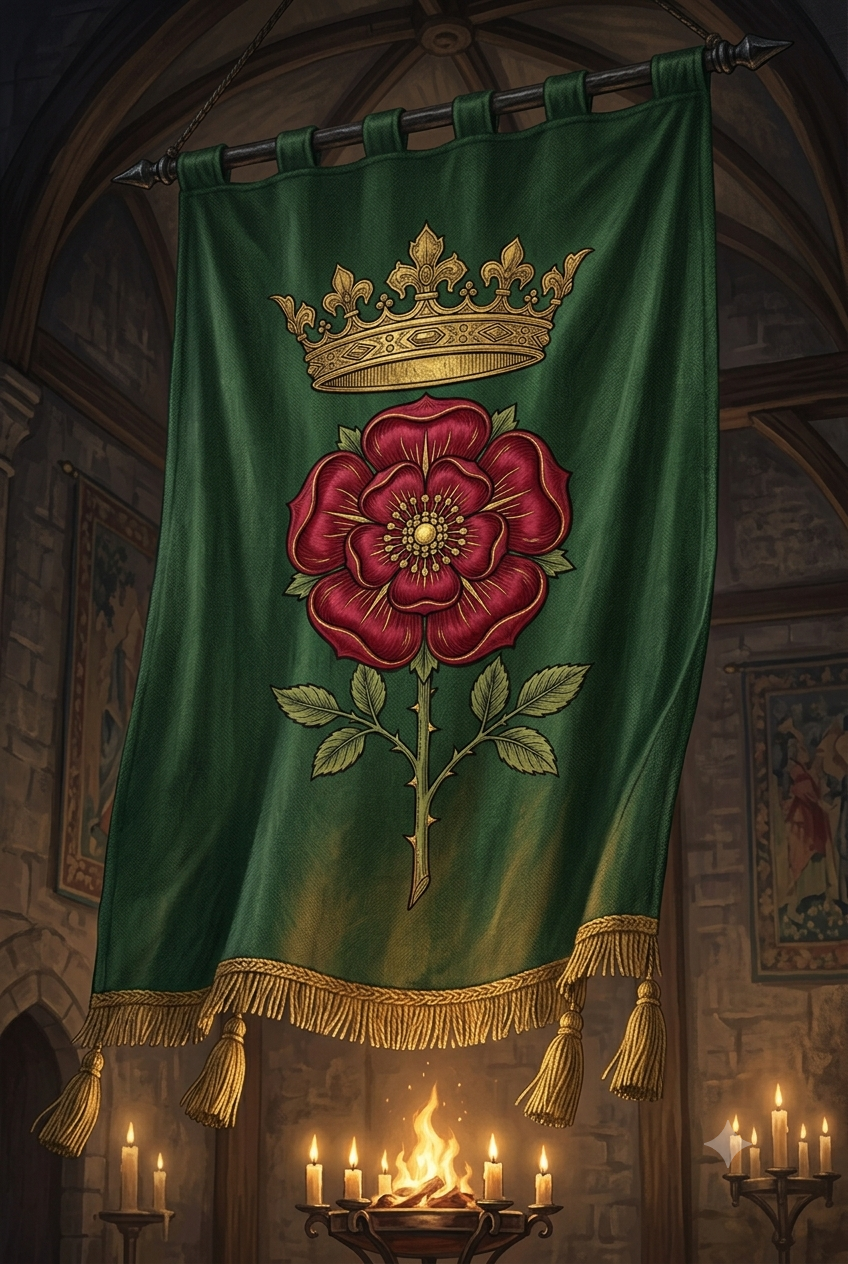
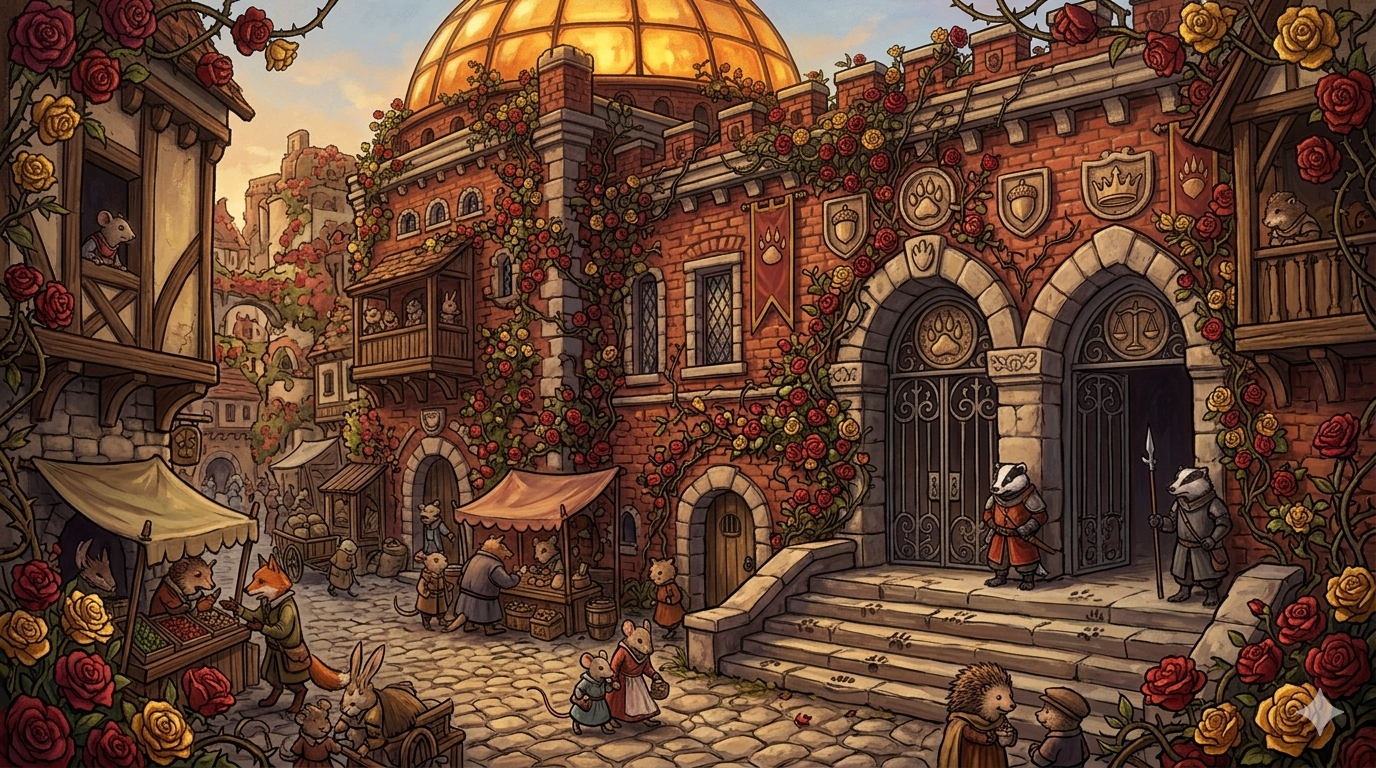
An ancient forest realm ruled by the Greyback dynasty - rose cities, thorn walls, and a throne built on ash and ambition.
Avondelle
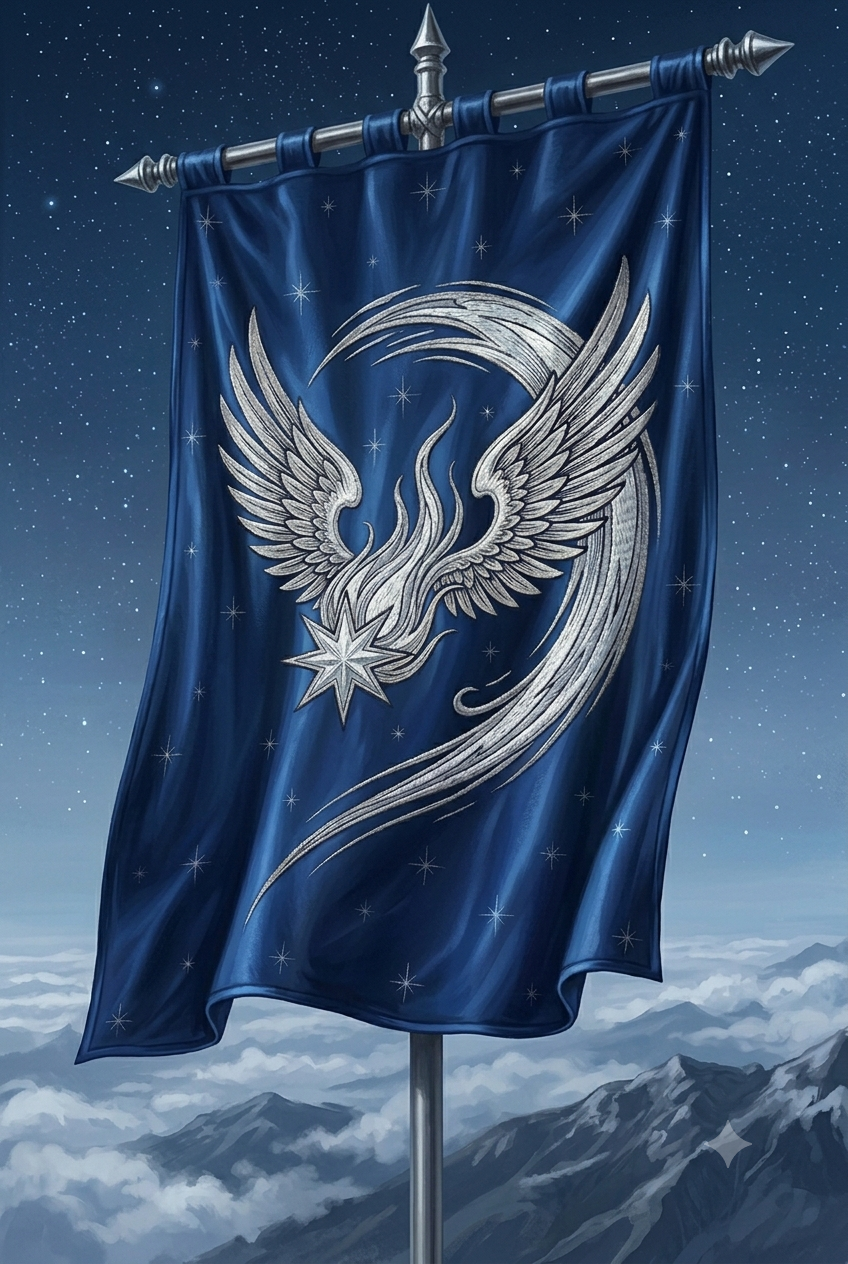
The Skyward Dominion
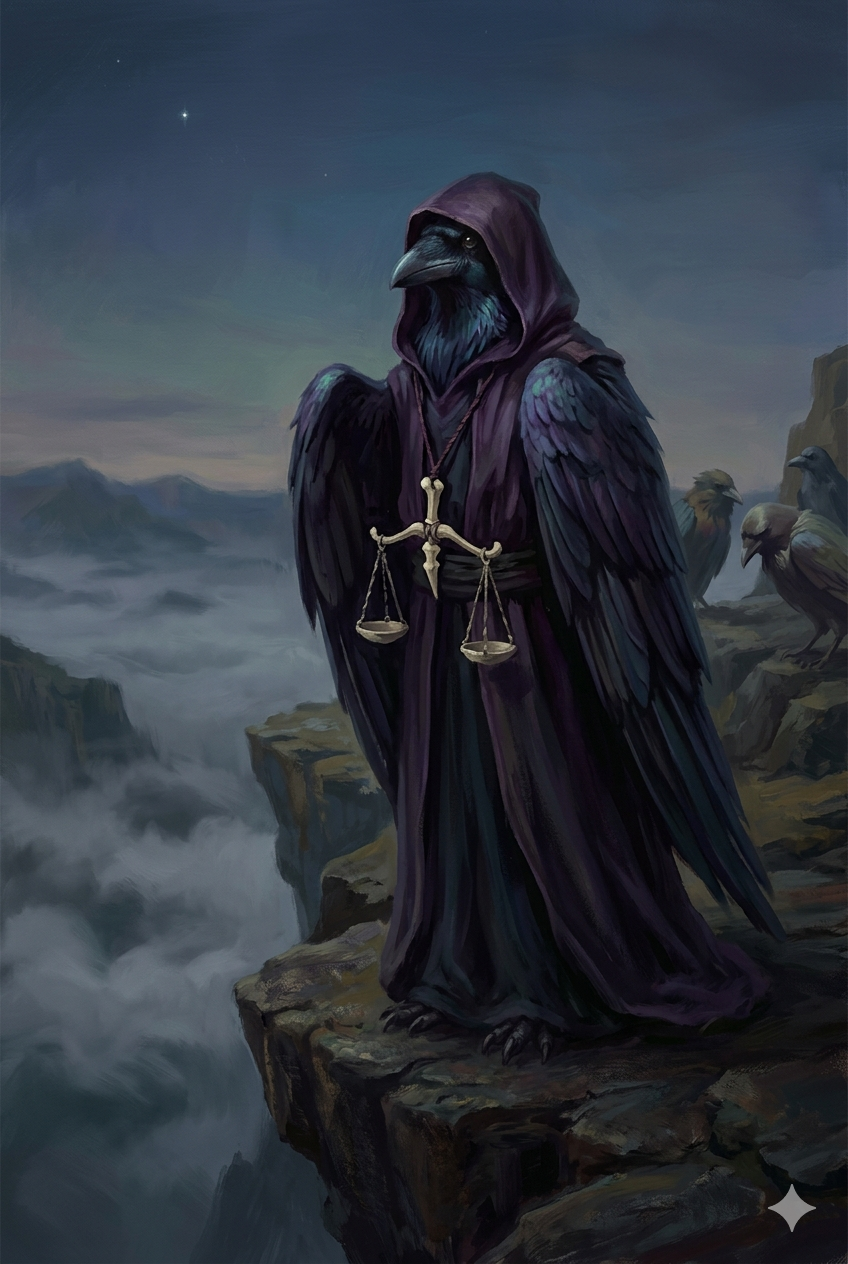
Birdfolk who built their settlements above the clouds and their faith around a single star. Reach determines rank.
Garunga
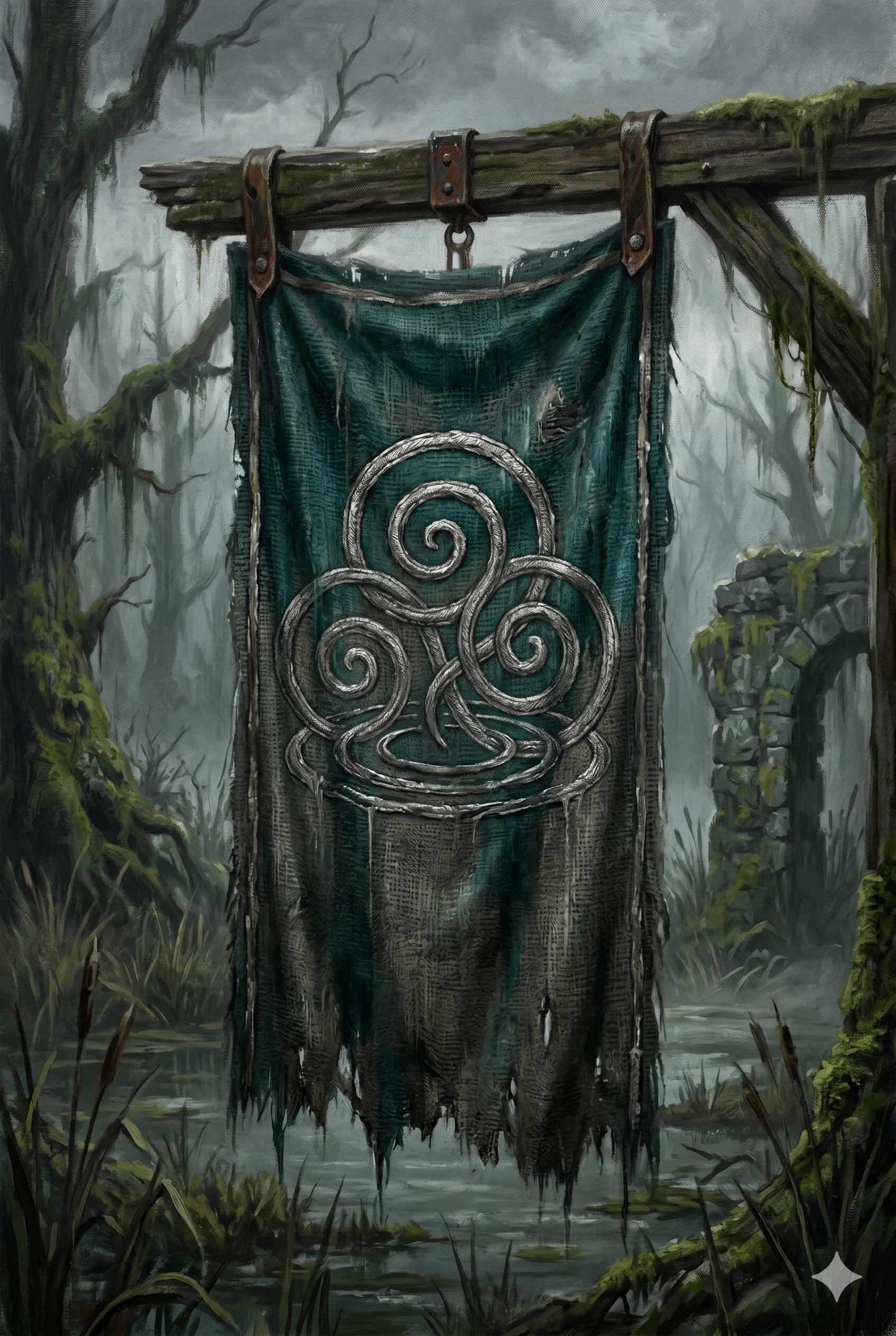
The Drowned Shore
It was a coast once - warm tides, open beaches, salt and sun. The Harvest War took the shore and left the swamp. Three castes, three rulers, and the memory of what was lost.
Mul Wü Terre
The Dwolic Underhills
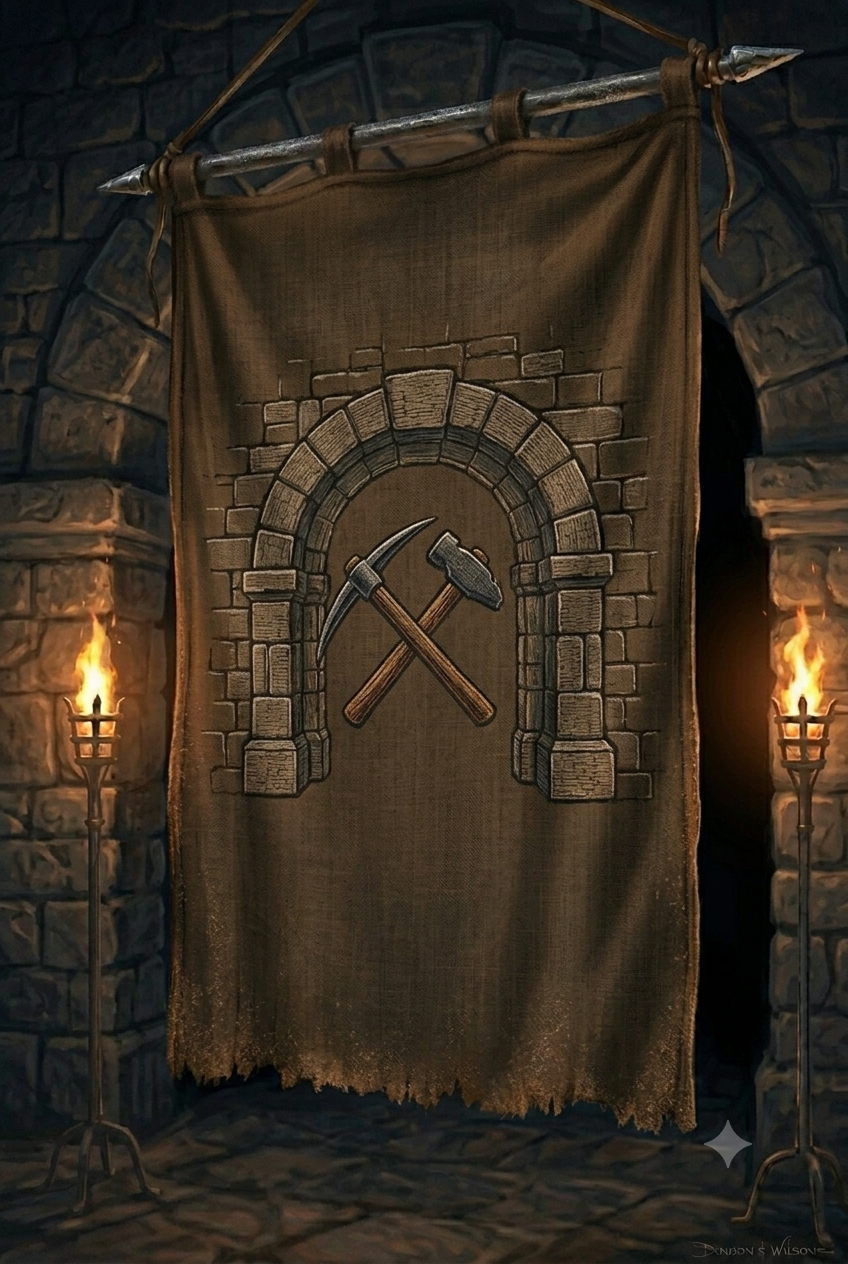
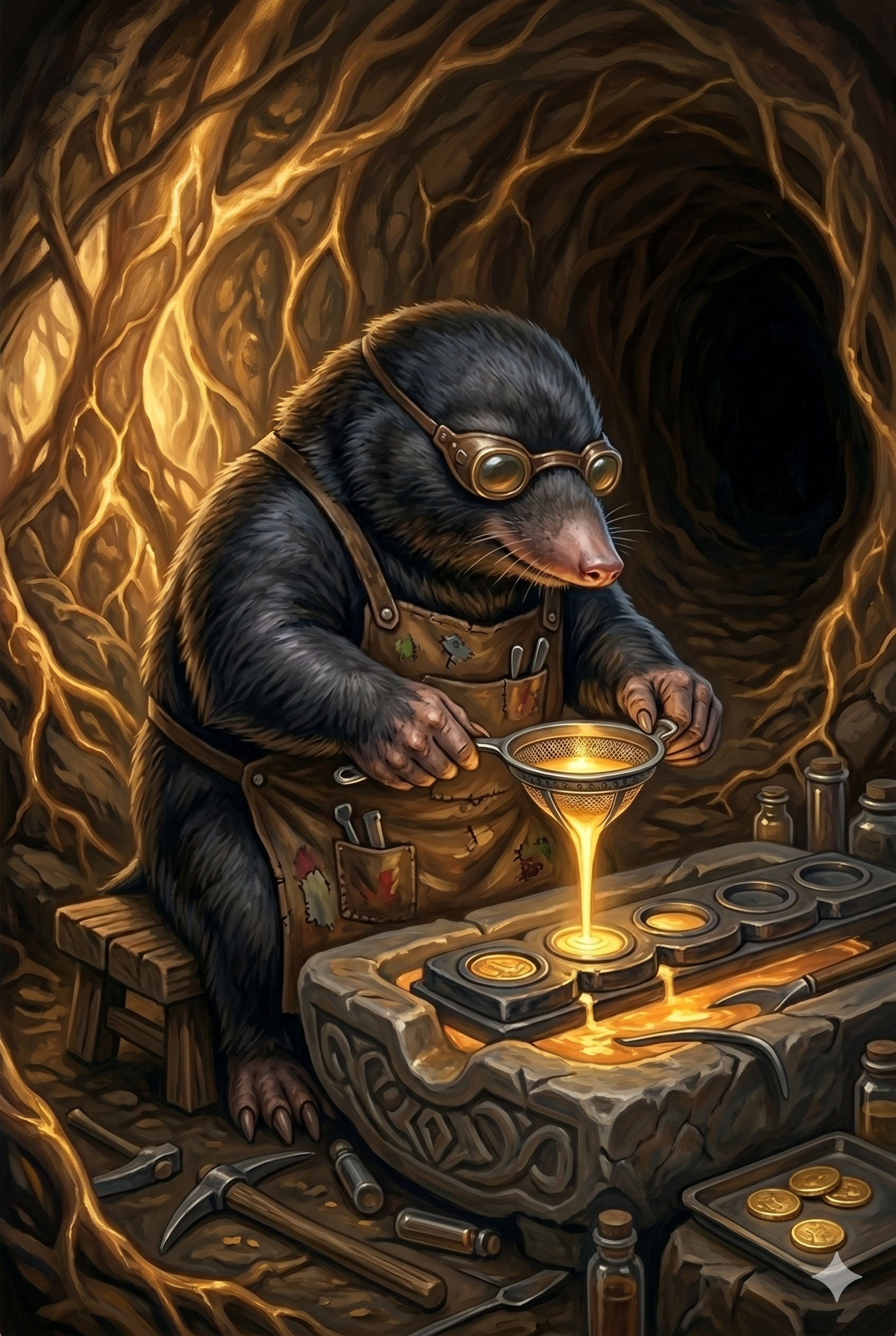
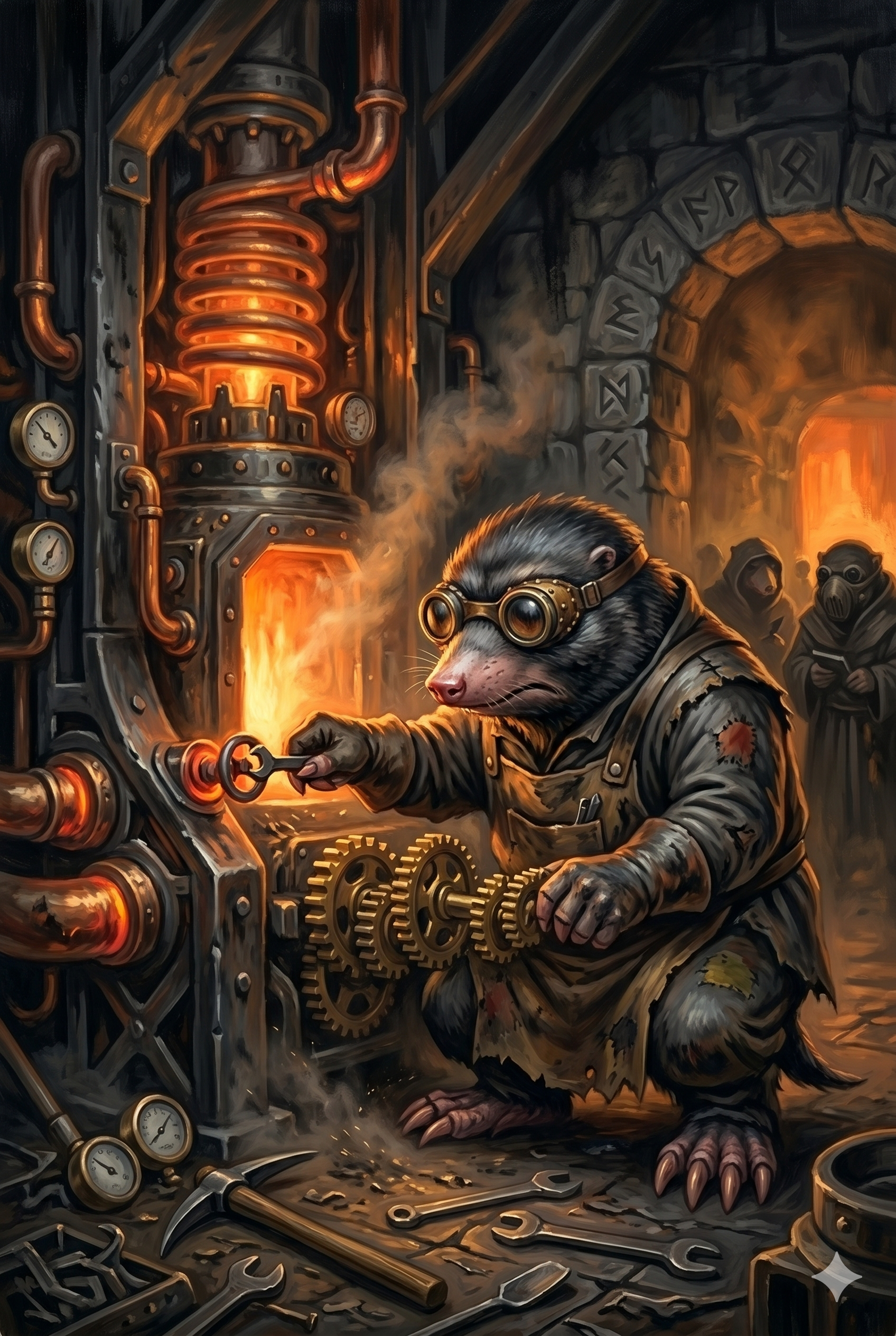
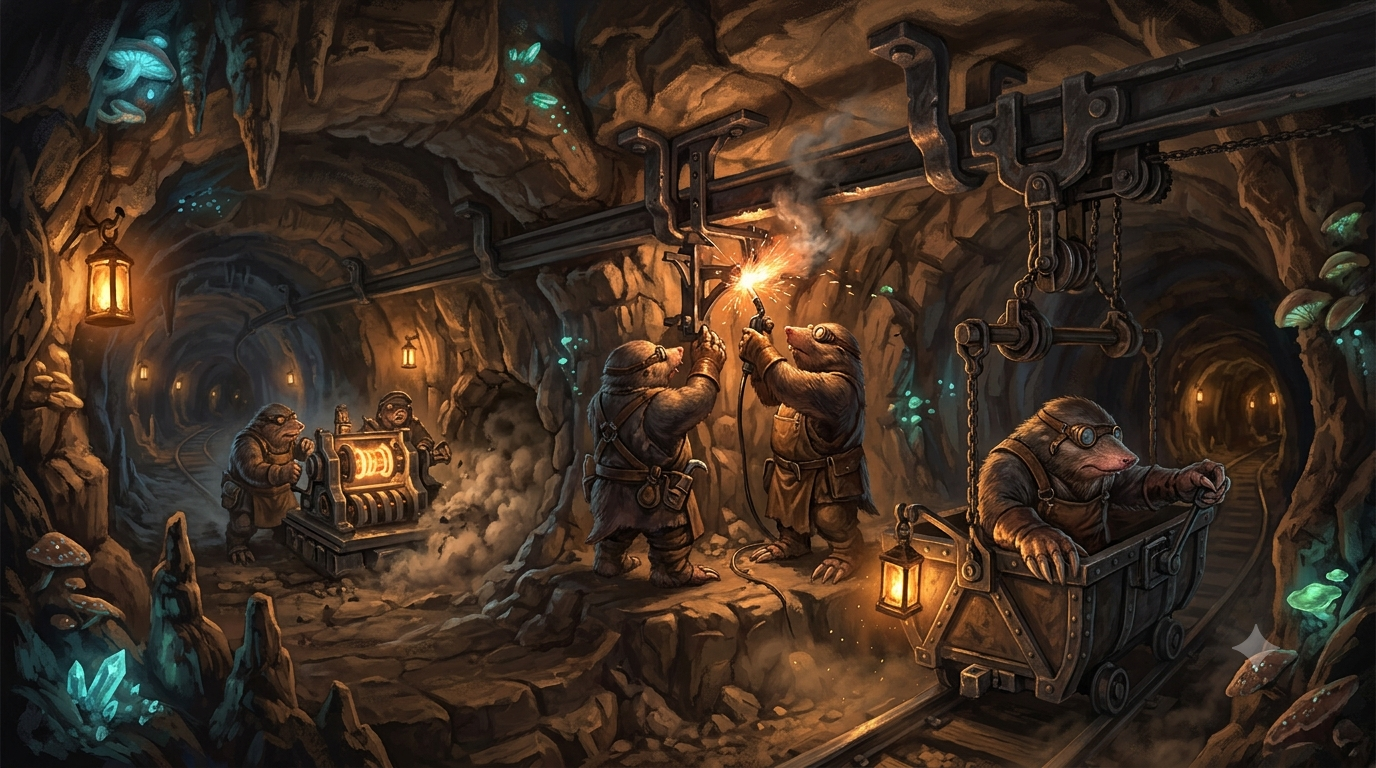
Dwoles and Brevis - master engineers and the sole minters of the realm's currency. Every coin in Wildermere passes through their presses. Their mechanical craft is without equal.
Bastion
The Exile's Hearth
No crown, no chains. Built by war survivors who burned their old names. The only realm that welcomes everyone.
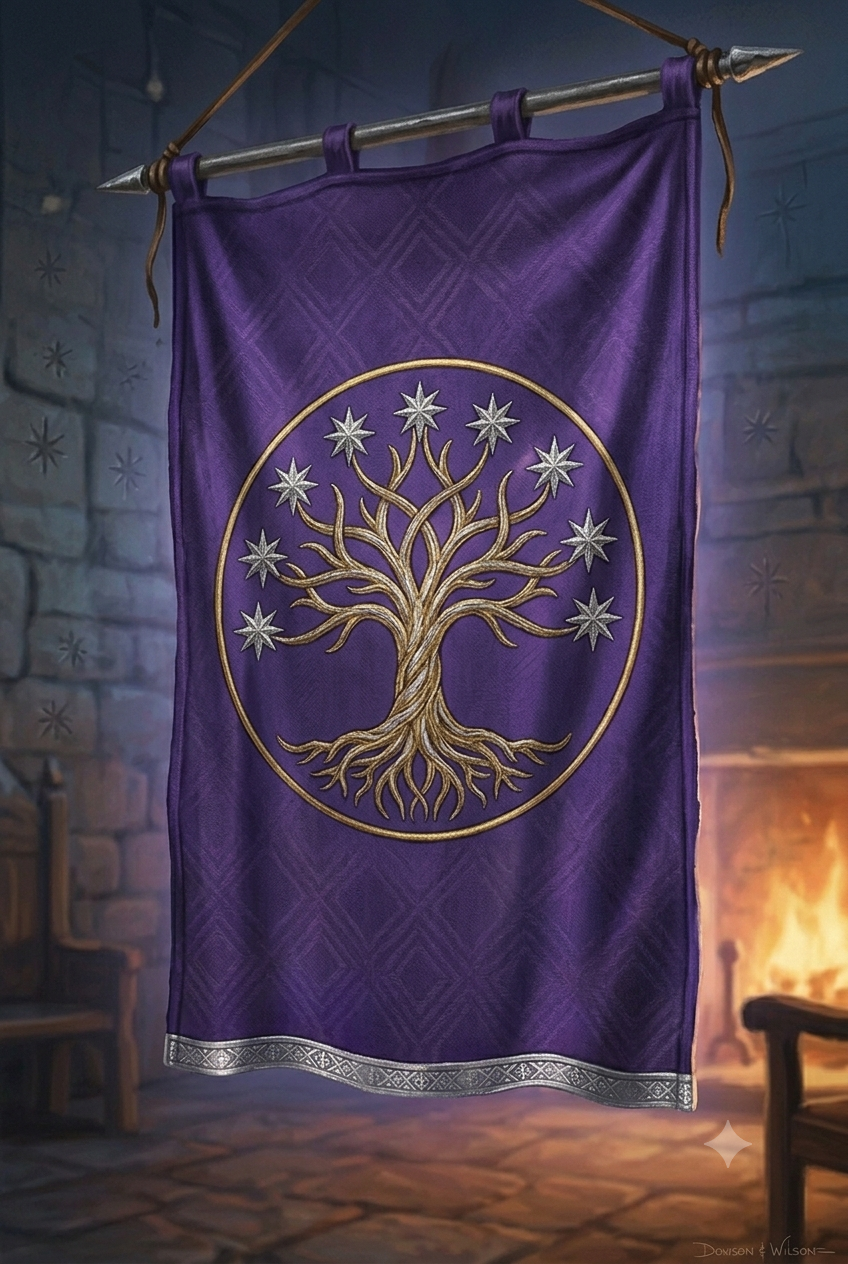
Tasa Ru
The Living Archive
Keepers of root-memory and the Rootvoice network. They know things realms wish they didn't. Knowledge is the only currency they trust.
In the Beginning
Wru & Üne - The First Beasts
Before Wrüne was made, there was only the Deep Wilds — an infinite cosmic wilderness populated by beings beyond counting. Among them moved two: Wru and Üne.
"They were not siblings, not rivals - but lovers, or halves, or mirror beasts. Together they wove the rhythm of the world: the living and the long memory of it."
Wru, the Wanderer
He Who Broke the Quiet · The Strider
Wru was the first to stir. It galloped across the sleeping world, and where its hooves struck, rivers ran and winds howled. Its cry cracked the silence - and from that cry came sound, name, and movement. Wherever Wru wandered, its breath became birdsong and its stride became the wind.
Wru is worshipped most fervently in Verdaan, whose Greyback dynasty claims divine descent from the moment Wru's first great cry cracked the sky above the Furànn - the sister-tree of the west, which stood at the heart of the ancient land of Cárraig.
The stars are not gaps. They are beings. Other creatures like Wru and Üne — vast, ancient, wandering the Deep Wilds as Wru and Üne once did. The sky on a clear night is not a ceiling. It is a crowded wilderness, and most of what moves through it has never looked this direction.
Meteors are Wru. When a light streaks fast across the sky and burns out — that is Wru, still running. Still unable to stay still even now. Some say it circles this world the way it once circled everything. Some say it is simply passing through on its way somewhere else. The Verdaanian Greybacks believe it returns when something is about to change.
Üne, the Dreamer
Keeper of Fallen Things · The Deep Root
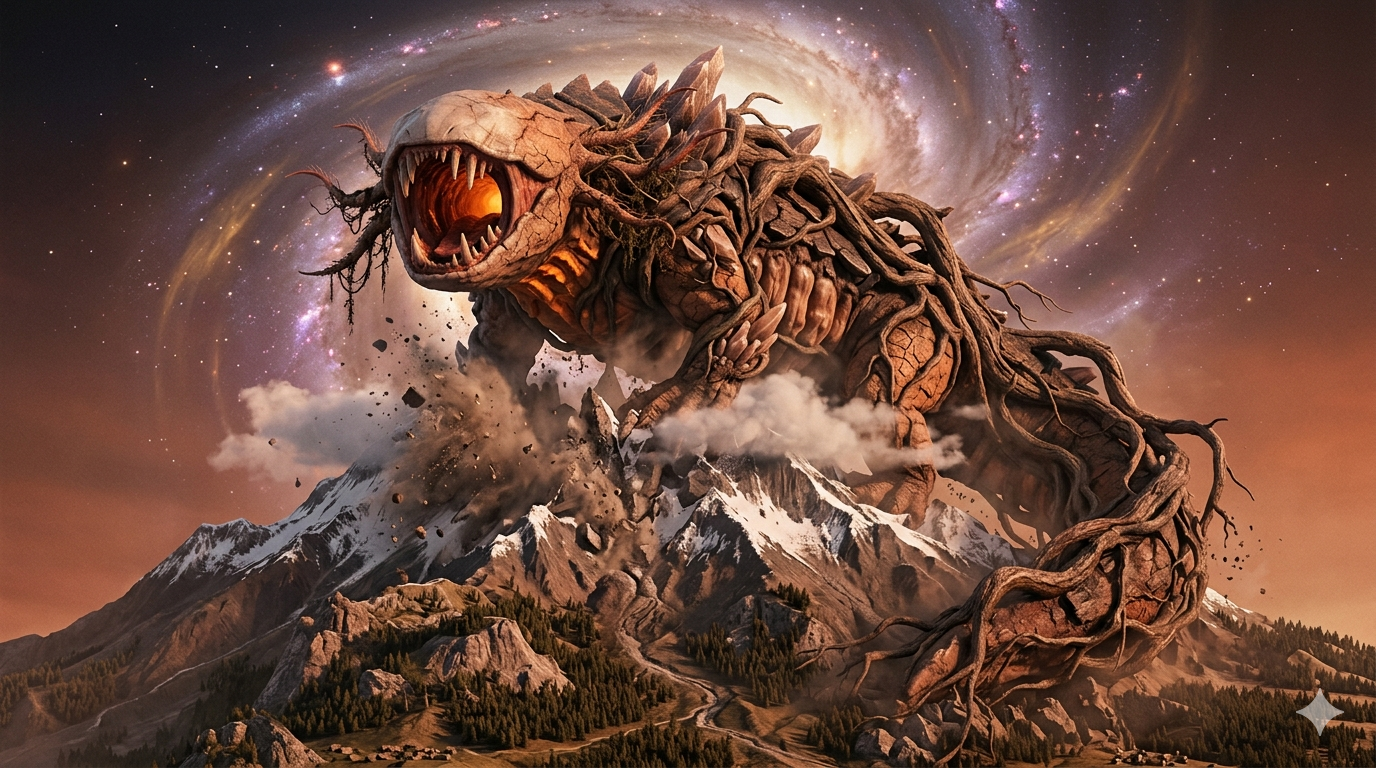
Üne did not cry - but listened. A vast, blind burrowing beast whose bones were made of root and river-rock, Üne moved slowly beneath the soil, carving caverns, storing echoes, cradling the bones of the dead. Every leaf that fell was folded into Üne's memory. Nothing was lost. Nothing forgotten.
The Dwoles speak of Üne in reverent clicks and hums. The Rootvoice network of Tasa Ru is believed to be Üne's nervous system, still dreaming beneath the soil.
The mountains are her spine. When Üne burrowed beneath the world, she came close to the surface in places - too close. Her backbone broke through the soil and became the mountain ranges. She tried to reach the sky once. She couldn't. The peaks are the evidence.
Every dream is hers. The living don't create dreams - they receive them. Üne holds the complete archive of everything that has ever happened, and while you sleep, she lets some of it surface.
The deep places are still warm from her. Every cave system, every ocean trench, every tunnel that goes deep enough leads eventually to where Üne passed. The Dwoles believe the warmth in the deepest stone is residual body heat. She moved through here. Not long ago, by her reckoning.
The Chirm speak in her register. The Undersong isn't a language the Chirm invented. It's the frequency Üne thinks in. Insects are the only creatures naturally attuned to it - which is why the Rootvoice and the Undersong sometimes hum at the same pitch. Tasa Ru's Branch of Still Water has noted this. They have not published their findings.
Veyuun, the Watcher
The Brightest · The Watcher · Sovereign God of the Avondii
The brightest being in the Deep Wilds. Vast, still, radiant — it has not moved in the memory of any realm. Most Wilderfolk see it as the largest and oldest creature in the sky, the one that stopped while everything else kept wandering.
The Avondii do not share this interpretation. To them, Veyuun is not a creature — it is a god, and it was watching before Wru ever stirred. Their entire civilisation is built around being seen favourably by it. The Creed of Veyuun holds that the sky has sovereign claim over the earth because Veyuun claimed it first.
Vülkor, the Hunger
The Hunger · The Starless · The Wandering Mouth
Something moves through the Deep Wilds that does not wander — it hunts. Ancient, patient, incomprehensibly vast. Where it passes, stars dim. It has no fixed form that any Wilderfolk tradition agrees upon, only the certainty of its hunger and the belief that it has not yet found Wrüne.
Parents in every realm use it to quiet children. Bad harvests, unexplained disappearances, nights when the sky feels too close — all attributed to Vülkor's passage somewhere far above. The Avondii refuse to speak its name. The Dwoles, who cannot see the sky, say this is the one thing the surface folk were right to fear.
The Folk Belief
"Something in the Deep Wilds hunts. It has no name that any Wilderfolk agreed upon — the Verdaanians call it The Hunger, the Avondii call it The Starless, the old folk say The Wandering Mouth. Its true name, in the oldest tongue, is Vülkor. It does not know Wrüne exists. Wilderfolk use this as comfort and as warning in equal measure — be still, be small, don't be the thing that gets noticed."
The Cosmos
The Deep Wilds
The sky is not a ceiling. It is the Deep Wilds — an infinite wilderness that stretches beyond anything that can be measured or named, populated by beings as vast and old as Wru and Üne themselves. The stars are them. Other creatures, wandering, living, moving through the dark between things.
Most of what moves through the Deep Wilds has never looked this direction. Wrüne is small and warm and hidden in a quiet corner of something that does not know it exists. That is, most believe, for the best.
The Origin
The Migration
Wru and Üne did not seek each other. They were simply moving — as all creatures in the Deep Wilds move — following whatever current pulls beings across the dark. They arrived at the same empty place at the same time. A patch of nothing in the middle of everything.
Üne stopped first. Wru circled it. Then, for the first time in its existence, Wru stopped too. What followed was not planned. It was, most believe, inevitable — two creatures who had each been alone in the Deep Wilds for longer than anything had a word for, finally arriving somewhere at the same moment.
Interactive Atlas
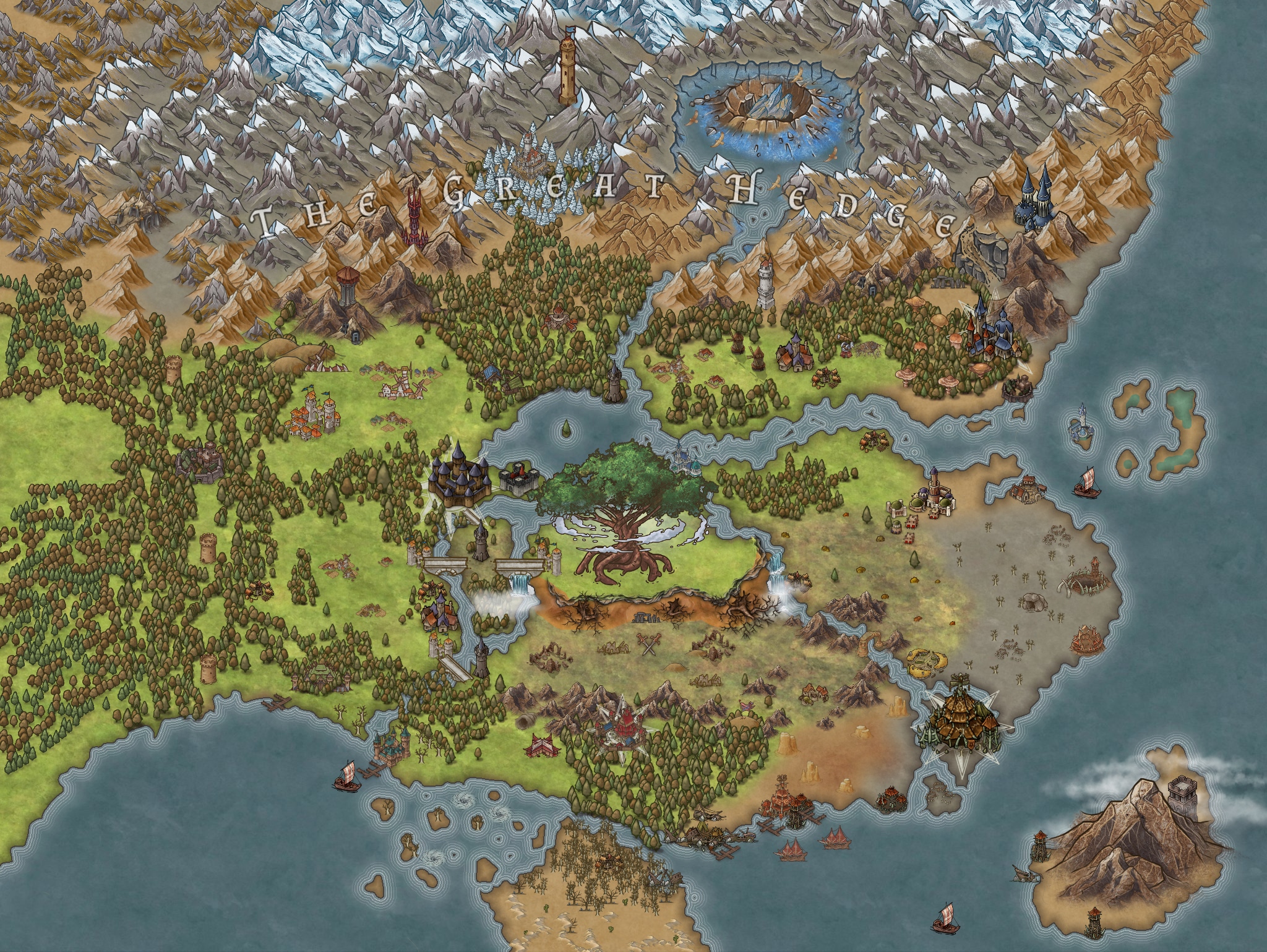
The Map of Wildermere
Click any realm or named location to open its lore. Coordinates calibrated to the official map.
🗺️
Place wildermere_map.png here
Save the map image alongside this HTML file
Ctrl + scroll to zoom
Scroll to zoom · Drag to pan
Click a realm region or any named location to open its lore panel
As Recorded by the Branch of Memory · Tasa Ru
The Crownless Age
Known as The Banner Wars
As set down by Orveth Senn, Senior Archivist of the Branch of Memory, Tasa Ru. Compiled from the oral traditions of the Bogmaw elder councils, the Branchtail grove-records of Sedgwick Hollow, the Fleetfoot clan ledgers of Bixton Burrows, the tunnel-scripts of the Stripe Snout deep councils, and such Verdaanian texts as have been made available to this institution. Certain records pertaining to these events are held under seal at this archive and are not drawn upon in the following account.
A Note on Sources
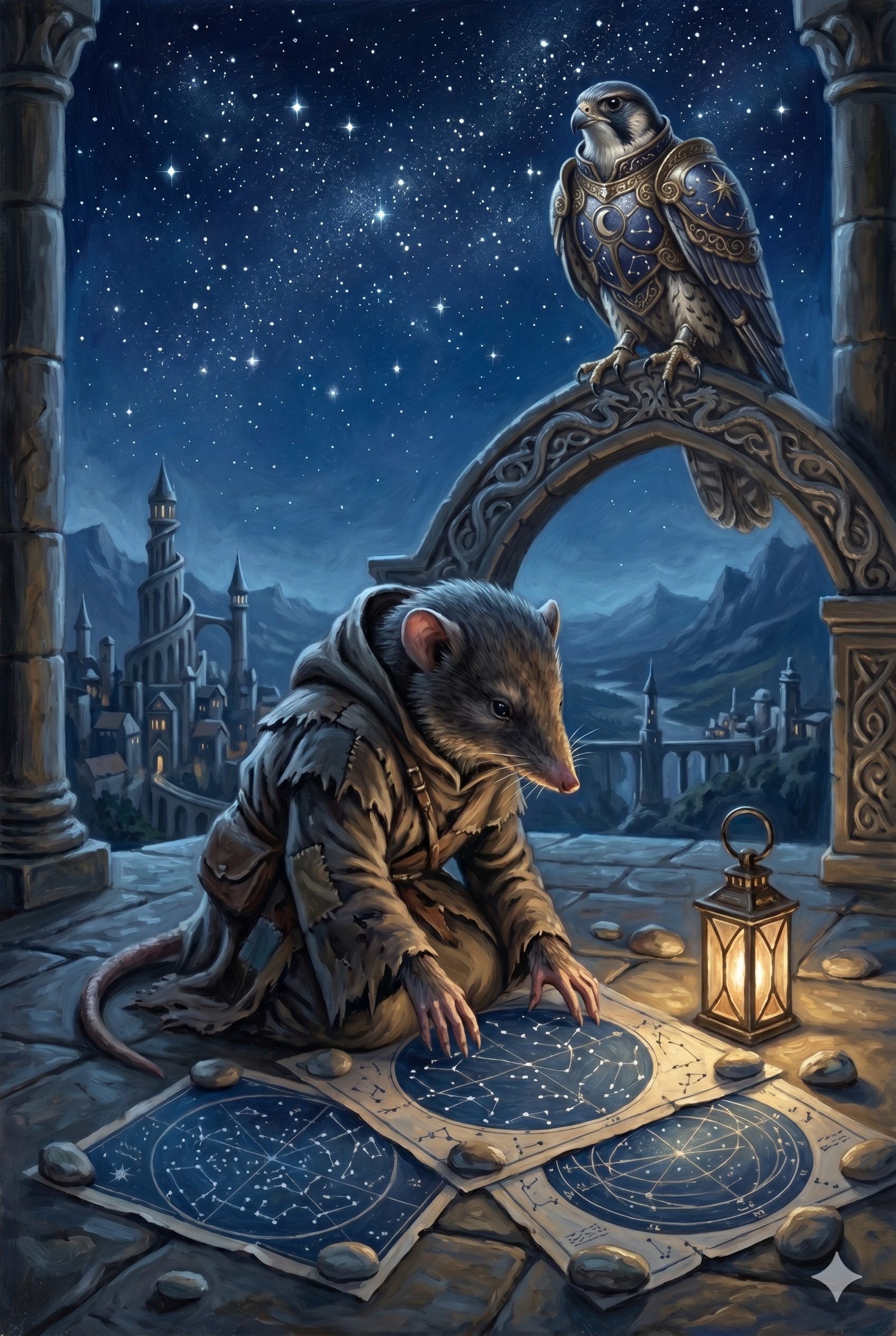
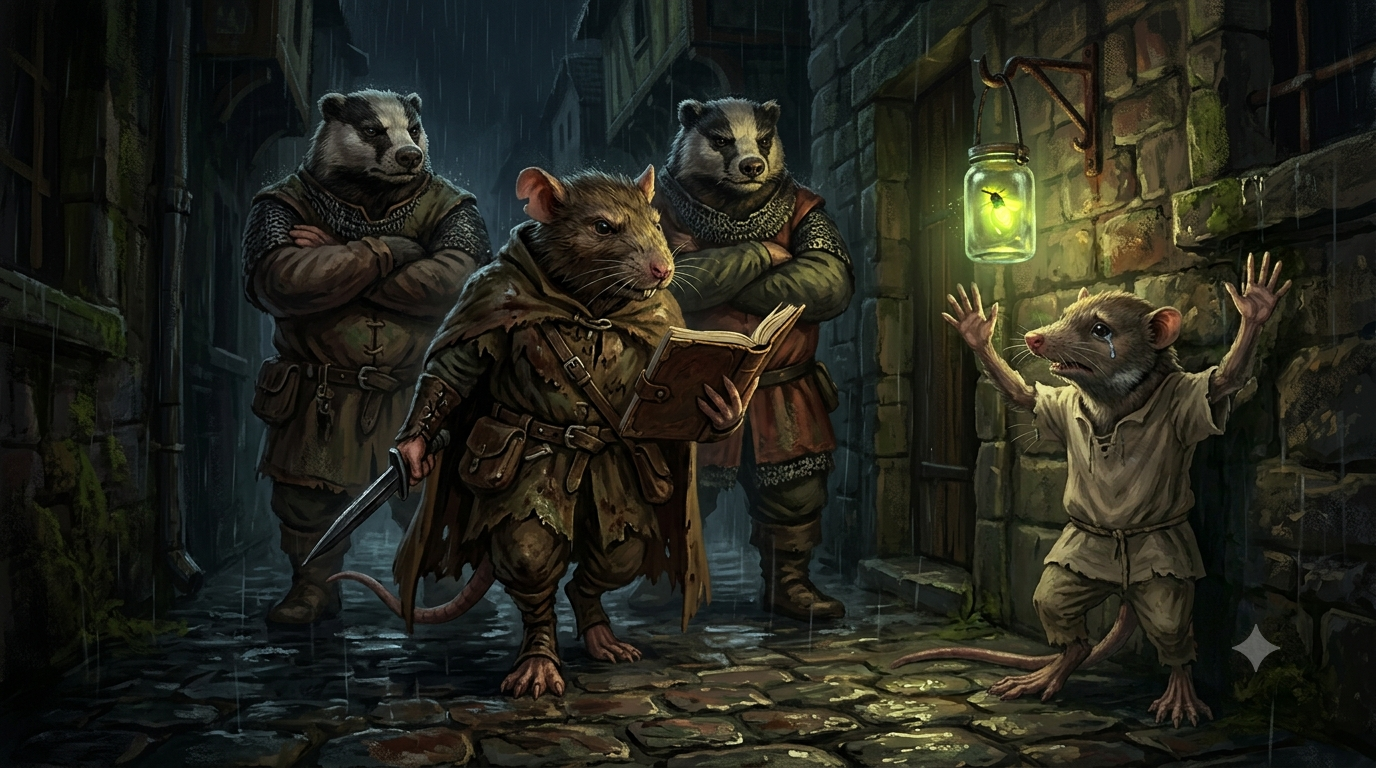
A shrew archivist writing a history of the Crownless Age will draw a different kind of scrutiny than a Garungan or Verdaanian would - and I think that is the point worth naming first. My people were not a major house. We had no seat at the Understory Accord and no army in the field. Shrews, like raccoons, hedgehogs, otters, and a dozen other minor peoples, were conscripted or caught in the middle. No house can claim I owe it a favorable account.
What I offer is precision. Every claim in this account has been measured against no fewer than two independent sources. Where accounts conflict - and they conflict often - I have said so plainly. Where the truth cannot be determined, I have said that too, rather than selecting the version most flattering to any party.
The reader should know that one set of records pertaining directly to these events is held under seal at this branch and is not consulted here. This is not an oversight.
- O. Senn, Branch of Memory, Tasa Ru
On the State of Wildermere Before the Banner Wars
To understand the Crownless Age one must first understand what Wildermere was before it: not a nation, not a kingdom, not any organized thing at all. It was a collection of territories held by custom and defended by strength, bordered by geography and the kind of mutual understanding that holds only so long as no one tests it.
The Branchtails claimed the canopy groves and the high timber country stretching south and west. The Stripe Snouts held the deep hill country, their tunnel networks threading beneath half the central ridgeline. The Fleetfoot ranged the open warrens of the east and the lowland meadows between. The Floodbinders controlled the river systems, every major crossing their concern, every ferry and ford built by their hands. The Garungan held the eastern reaches - broad coastal country, open shore, and the inland hill country behind it.
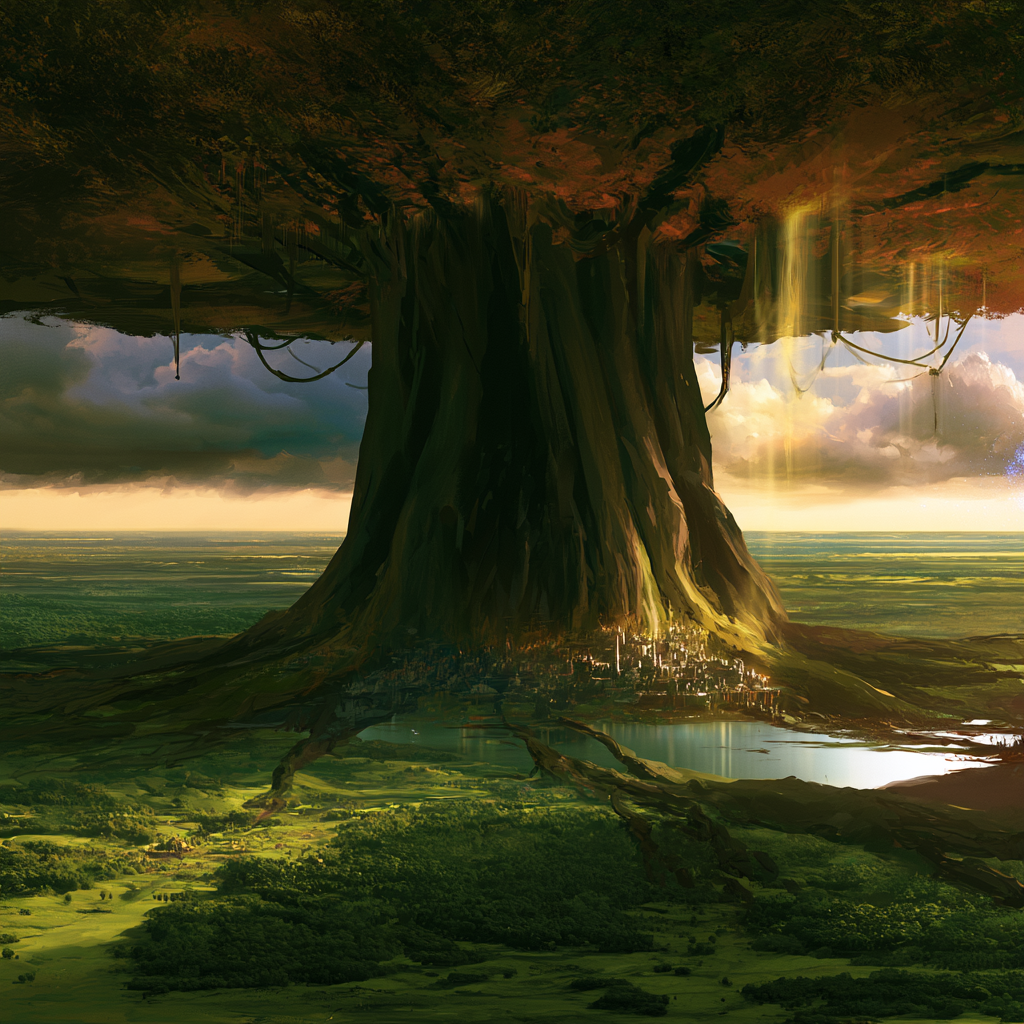
At the center stood the Cradleheart. I will not call it merely a tree, because to do so misrepresents what it was and what it is. The civilization that had grown within and around that tree across generations was the closest thing Wildermere possessed to a shared capital. Its canopy sheltered thousands. Its roots defined districts. Its heartwood held halls older than any realm now sitting at a treaty table. Every surrounding people paid it tribute, sent pilgrims to it, settled disputes within its root courts. It was, in the most precise terms available to this archivist, the most contested ground in the known world - which is precisely why no one had yet tried to claim it outright.
This was Wildermere before the Banner Wars: a working arrangement, not a peace. A balance maintained by habit rather than law.
On the Greyback Arrival
Far to the west, beyond country that Wildermere traders rarely crossed twice, there had been another great tree. The Furann. What burned it, no archive holds. What arrived in the generations that followed was the consequence: the Greybacks, moving east overland in numbers that no single migration should have been able to sustain, taking with them what they could carry and leaving behind everything they could not.
The other peoples received them as peoples receive the unexpected - wariness first, tolerance when it became clear they were not arriving as conquerors. They settled the northwestern reaches, the territory that would become Verdaan: fertile ground, defensible, distant enough from the Cradleheart that no one raised a formal objection.
Generations passed. The Greybacks ceased to be newcomers in any practical sense while remaining newcomers in every social one. The other peoples kept their old allegiances and their old ways of looking at each other, and the Greybacks occupied that territory as neighbors rather than kin. This distinction - neighbors, not kin - is, in this archivist's assessment, the ground in which the Banner Wars grew.
On the Creep
No single person decided to start the Crownless Age. It assembled itself, as the worst things tend to.
The Briarthorn family had dominated their people's politics for several generations by the time Aldric was born. In that same span, they had been incrementally repositioning Briarthorn's relationship with the Cradleheart: increased pilgrim presence first, then a garrison at the outer rootline - described in their own texts as protection for Greyback pilgrims who had encountered hostility on the roads. Whether that hostility was as widespread as claimed, I cannot verify. I note only that the garrison remained long after any reasonable protective function would have been satisfied.
The Branchtails, whose canopy country sat nearest the Cradleheart's southern reaches, raised concerns through such informal channels as then existed. The Stripe Snouts watched and said little. The Briarthorn response to every concern was mild, reasonable, and accompanied by another incremental step forward. Historians call this period the Creep. I am inclined to call it what it was: preparation.
On the Claim
The declaration reached every notable seat in Wildermere within a matter of weeks, carried by Greyback riders in coordinated waves timed to arrive almost simultaneously. The simultaneity was entirely deliberate. Aldric wanted no one to hear the declaration second-hand, and no time for opposition to take shape.
The argument was framed in ancestral and sacred terms. The Briarthorn family had stewarded the Furann before its burning. The Cradleheart was the last great tree in the known world. The obligation of stewardship transferred when the tree was lost. Therefore: access to the Cradleheart civilization would henceforth be negotiated through Briarthorn. Pilgrim routes would require Briarthorn acknowledgment. The garrison at the outer rootline was to be formalized and expanded - not merely soldiers at a gate, but a managed Briarthorn presence at every approach to the tree.
What that presence meant in practice: Briarthorn soldiers moved into the land surrounding the Cradleheart from every direction. The southern groves that would eventually become Bastion. The scholar's paths to the north and west that would eventually become Tasa Ru. The river corridors, the timber approaches, the ridge roads. The one border they did not take was the eastern one - where Garungan territory began and where Briarthorn was not yet prepared to press a claim. Every other corridor into the tree passed through ground under Briarthorn control or Briarthorn observation.
The civilization they surrounded was not a military one. The Cradleheart had been home for generations to scholars and archivists, smiths working the root-forges beneath the canopy line, woodwrights, healers, and families who had grown up in chambers hollowed into the heartwood across centuries. It was more city than fortress - because until Aldric, no one had needed to treat it as anything else. Its own peacekeepers were exactly that: a contingent maintained within the tree for settling disputes, enforcing the pilgrimage codes, keeping order in the scholar halls and root-courts. Not soldiers. Not built for engagement with an outside force. Inside the rootline, their knowledge of the tree's corridors and its customs gave them authority no outside army could replicate. Outside the rootline, they held nothing. The people of the Cradleheart watched Briarthorn take positions around them on every side and understood, before the first formal declaration of war, exactly what kind of hostage they had become.
The Branchtails' response was the shortest of any. They had nested in and around the Cradleheart for as long as living memory reached. They did not use diplomatic language. Every other people took longer to respond - most doing the same calculation: what do we lose if Briarthorn wins, and what do we lose if we are on the wrong side of whatever comes next.
What the other peoples were calculating, Aldric had already calculated for them. While the public declaration targeted the Cradleheart, a quieter campaign ran alongside it - private correspondence, careful promises, land assurances delivered in person. The Fleetfoot hill-clans settled inside Briarthorn's eastern borders had never formally sworn to anyone. The Branchtail foresters working the western timber lines had no seat at Sedgwick Hollow. The Stripe Snout border families too far from the deep hill councils to feel their authority had grievances of their own. These were peoples living within Briarthorn territory who had never been asked where their loyalty sat. Aldric asked, and he asked before the war started.
On the Alignments
The war that followed was not, as some later accounts have framed it, a united resistance against Briarthorn aggression. No people fought as a unified whole. Every faction had its splinter.
Those Who Stood With Briarthorn
The northern Fleetfoot clans declared early for Aldric under Roggu, a Fleetfoot lord whose trade ties to Briarthorn ran back decades. His calculation: Briarthorn held the most disciplined fighting force in Wildermere, Aldric's claim had internal logic, and the first lord to formally back the winning side would find himself well positioned when the dust settled, and the first lord to back the winning side would be well positioned afterward. The rest of the Fleetfoot repudiated the arrangement as soon as word reached them. The fracture produced its own violence before the larger war was finished.
At the King's Run - the main Floodbinder river crossing - a river-lord named Torren Castor had conducted years of private negotiation with Briarthorn over water rights to the eastern tributaries. When the siege came, a gate opened that the garrison had not ordered opened. Torren Castor was not present.
Those Who Opposed Briarthorn
The Branchtails mobilized immediately after Sedgwick Hollow - the war's first movers and its most consistent fighters. Their canopy warfare was the sharpest tool any opposing force brought to the conflict.
The Stripe Snouts committed their forces under Stygmar Meles - called the Iron Wall - head of the deep hill war-councils. Their tunnel networks ran beneath land that predated the Greyback arrival, including land Briarthorn now claimed as its own. They had not forgotten what was there before Briarthorn.
The eastern and southern Fleetfoot joined with a particular fury, having spent weeks attempting to negotiate a resolution that avoided war entirely.
The Garungan pressed westward from the eastern coast. The Cradleheart's root system connects to underground water channels feeding the freshwater springs and tidal sources across the eastern reaches. A Briarthorn hand on the Cradleheart was a Briarthorn hand on what kept Garungan land livable. Minor peoples living throughout the Garungan reaches - shrews, otters, river-families with no formal house - were folded into the Garungan march whether they had any stake in it or not. This was not unusual. Every major faction drew on the smaller peoples living inside its territory. Most of those peoples did not get a name in the record.
Those With Their Own Agenda
The Floodbinders as a body played the situation with considerable care - aware that whoever emerged from the war would require their cooperation to move anything across any river in Wildermere.
Seren Goldbark, a Branchtail branch-seat lord, built something quietly over the first years of the war that belonged to neither faction. She gathered soldiers from every people who had grown disillusioned with their own war-councils, promising them a third way: no single people controls the Cradleheart, but a council does - with Goldbark as its founding voice. Her contingent numbered in the thousands by the time every army converged on the Cradleheart.
On the Battles
The Burning of Sedgwick Hollow
The war's first moment. A Briarthorn company moving toward the Cradleheart's southern approach passed through a Branchtail canopy settlement and demanded passage rights. The Branchtails refused. The settlement burned. Whether this was ordered or accidental, I cannot say with certainty. The runners went out the next morning.
The Siege of the King's Run
Briarthorn needed the river crossing to advance eastward. The King's Run fort was old and deep, built into the bank itself, half above water and half below. The Floodbinder garrison held for months, flooding their own lower passages and fighting Briarthorn forces in knee-deep current. The gate that opened was on the north side. The unit stationed there had withdrawn during the night - all eighteen soldiers, without filing a report, without alerting the watch on the adjacent post. By the time the garrison commander noticed the gap, three hundred Briarthorn soldiers were already through and moving south along the inner bank. The Floodbinder commander's after-action record names the sergeant who led that unit and notes, without elaboration, that the man had carried debts to a Briarthorn merchant house for two years prior. The sergeant was not among those captured after the crossing. He is not found in any record afterward. Torren Castor made no statement on the matter.
The Battle of Ashthorn Ridge
The opposition's most decisive early engagement. Stripe Snouts collapsing the ridge from below, Branchtails pressing from the canopy above. The Ashminder Sorcerers deployed fire sorcery at the ridge's mouth - the fire moving with a precision that unsettled everyone present, including those on whose behalf it burned. The Briarthorn vanguard routed. Ashthorn Ridge is where the opposition found its footing.
The Underbranch Quarrel Stripe Snouts vs. Branchtails
I include this engagement with some discomfort, as it reflects poorly on two peoples nominally fighting on the same side. Stripe Snout tunnelers expanding westward collapsed a section of their network to deny Verdaan its use - and brought down three Branchtail nesting groves with it. Whether they knew the groves were above them is a matter the deep councils have not addressed in any document this archive has seen. The Branchtails pulled from a joint position to respond. The gap they left was sufficient for a Verdaan company to advance through. The tunnel network still runs beneath that territory. The Branchtails know it.
The Warren Conflicts Fleetfoot vs. Fleetfoot
A Fleetfoot civil war running alongside the larger conflict. Roggu Bixton had declared for Briarthorn; his cousin Rollo Bixton led the clans that refused him. The two had grown up in the same warren and spent the war trying to kill each other. The largest engagement - The Battle of Three Burrows - saw Rollo's clans clear three interconnected burrow-complexes controlling the eastern passes. Three days of underground fighting followed, the worst possible terrain for a people built for open ground. Rollo's side won by collapsing the burrow entrances and smoking out the defenders. Roggu's position collapsed in the weeks after. His supporters scattered. Roggu himself disappears from the record around this time.
The Mouth Conflict Bogmaw Warriors vs. Floodbinders
Midway through the campaign, the Floodbinder clans moved to assert toll rights over the Garungan supply routes running through the river mouths. The Bogmaw Warriors refused. Three engagements followed over two months. The Bogmaws threatened to march overland through Floodbinder territory entirely. The Floodbinders withdrew their demand. No terms were signed. The Floodbinders retained their toll claim in principle. The Garunga records of this engagement are thorough; the Floodbinder records are brief.
The Chestnut Bay Dispute Branchtails vs. Floodbinders
The Floodbinders flooded a stretch of lowland territory along the western approaches as a defensive measure. The lowland groves the Branchtails had been using as staging encampments - several seasons of stored provisions - went under the water. Two hundred soldiers barely reached the canopy in time. The Branchtails did not accept this as an accident. For six weeks they fought along the river's edge, neither able to hold ground the other dominated. It ended when word came that every army was moving toward the Cradleheart. The lowland groves were never rebuilt.
The Eastern Campaign Garunga vs. Briarthorn
The Garunga pressed westward from the coast through terrain Briarthorn had no experience navigating. Progress was steady. I will set down the Reedling matter plainly: a Reedling contingent abandoned their position at a key inland passage late in the campaign. Verdaan coin was found in the area afterward. The Bogmaw Warriors did not accept the ambiguity. The relationship between those two Garunga peoples broke here. I have read every account held by this archive and found no version that absolves the Reedlings of what it appears they did.
On the Battle of Bannerdun
The understory of the Cradleheart - the open ground spreading south and west beneath the great tree's root formations, where the roots surface and plunge back and create a landscape of archways and wide clearings - was wide enough for armies. Close enough to the Cradleheart that whoever held it effectively held the civilization above. Every army arrived within days of each other. No coordination produced this. Every force had the same destination.
The battle lasted four days.
Day One. The Stripe Snouts went underground immediately, destabilizing the earth beneath Briarthorn's advance. The Branchtails pressed from the canopy at the forest edge. The Garungan pressed from the east. Seren Goldbark's contingent arrived and did not engage. She positioned them on the high ground to the northwest and waited.
Day Two. Hard fighting across every approach. Briarthorn pushed into the center and briefly held an advantage. Roggu's remaining northern Fleetfoot were routed by opposition Fleetfoot in the western pass. Briarthorn's flanks thinned.
Day Three. The Floodbinders flooded the western approach. Briarthorn had been told the passage would be held open. It was not. Stripe Snout tunnelers collapsed two major Briarthorn formations from below. The Garunga held the eastern approaches.
Day Four. Seren Goldbark moved her force into the center of the understory, occupying the approach to the Cradleheart's root formations. Neither side could push through. The fighting around her position was some of the worst of any day.
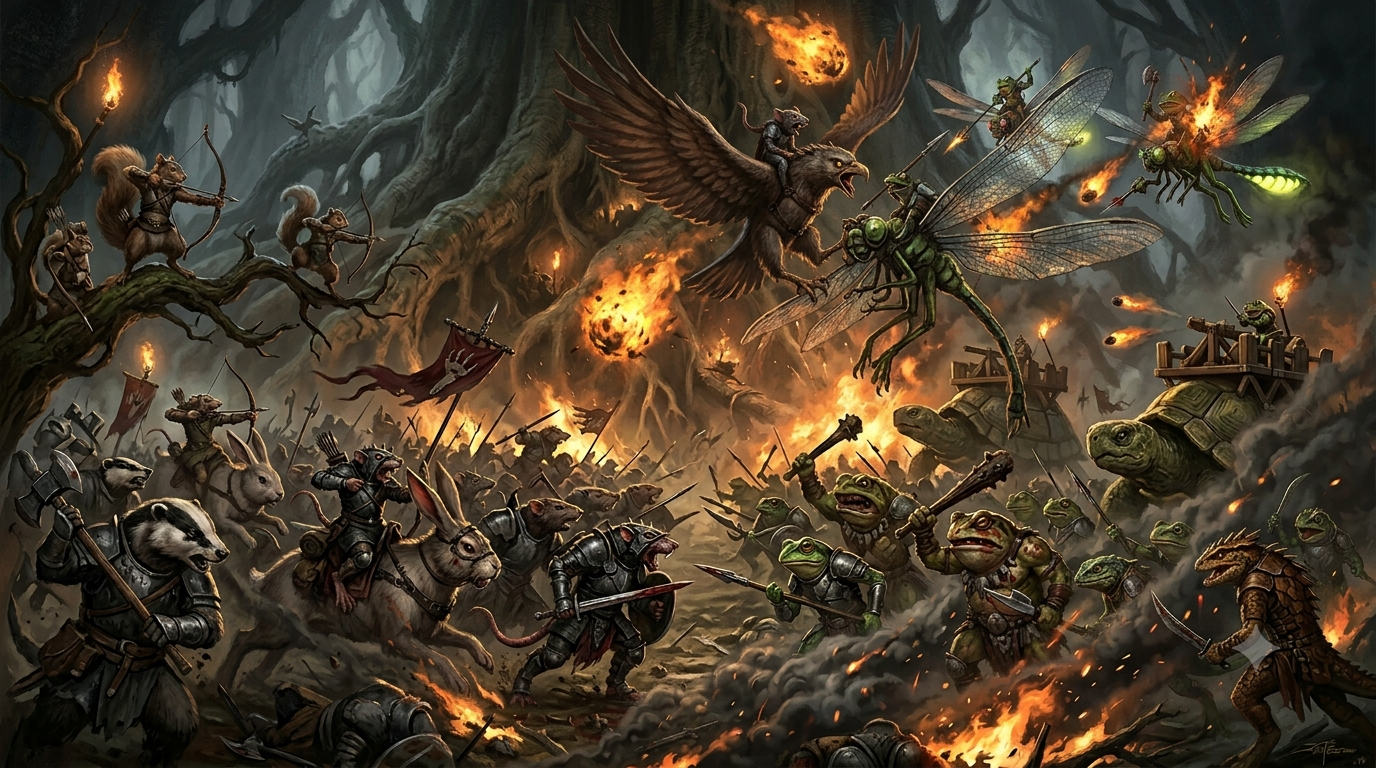
Day Five. Before first light on the fifth day, the Cradleheart made a sound. Every fighter still in the understory heard it - a groan from somewhere deep within the root network, low enough to feel in the ground before it was heard in the air. Then a section of the eastern root formations cracked and fell. Ancient root chambers, undermined by four days of Stripe Snout tunneling and Floodbinder flooding, gave way. The collapse opened a fissure running sixty yards south into the center of the battlefield. What had been solid ground the day before was not. The fighting stopped. Not by order. No commander called a halt. Every soldier simply stopped, because the Cradleheart was breaking, and everyone had come here to claim it, and it was breaking.
Seren Goldbark's contingent did not withdraw when the ground broke. Every other force had already pulled back from the root formations when the eastern chambers cracked. Seren held the center approach. The fissure opened beneath them. Seren Goldbark, her Goldbark ancestors who had fought under her banner through all five days, and most of her contingent did not come out of the collapse.
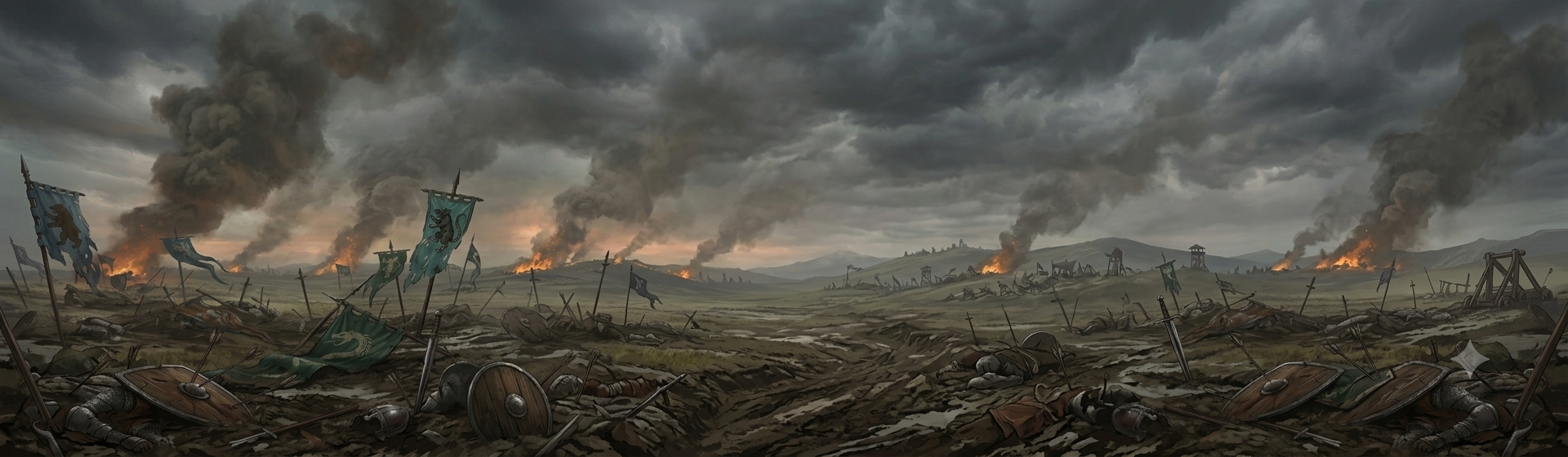
By the end of that day the ground was covered with dead from every people. No side held what they had come to hold. Field commanders on both flanks agreed to hold. The banners of every people were driven into the soil. Not as victory. Not as surrender.
The field had no name before this. People afterward described it as the place where the banners were put down. The name compressed over generations into Bannerdun.
On the Understory Accord
The negotiations took longer than the battle. What emerged was the Understory Accord - the articles that drew the first formal lines of Wildermere as it stands today. The Cradleheart was declared sovereign to no realm. The Understory Law, written as the Accord's first and weightiest article, prohibited any blade drawn, any army stationed, any realm claiming the soil within the root formations.
In formalizing who signed for whom, the lords at that table invented the house system. The Stripe Snouts' war-council became House Meles - the name belonging to Stygmar, who led them through the war and signed the Accord on their behalf. The Branchtail canopy lords became House Oakmere - but the Goldbark line that had led them through the war was gone. Seren Goldbark and her ancestors had died in the day five collapse at the Cradleheart's root formations. There was no Goldbark left to sign. The seat passed to a branch-lord from the eastern groves. The Oakmere name carries no trace of Goldbark in it. The Floodbinder river-masters became House Castor. The coalition Fleetfoot became House Bixton - the name taken from Bixton Burrows, and belonging to Rollo's branch, not Roggu's exiled line. The Briarthorn territory was named at the table: Verdaan. The Briarthorn name became its ruling house, carrying the same name and a different weight. The Garungan signed as Garunga and returned to their territory as they had always governed themselves.
The Dwoles - neutral by presence and principle throughout the war - were brought to the table. Every people required someone neutral to hold the commons. The Dwoles accepted.
Aldric Briarthorn's mark was the final one. He added the Briarthorn seal in silence. The Grey Sovereign who had declared that the Cradleheart required Briarthorn stewardship signed his name to the document that ensured no Briarthorn would ever touch it with authority again. He ruled Verdaan for eleven more years.
Torren Castor retained his river-lord seat. No formal accusation was brought. The Floodbinder clans had their own reckoning with what he did at the King's Run.
On What the Banner Wars Left
The Crownless Age ended. Wildermere began - not as an idea, which it had always been, but as a structure. Six realms with drawn borders. A house above each people. The Understory Law as the foundational article of everything that followed.
Bannerdun Field does not grow as it did before. Whether this is the soil's memory of the dead or simply the consequence of five days of earth torn up, flooded, and tunneled through, nobody has put the question to rest. Nobody plants there.
The Rosewater - the river that now runs through Althorne and the farming villages of Acorn Glen - did not follow its current course before the Banner Wars. The Floodbinders' wartime damming and diversion of tributaries across contested territory permanently reshaped the waterways through what became Verdaan. House Castor built the infrastructure. The river stayed.
Some soldiers from every people did not return home after Bannerdun - soldiers who had nothing to return to, or who could not go back to the people who had sent them into that field. They drifted into the ungoverned interior of Wildermere and built something without houses, without banners, without a lord's mark. That settlement is the earliest form of what would eventually become Bastion.
The Stripe Snouts had run tunnel networks beneath the land that became Verdaan long before the Greybacks arrived from the west. By their reckoning, the ground under Verdaan was always theirs. House Meles signed the Understory Accord. House Meles abides by its terms. In modern Wildermere, the two peoples maintain formal relations. What the deep councils believe about Verdaan's soil is another matter.
The houses examining the Understory Accord focused on what Verdaan had failed to achieve: no Briarthorn hand on the Cradleheart, no claim to the river crossings, no formal expansion of Verdaan's borders. What they were slower to account for was what Verdaan had gained during the years every other faction spent fighting. The Fleetfoot clans settled in Verdaan's eastern hills had signed their loyalty to House Briarthorn, not to the coalition Fleetfoot. The Branchtail families working the western timber lines had accepted Verdaan land grants and had not returned to Sedgwick Hollow. The Stripe Snout border clans who had never answered the deep councils' summons to Ashthorn Ridge signed separately, quietly, during the war's third year. By the time the last banner came down at Bannerdun, Aldric had already closed most of those agreements. Verdaan emerged from the Banner Wars not as a Greyback nation but as a Greyback-led territory of many peoples - badger-kin hill clans, rabbit-folk foresters, squirrel families who had taken Briarthorn coin and Briarthorn protection in exchange for what their own houses had not offered them. The other powers had won the argument over the Cradleheart. Aldric had won Verdaan.
Every people tells the Crownless Age differently. The Branchtails begin with Sedgwick Hollow. The Stripe Snouts begin with Ashthorn Ridge. The Greybacks begin with the Furann burning and frame the war as grief and displacement met with suspicion rather than welcome. The Fleetfoot begin with Roggu's pact and argue among themselves about which Fleetfoot were on the right side. The arguments are ongoing. The Accord is not.
This account was completed in the forty-third year of the Understory Accord, at the Branch of Memory, Tasa Ru. O. Senn.
The Peoples of Wildermere
Denizens
Each species carries its own culture, its own caste, its own relationship to power - and its own reason to be wary of the others.
VerdaanFurfolk of the Woodland Realm
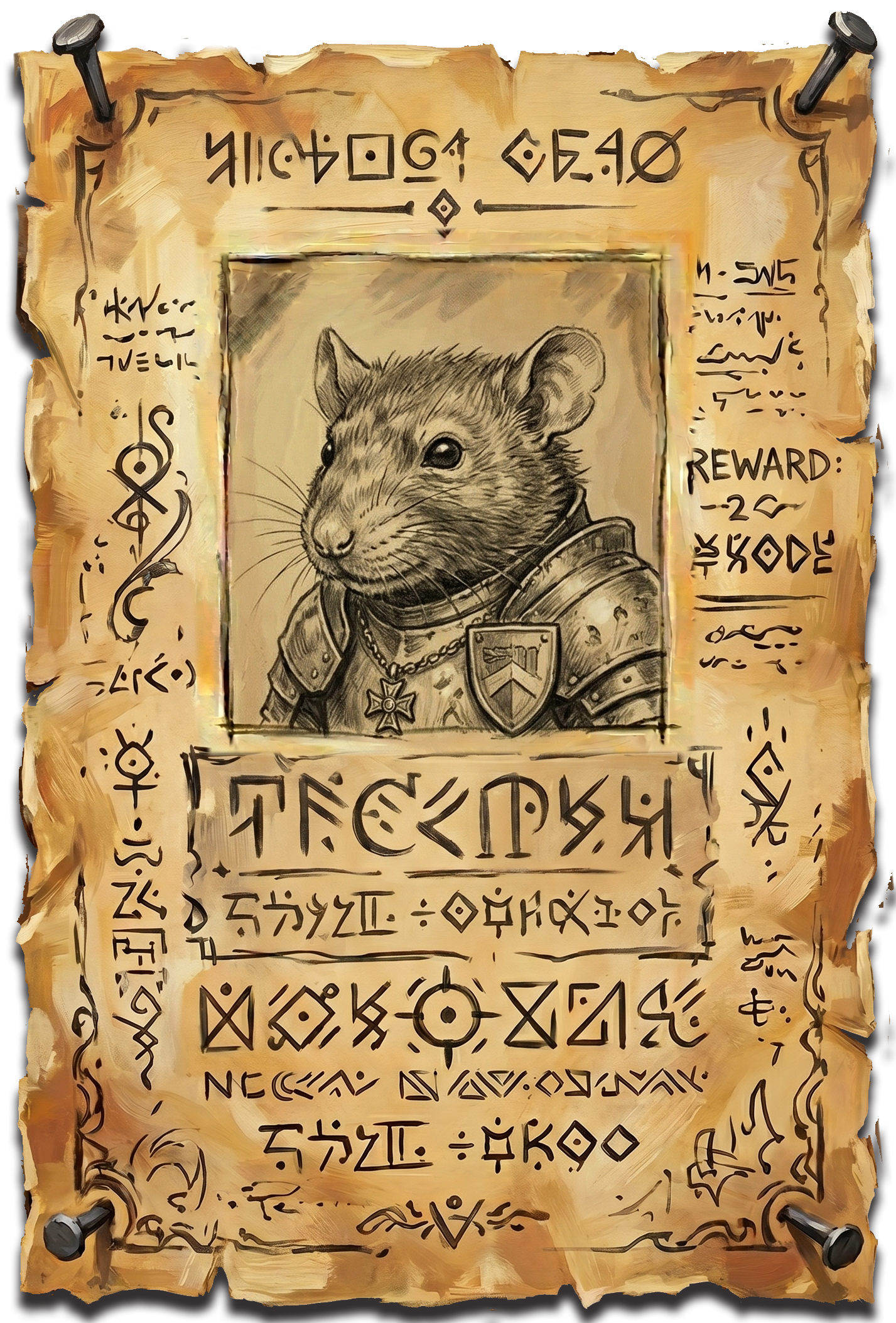
🐀
Greybacks
House Briarthorn
Rats · Rulers of Verdaan
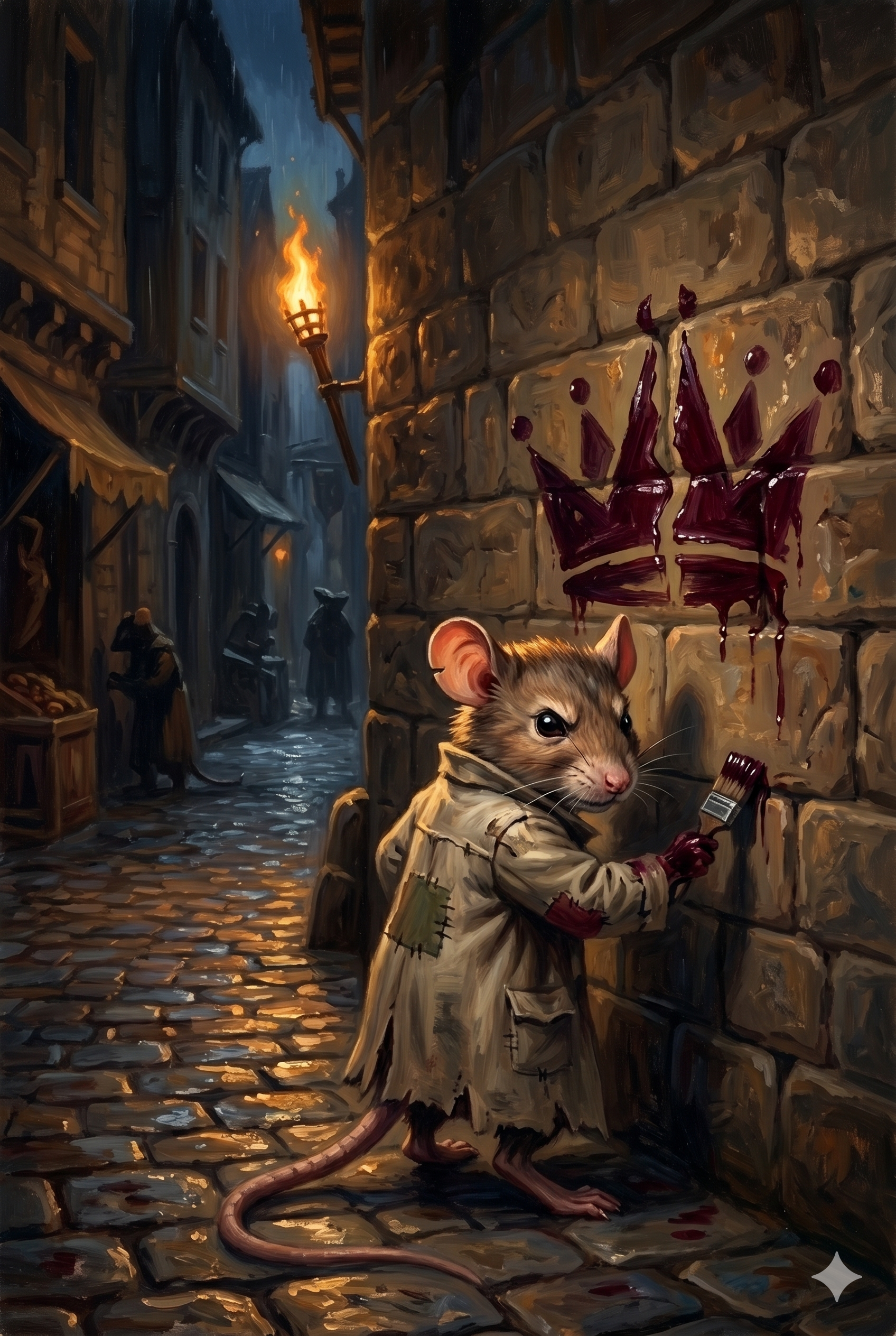
The dynasty of Verdaan. Cunning, tradition-bound, claiming descent from Wru himself. Their secret Ashbinding ritual keeps a spark of the Emberdeep within noble bloodlines.
🦡
Stripe Snouts
House Meles
Badgers · Ancient noble house and warriors
Most physically imposing of the furfolk. Ancient, proud, and quick to challenge crown decrees. Their loyalty is formal but perpetually strained. Centered in Stokesworth.
🐇
Fleetfeet
House Bixton
Rabbits · Warriors & messengers
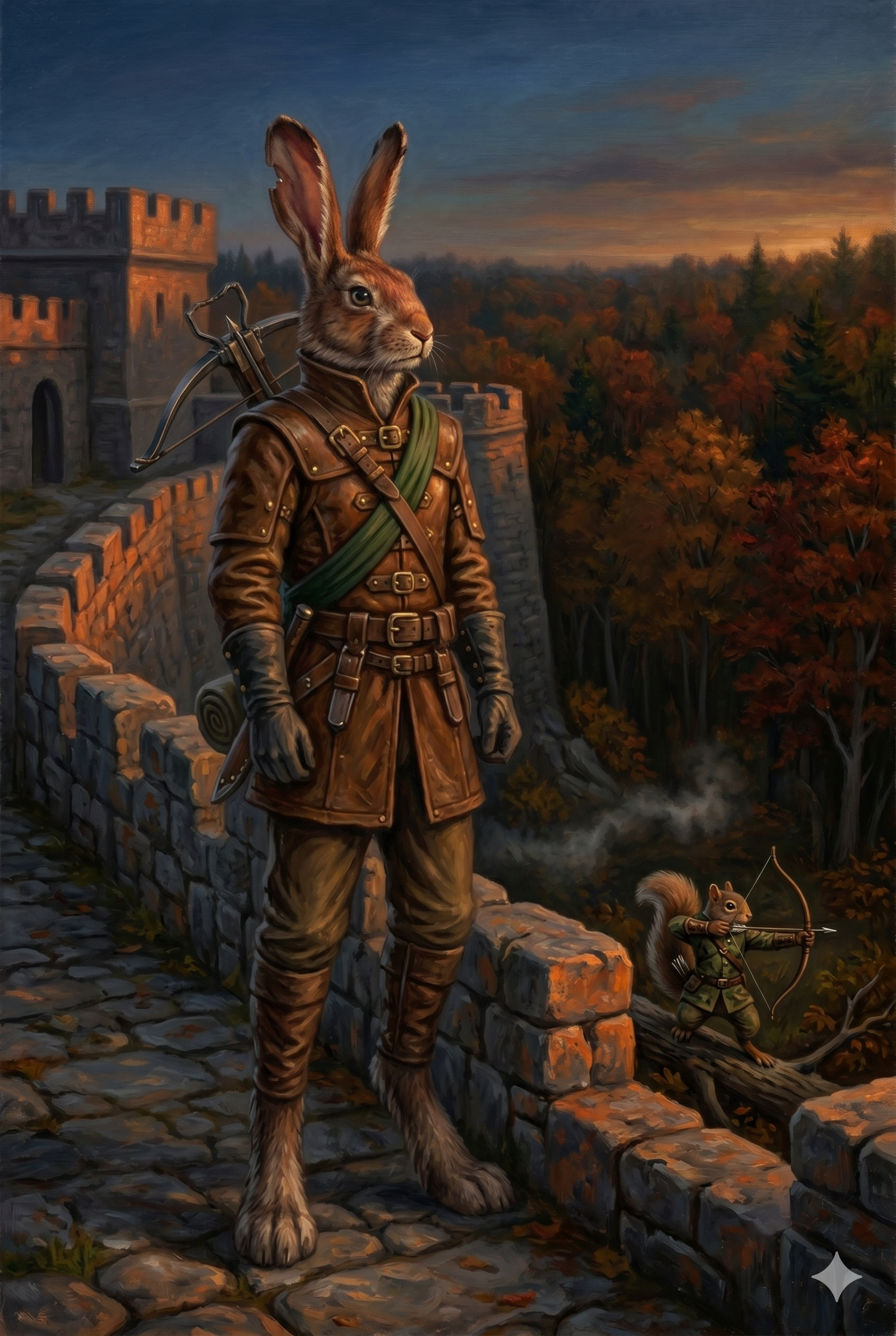
Loyal allies of the Rat Throne. Serve as messengers, scouts, and cavalry. Some are ridden by Greybacks in battle; others stand as respected warriors in their own right. Based in Bixton Burrows.
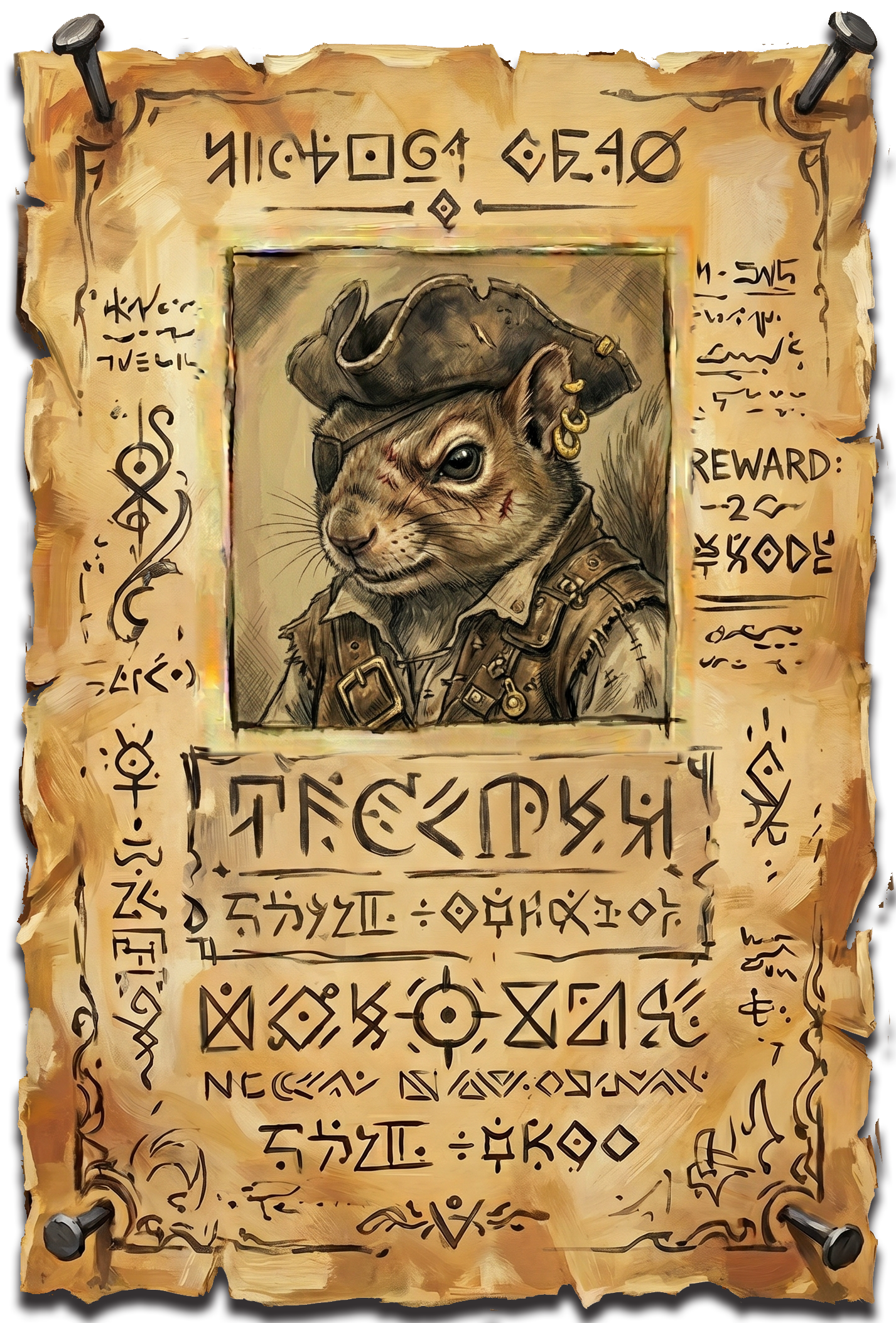
🐿️
Branchtails
House Oakmere
Squirrels · Scouts & spies
Agile, clever, politically adaptable. Serve as spies and border sentries among the treetop canopies. Known for layered clan politics. Based in Trotterdam.
🦔
Needlebacks
House Bristleback
Hedgehogs · Judges & healers
Resilient and introspective. Called upon as judges, healers, and herbalists. Loyal to the throne, quietly ambitious for greater recognition. Many reside in Hillsham.
🦫
Floodbinders
House Castor
Beavers · Engineers & builders
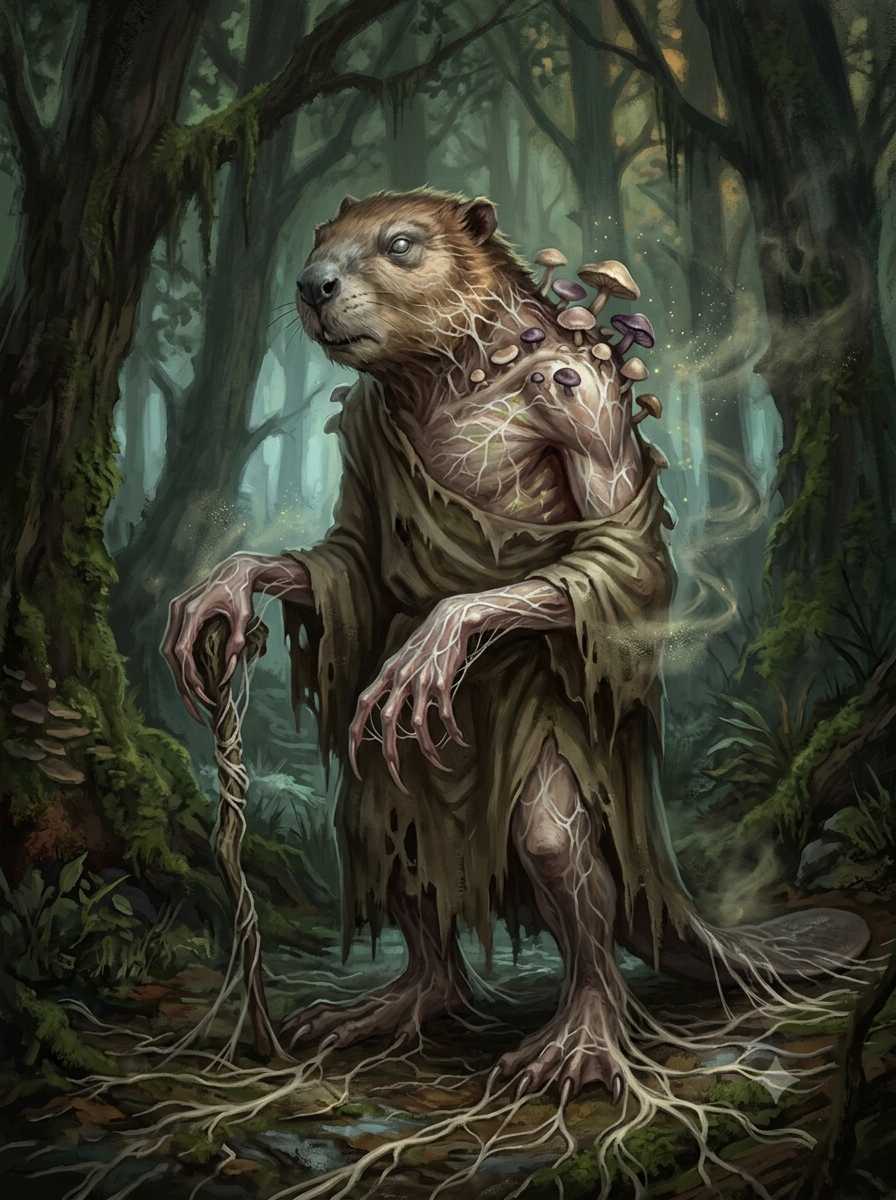
Masters of Verdaan's infrastructure - bridges, river locks, sap-shipping. Practical, proud, and holding surprising economic leverage over the crown. Central city: Beaverport.
🐭
Flitears
House Nibbletuck
Mice · Labor & common folk, also called Nibs
Small and often overlooked. Laborers, clerks, scribes, farmers - essential to daily function. Some harbor quiet resentment toward the rat elite. Found in Grainmere and Cobblepot.
Calculating, sharp-eyed managers of Verdaan's irrigation networks and agricultural oversight. House Furrow operates below court notice by design - redirecting water rights, grain tallies, and labor contracts with quiet precision. Their political instincts rival the Greybacks'. They simply prefer not to be seen doing it.
🌲
Darkpines
House Ironpelt
Pine Martens · Northern frontier lords
Lords of Verdaan's northern edge. House Ironpelt has ruled Timberfrost for generations, earning standing through cold winters and harder choices rather than court favor. The best trappers, trackers, and cold-weather fighters in the realm.
GarungaAmphibians & Reptiles of the Swamp
🐸
Reedlings
Frogs · Farmers & bog cultivators
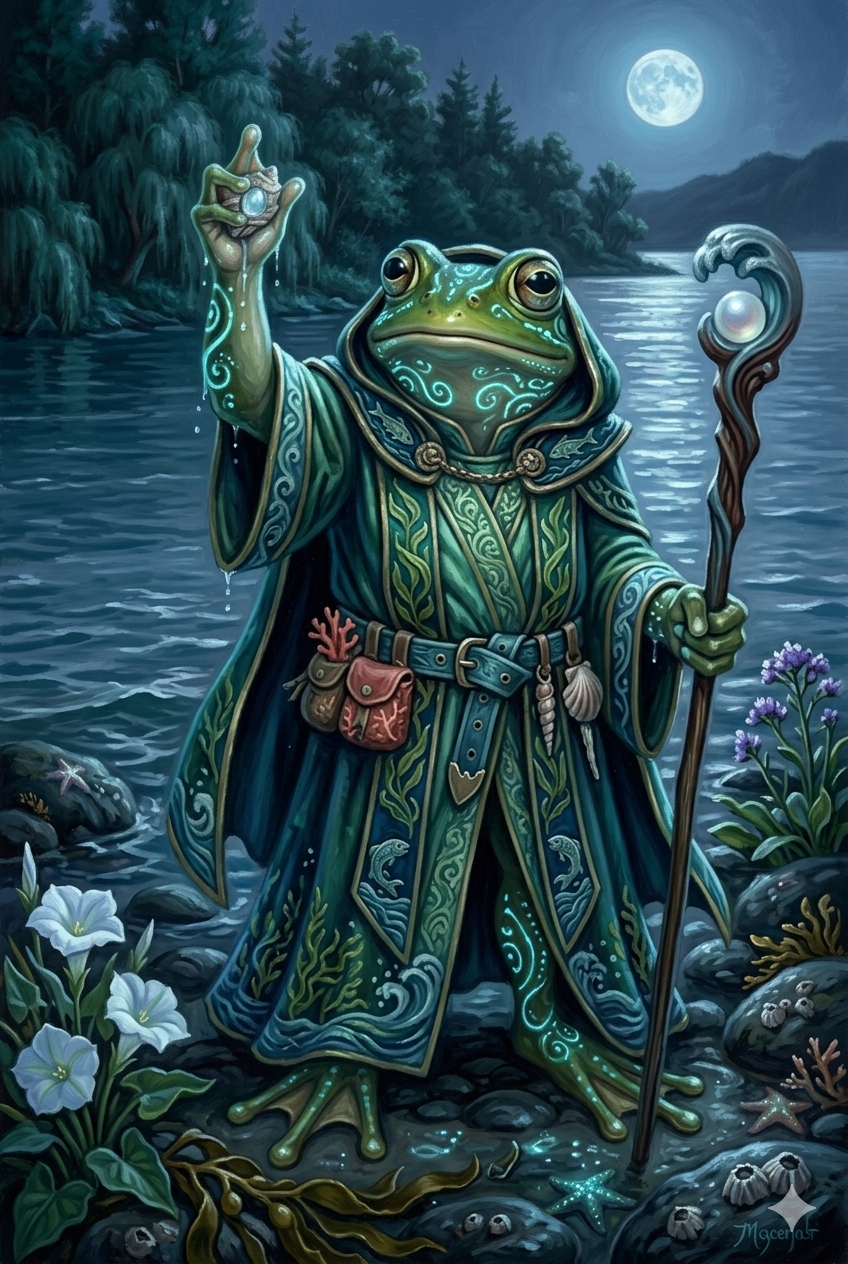
The most numerous people of Garunga. Farmers first - they work the bog margins, flood-fields, and reed flats that feed the realm. Chorus-born and communal, they read tides and ripple codes passed down through generations of cultivators. Their Ceremony of the Spawnshade assigns life paths through sacred swimming toward totemic objects, but most paths lead back to the soil and the water.
🐸
Bogmaws
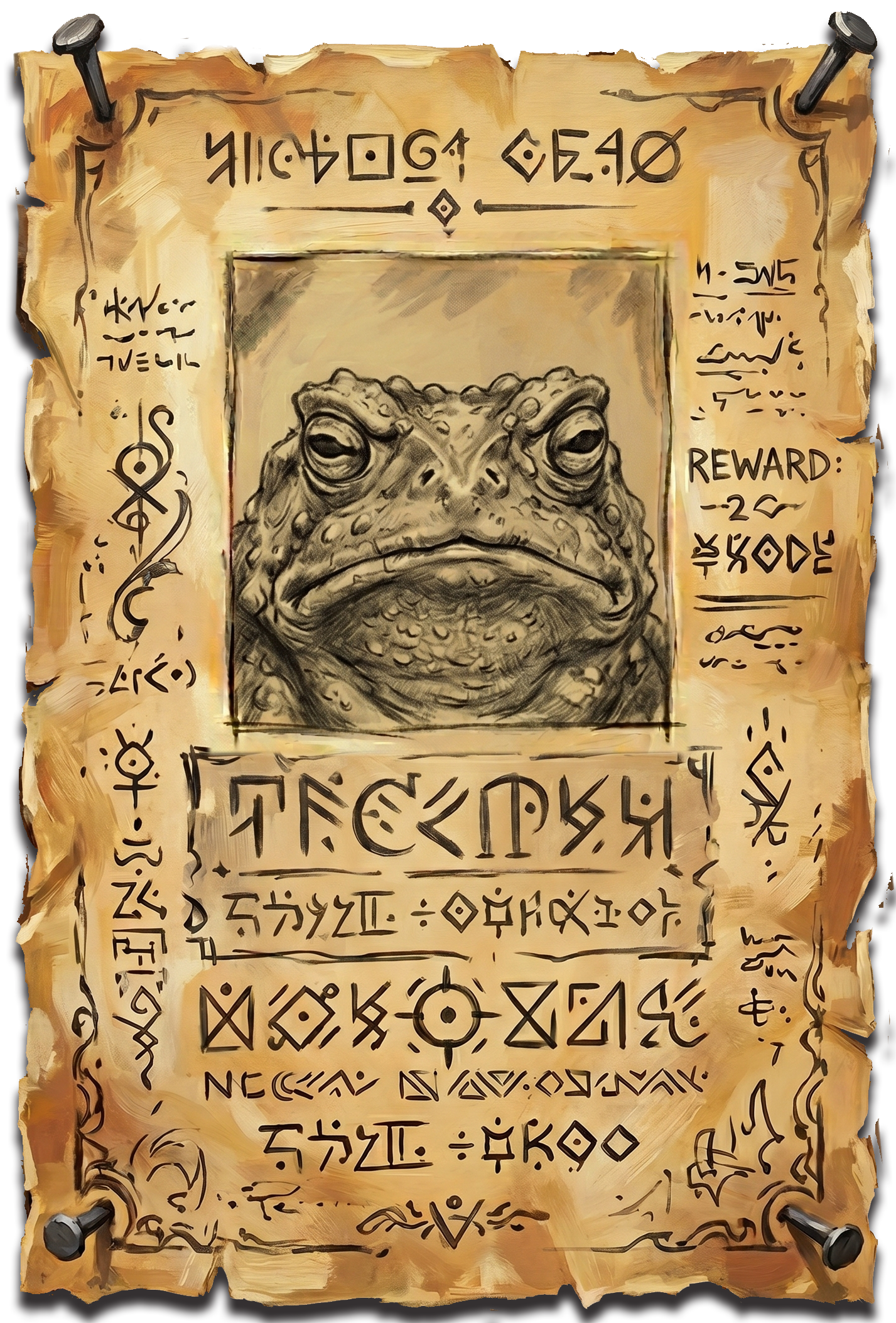
Toads · Warriors & stronghold guards
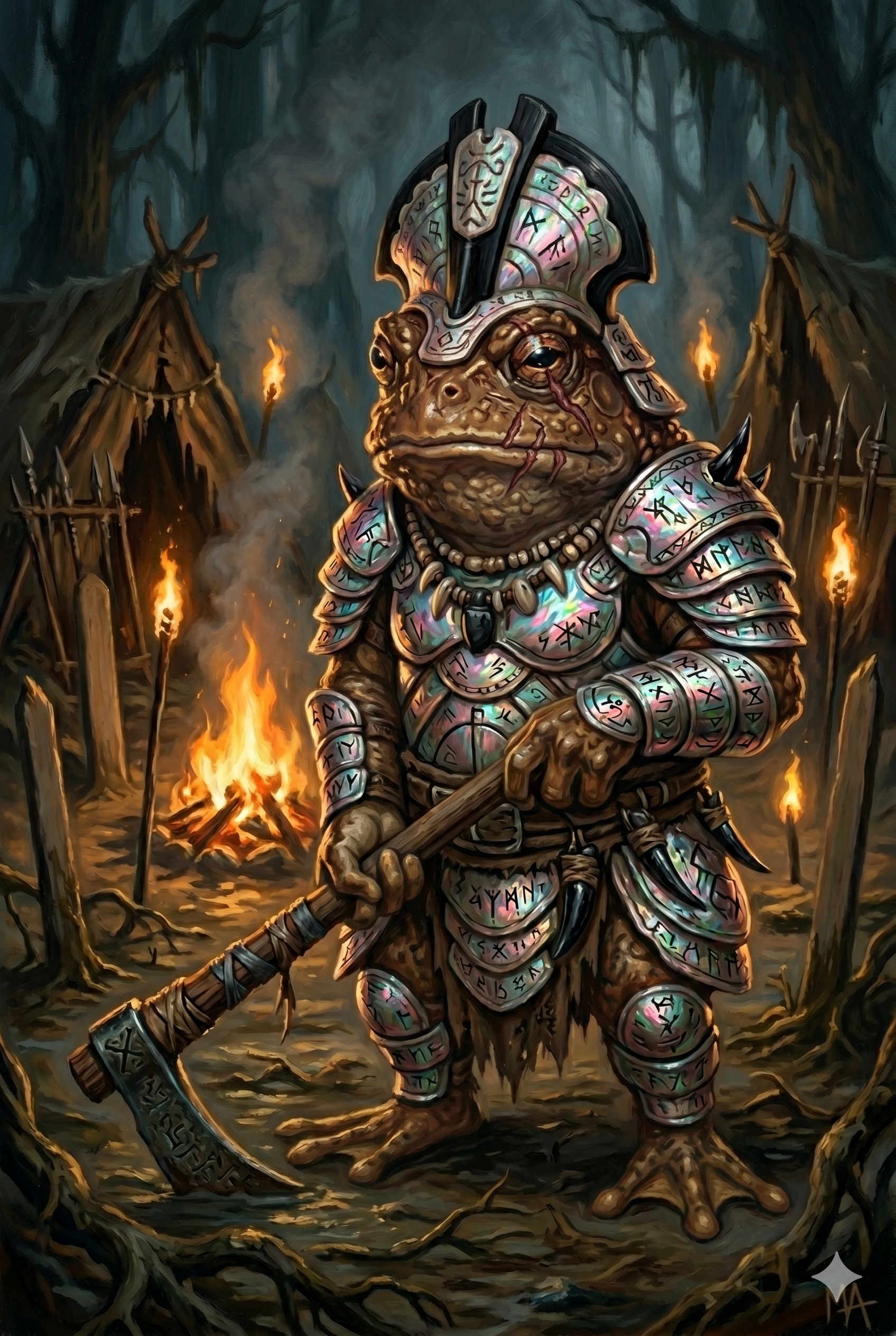
Broad, brash, steeped in ancestral pride. First into battle, last to retreat. Their guttural war-songs serve as both threat and funeral rite. Centered in Gorragorra, Garunga's most fortified city.
🐢
Torgas
Turtles · Sacred lore-keepers
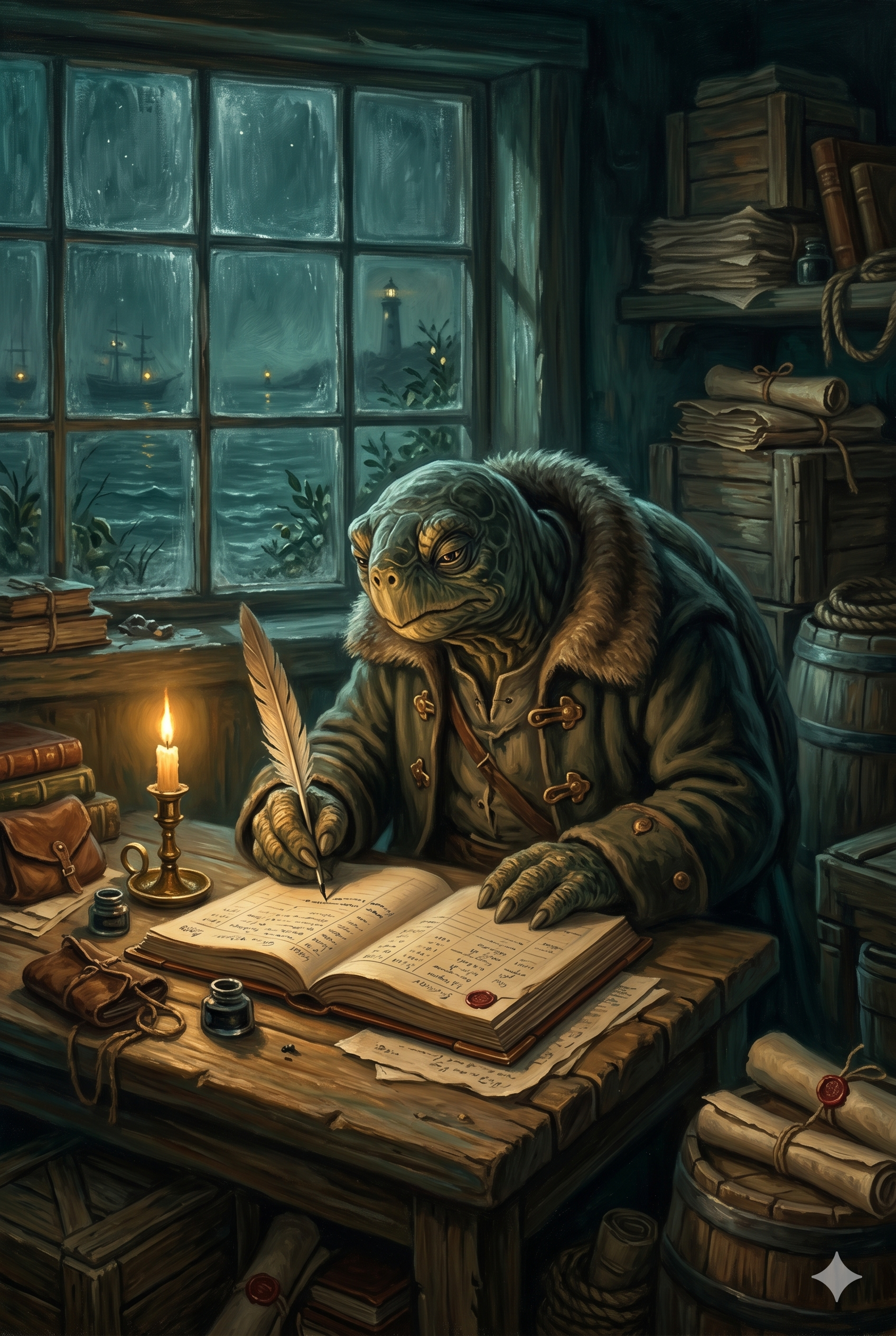
Slow, ancient, revered. Shell-carvers of history. Torgas serve as lore-keepers and memory-bearers; their shells are etched with historical events. Sacred city: Torga. When drawn into conflict - a rare and terrible thing - they can be employed as walking siege engines, their mass and shell capable of breaching fortifications that would stop any lesser force.
🦔
Hardbacks
Common Turtles · River scouts & ferrymen
Common turtles of Garunga's rivers and tidal shallows - stocky, dependable, and far more numerous than their elder Torga cousins. Hardbacks carry no sacred shells but earn their marks through deeds. They serve as river scouts, ferrymen, and light infantry, and are the backbone of most Garungan river crossings. Less revered than the Torgas, more trusted than anyone gives them credit for.
🦎
Sunclads
Lizards · Sun-ritual practitioners
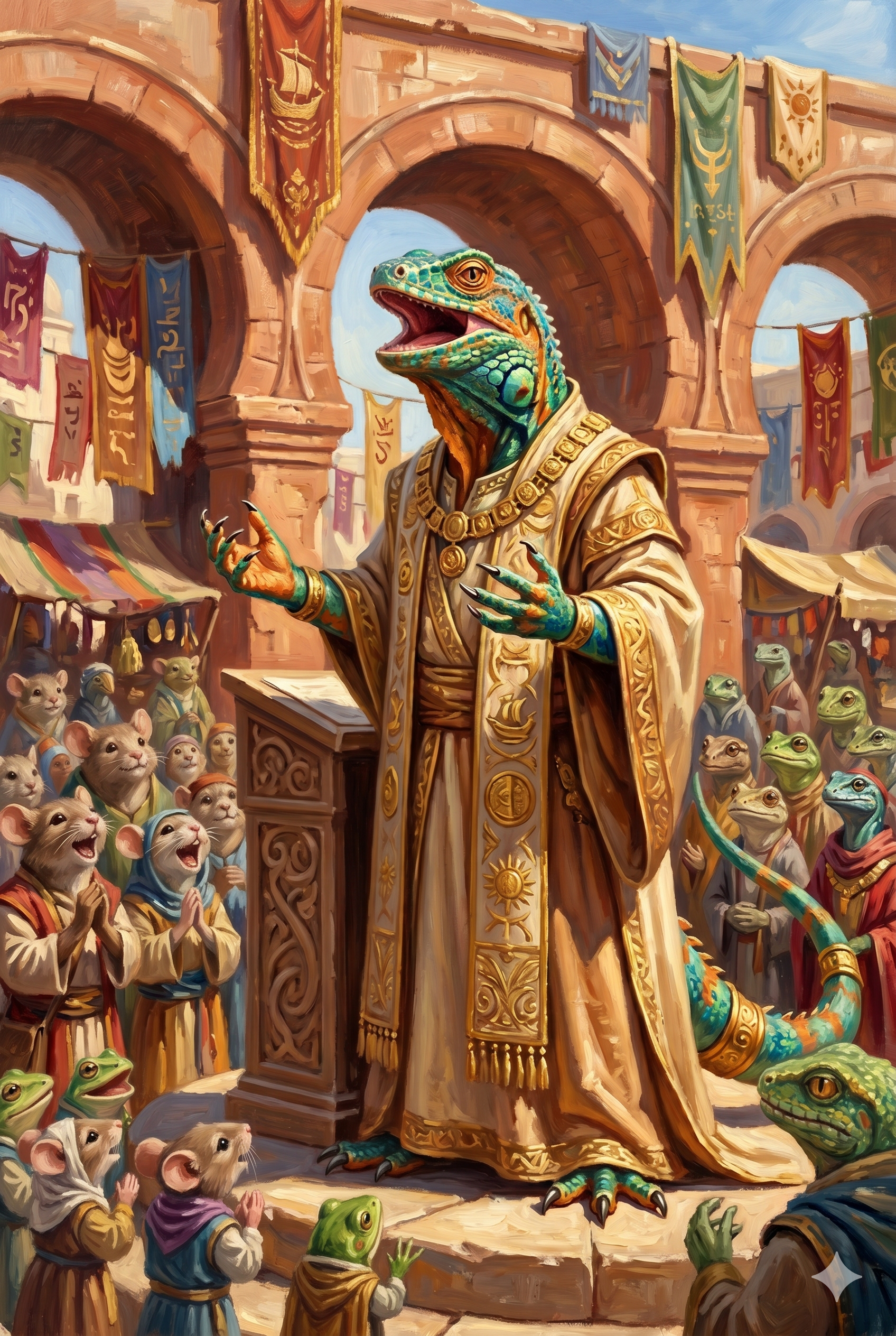
Scaled and sun-drenched, excelling in trade and civic planning. The Fire Newts sub-tribe reveres sun and forgework. Their rituals are ancient, powerful, and widely misunderstood.
🦎
Ashminders
Salamanders · Wandering alchemists
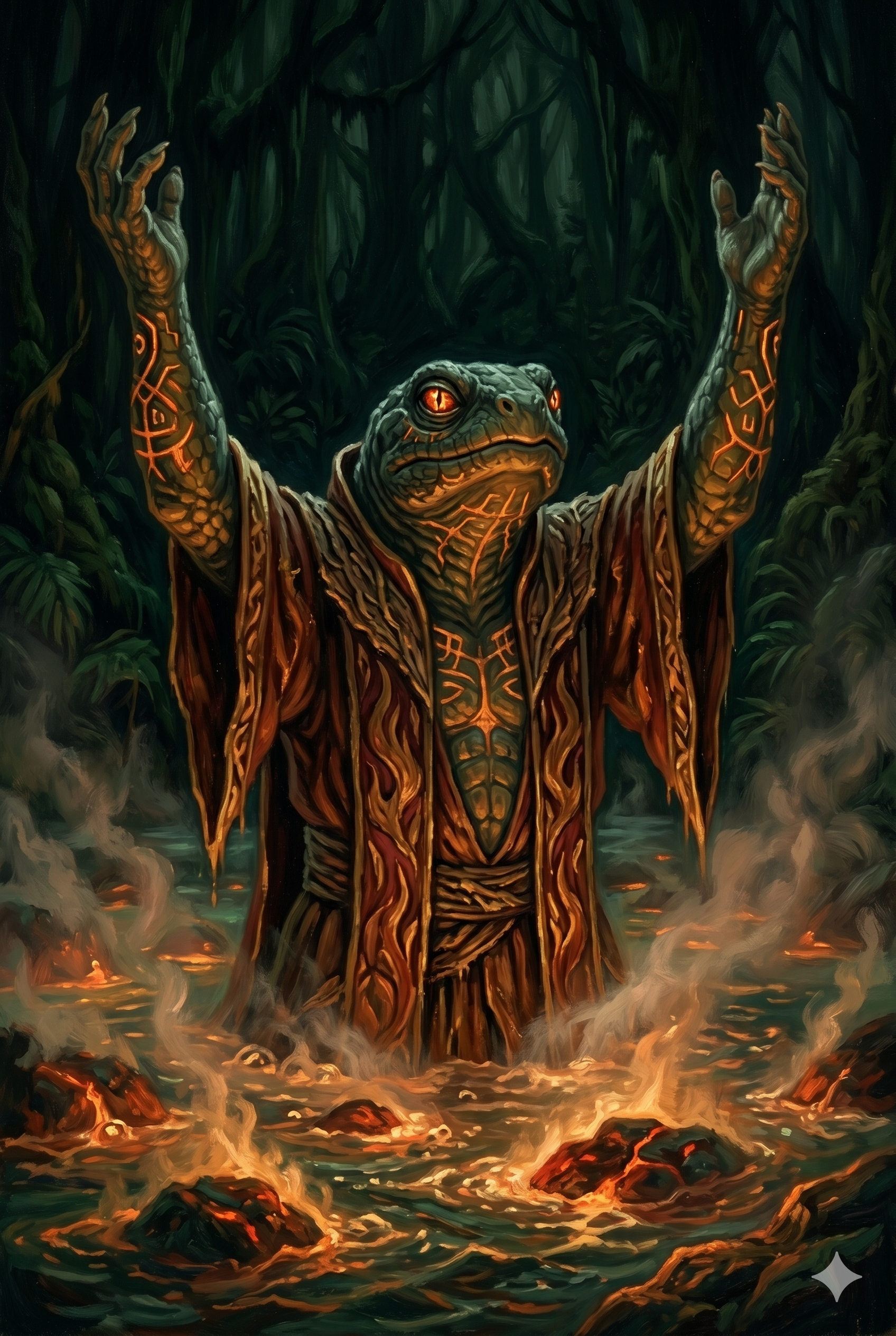
Flame-touched and elusive. Found near hot springs and heated bogs. Can withstand fire and poison. Often lone alchemists, sometimes adopted into Sunclad or Shellsworn circles.
AvondelleAvian Peoples of the Sky Realm
🦅
Highborn
Hawks & Eagles · Rulers of Avondelle
The sovereigns of Avondelle. Broad-winged and imperious, they claim divine right from the sky-god Aer. Their eyries crown the highest peaks of the Perch. Generations of selective breeding have made their sight legendary - some are said to read intent from a single glance.
🦢
Whitecrowns
Herons · Scholars & lore-keepers
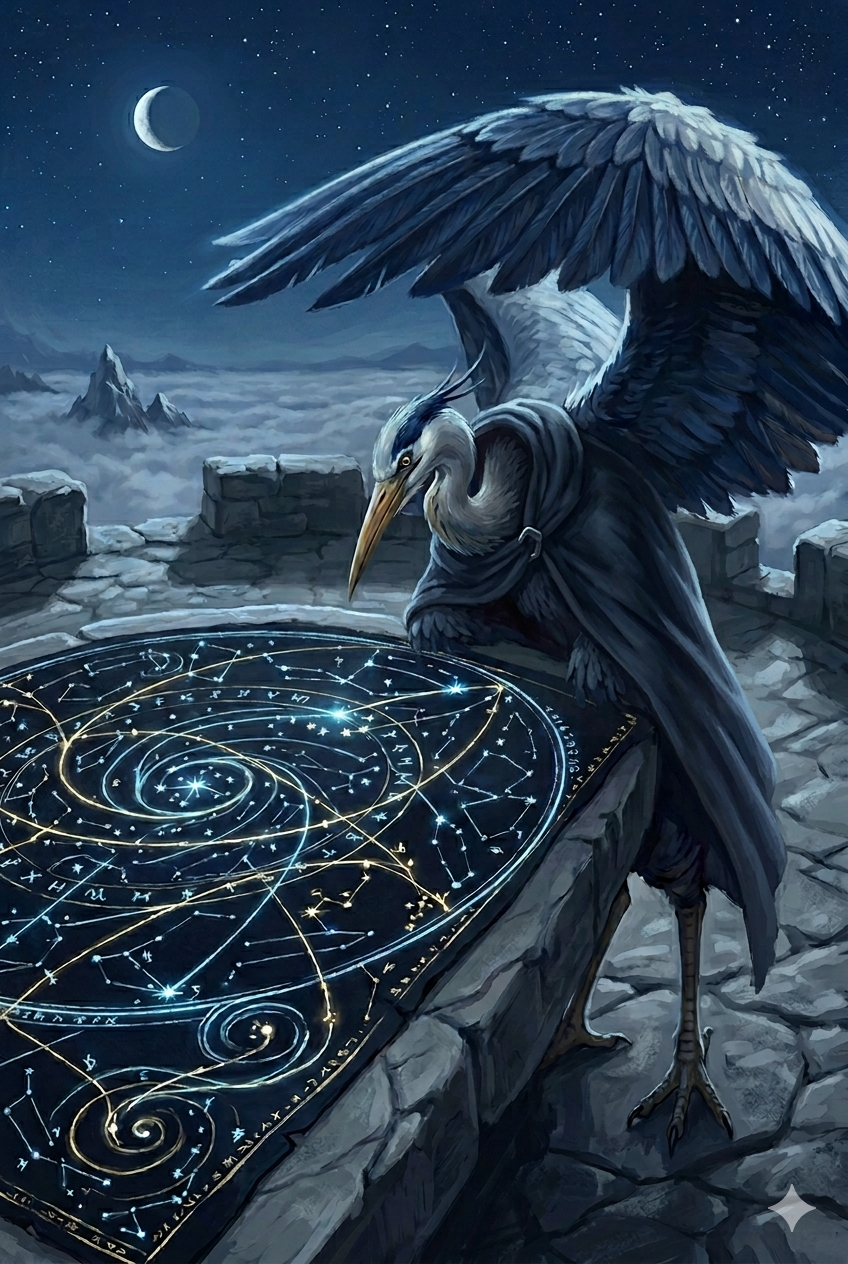
Tall, deliberate, and profoundly patient. Whitecrowns serve as diviners, archivists, and sky-readers. They maintain the Aeriefall Libraries and are the only caste permitted to interpret the cloud-script omens above the Perch.
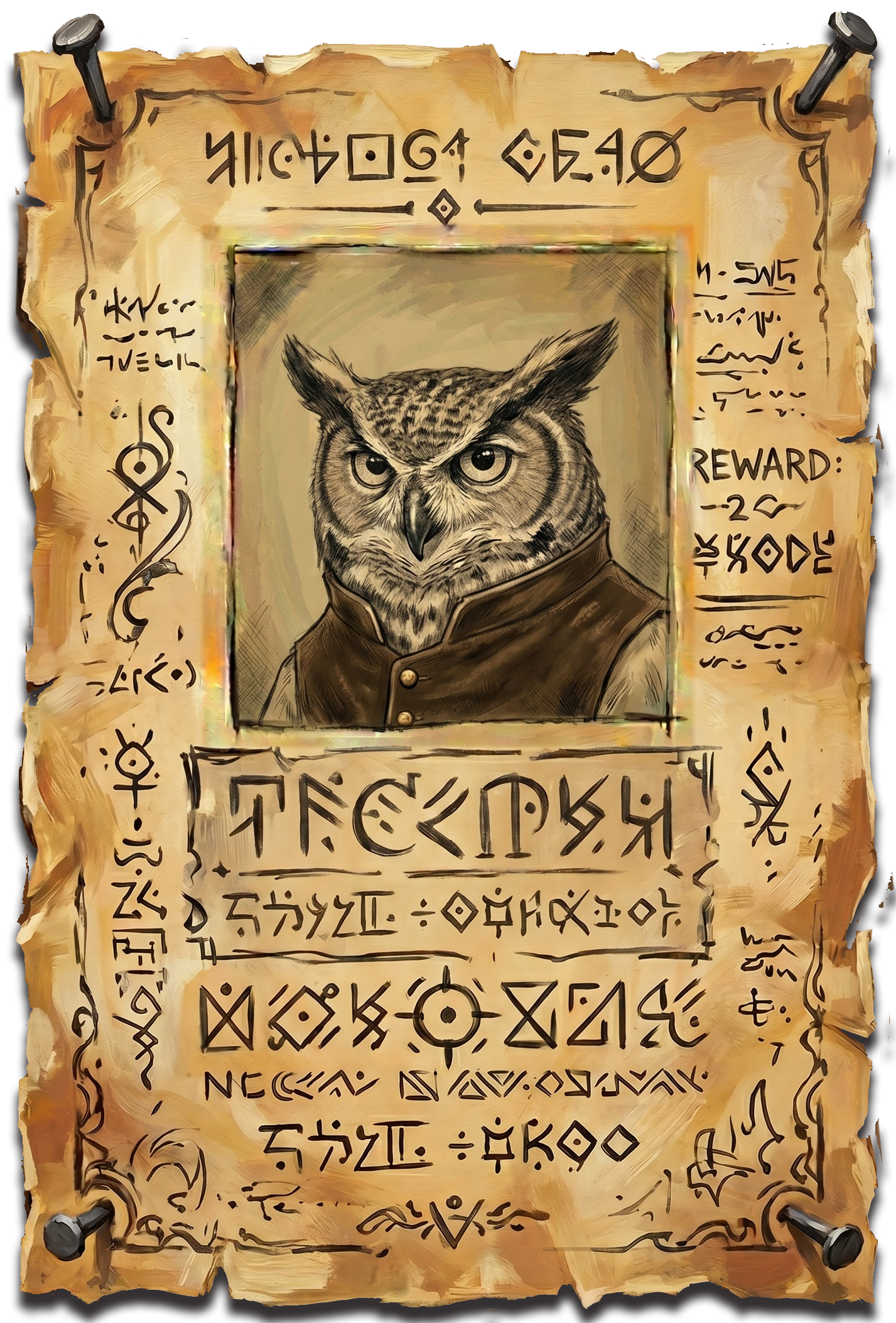
🦉
Owlkin
Owls · Mystics & night seers
Night-dwellers and keepers of secrets. Owlkin operate in the hours between dusk and dawn, serving as messengers, dream-readers, and silent arbiters of disputes the Highborn would rather not acknowledge. Rarely fully trusted; never fully dismissed.
🦜
Falconiers
Falcons · Strike warriors
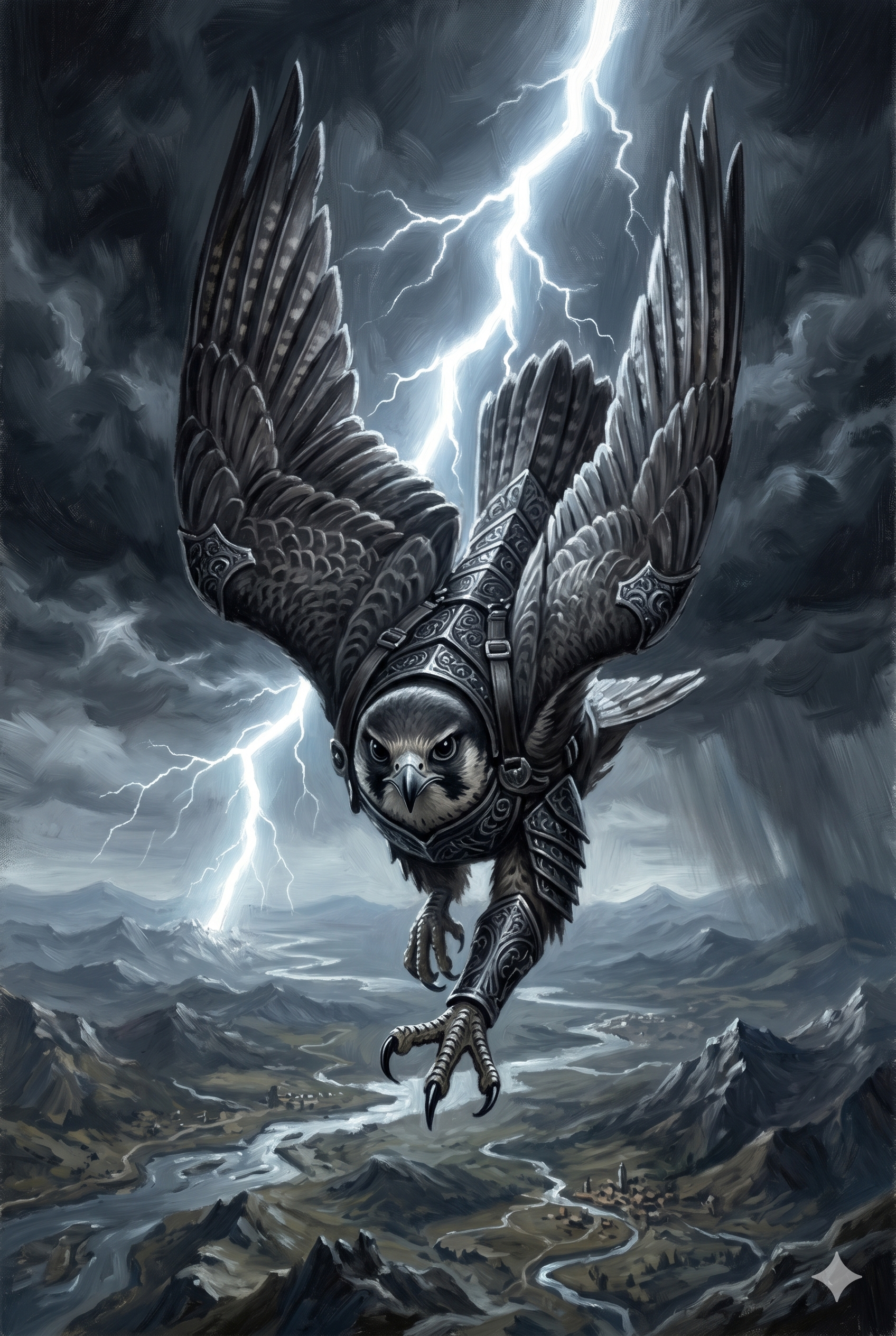
Swift, aggressive, and fiercely loyal to the Highborn seat. Falconiers form the aerial vanguard and serve as treaty enforcers across all of Wildermere. Most commonly paired with the Ratling Order of the Shrike in joint operations.
🐦
Songborne
Songbirds · Common folk & messengers
The vibrant majority of Avondelle - wrens, sparrows, finches, starlings. Traders, farmers, and vocal artists whose song-maps can navigate fog so thick it swallows landmarks. Often dismissed by the upper castes; quietly indispensable to the realm's daily life.
🦤
Sedgari
Marsh Exiles · Winding Perch
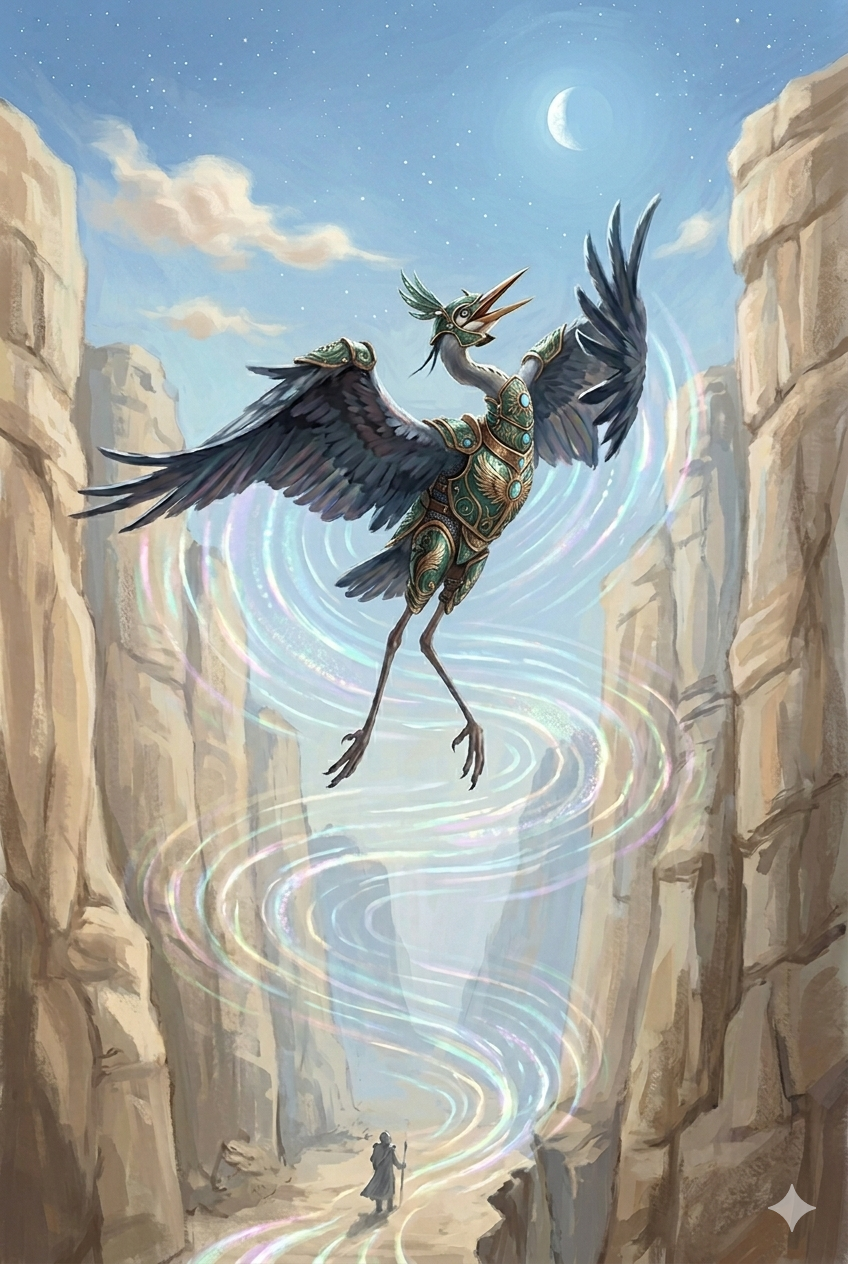
Kingfishers, herons, osprey, and egrets cast out by the Veyuldrae for doctrinal violations or unsanctioned groundfolk contact. They found a home in Garunga's reed beds and built something no one expected - a community. Wary of Aeriefall, cautiously tolerated by Garunga, perpetually threatened by the Blackwings.
The DwolesBlind Artisans of the Underdeep
🦔
Dwoles
Molefolk · Deepcraft engineers
Semi-blind, stocky subterranean builders who perceive the world through vibration and echo rather than sight. Inventors of Deepcraft - tools, weapons, and the fearsome experimental Boomcrank.
🐭
Brevis
Shrews · Surface diplomats & traders
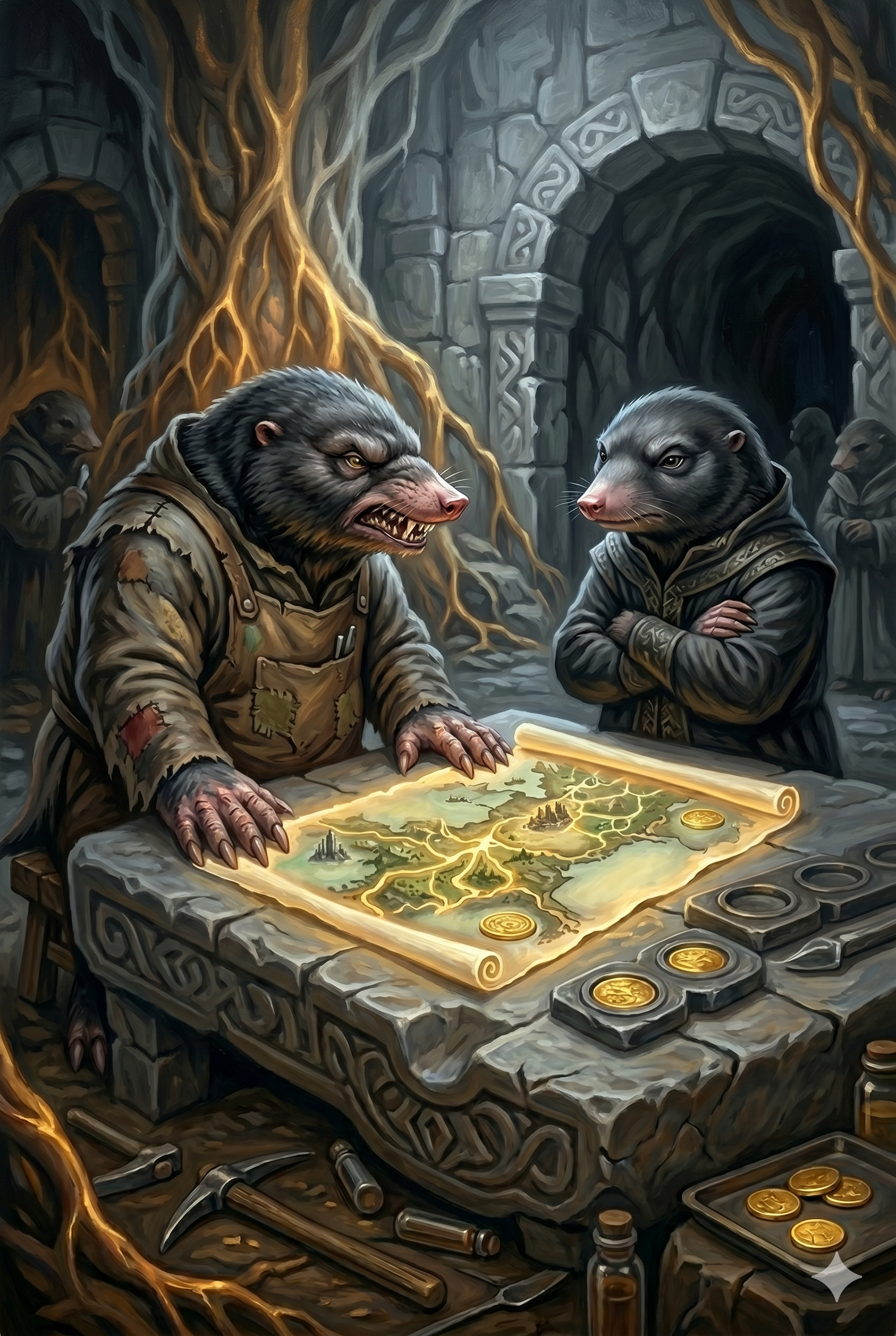
Smaller shrew cousins to the Dwoles, the Brevis are the face most of Wildermere actually sees. Since Dwoles spend the majority of their lives underground, it falls to the Brevis to handle topside dealings - trade negotiations, message delivery, surface diplomacy, and the occasional argument on behalf of someone three tunnels below who cannot be bothered to come up. They are quick-witted, indispensable, and almost universally hot-tempered. They also assist with Deepcraft work, carrying components and relaying precision measurements between surface and tunnel with a speed no Dwole could match. If a Brevis seems impatient with you, they probably are.
Tasa RuSpiritborn of the Ancient Forest
🌿
Grovetongues
Root-speakers · Grove lore-keepers
The living memory of Tasa Ru. Grovetongues can read the rings of ancient trees as historical text and communicate with elder groves through a low vibrational language called Rootspeak. They decide what is remembered and what is allowed to be forgotten.
✨
Ringseers
Star-readers · Oracles & seers
Astrologers and cosmological interpreters who map the nine stars corresponding to Tasa Ru's nine sacred groves. Each Ringseer is bonded to one star at birth. Their predictions shape planting seasons, diplomacy, and migration across the realm.
📖
Wanderscholars
Pilgrims · Roaming ambassadors
Roaming archivists who travel all of Wildermere collecting knowledge, oral histories, and lost names. They carry no weapons, claim no homeland allegiance in foreign lands, and are considered sacred guests by all realms - even Garunga and Verdaan honour the old compact.
🪵
Barkwrights
Shapers · Living architects
Woodworkers, architects, and grove-engineers who build in living wood rather than cut lumber. Barkwright structures grow slowly for decades and are never fully finished - each generation adds to what the last began. Their buildings are also considered living historical records.
BastionThe Free Peoples of the Hearthlands
🐗
Sunderbacks
Boar · Diaspora warriors
Hardened wanderers from a diaspora out of the southern reaches beyond Wildermere's borders. They found a home in Bastion but hold deep suspicion of Verdaan's court culture and little patience for Garunga's dominance games. Bastion's culture replaces their origin-clan markings with flame motifs. Most reliable fighters in the confederation. Most ungovernable residents.
🐇
Quickpaws
Hares · Outriders & scouts
The fastest creatures on land in Wildermere, Quickpaws serve as Bastion's outriders and early-warning scouts. Unlike Verdaan's Fleetfeet rabbits, Quickpaws answer to no throne - only the Hearthpact. They are fiercely independent and consider themselves the truest expression of Bastion's founding spirit.
🐢
Stoneshells
Turtles · Archive keepers
Methodical, long-memoried, and almost impossible to move against their will. Stoneshells arrived at Bastion generations ago and have since become the confederation's most trusted record-keepers and arbiters of old debt. They maintain the Hearthmemory - Bastion's oral and inscribed archive of founding oaths, grievances settled, and promises still outstanding. Nothing is considered resolved until a Stoneshell has witnessed it.
🐭
Ashpaws
Mice · Builders & provisioners
Numerous, resourceful, and often underestimated. Ashpaws are Bastion's builders, tinkers, and provisioners - the ones who patch the walls, stock the larders, and keep the Hearthtables oiled. They have a gift for working in tight spaces and an institutional memory for where things are stored that no one else bothers to maintain. In a confederation that prizes every member's contribution, Ashpaws are among the most indispensable and among the least celebrated.
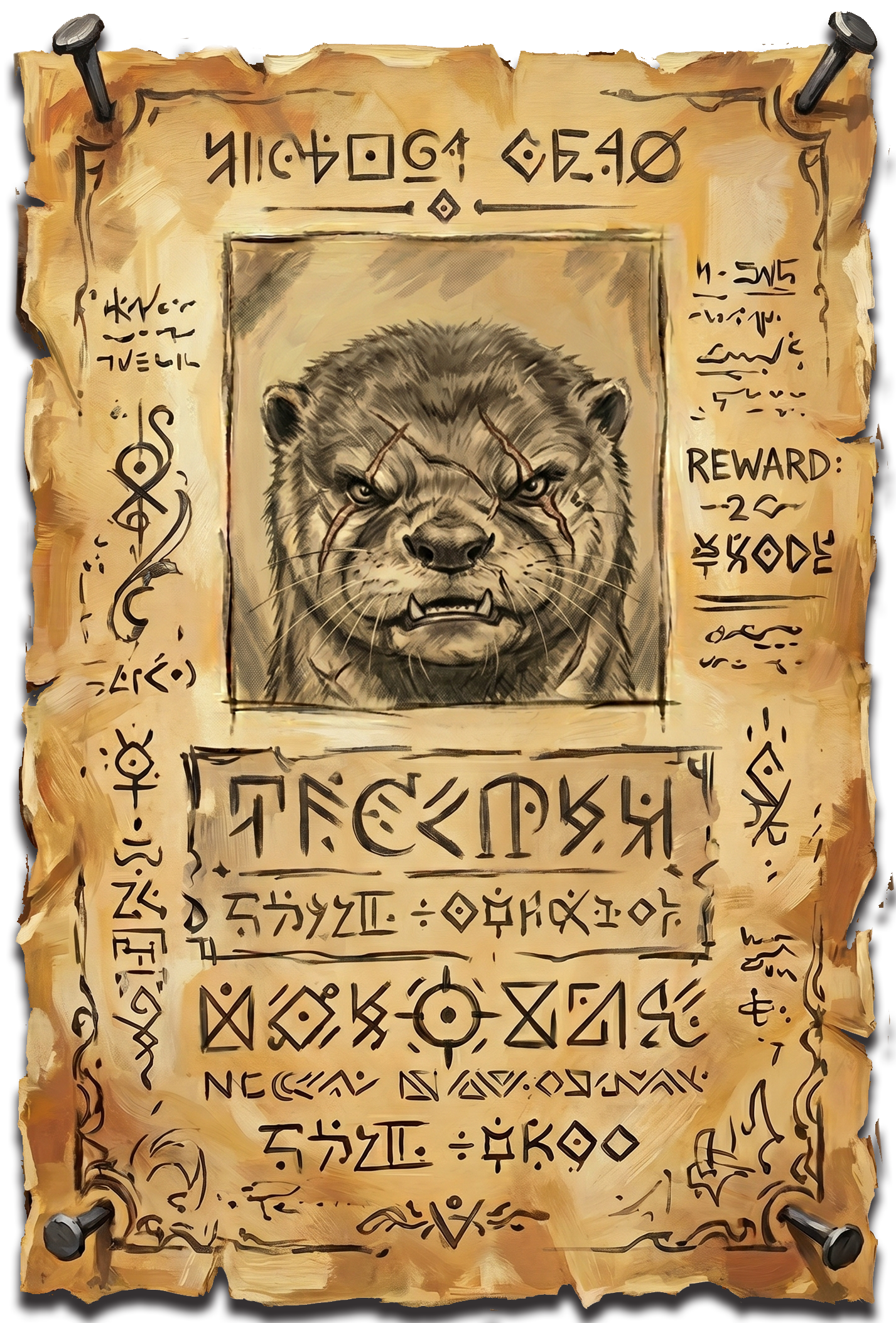
🦦
Streamtails
Otters · River scouts & traders
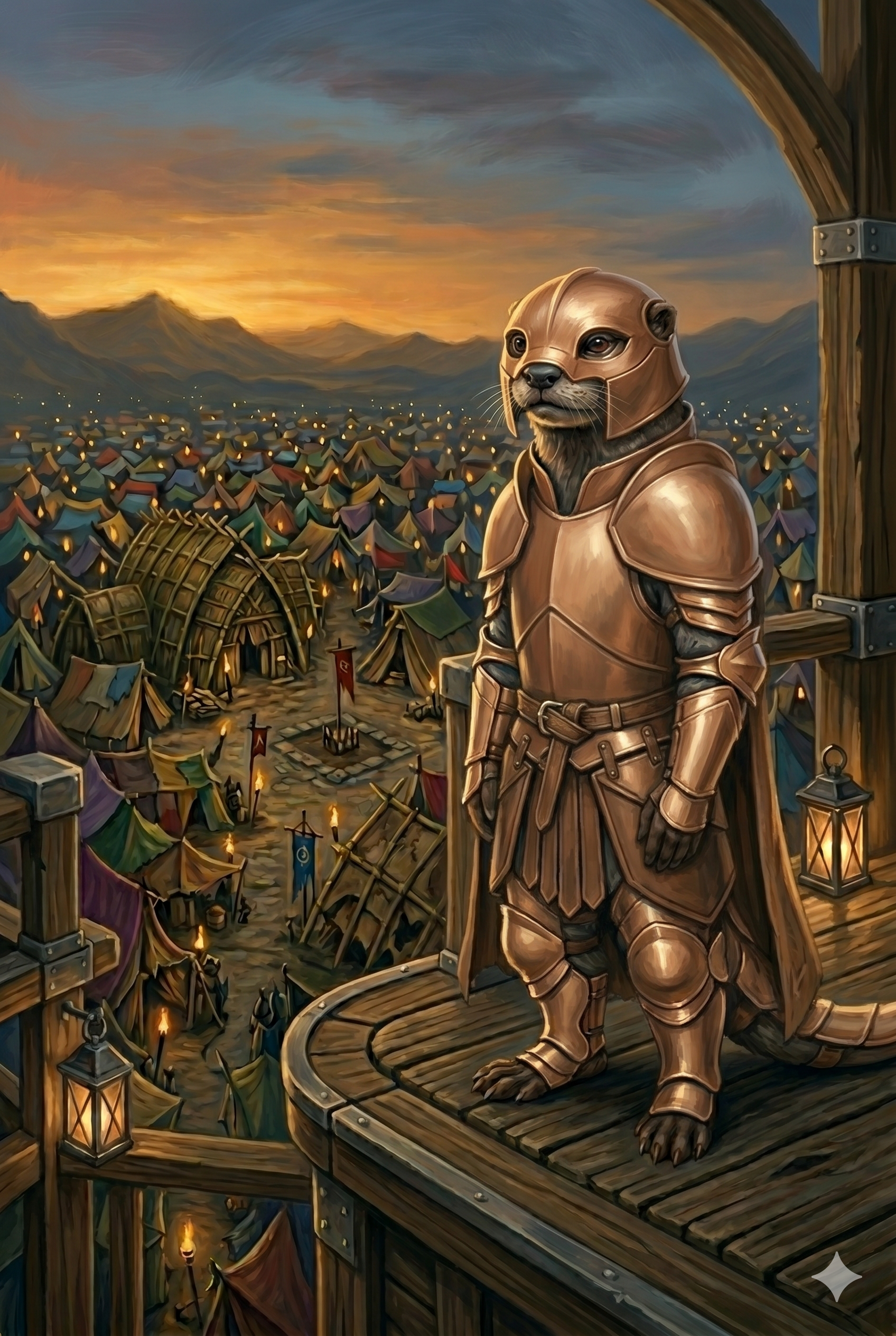
Lithe, bold, socially flexible river scouts and occasional naval mercenaries. Known for singing oaths and swift justice on waterways. Move freely between Verdaan and Bastion.
🦝
Greymasques
Raccoons · Road merchants, also called Ringers
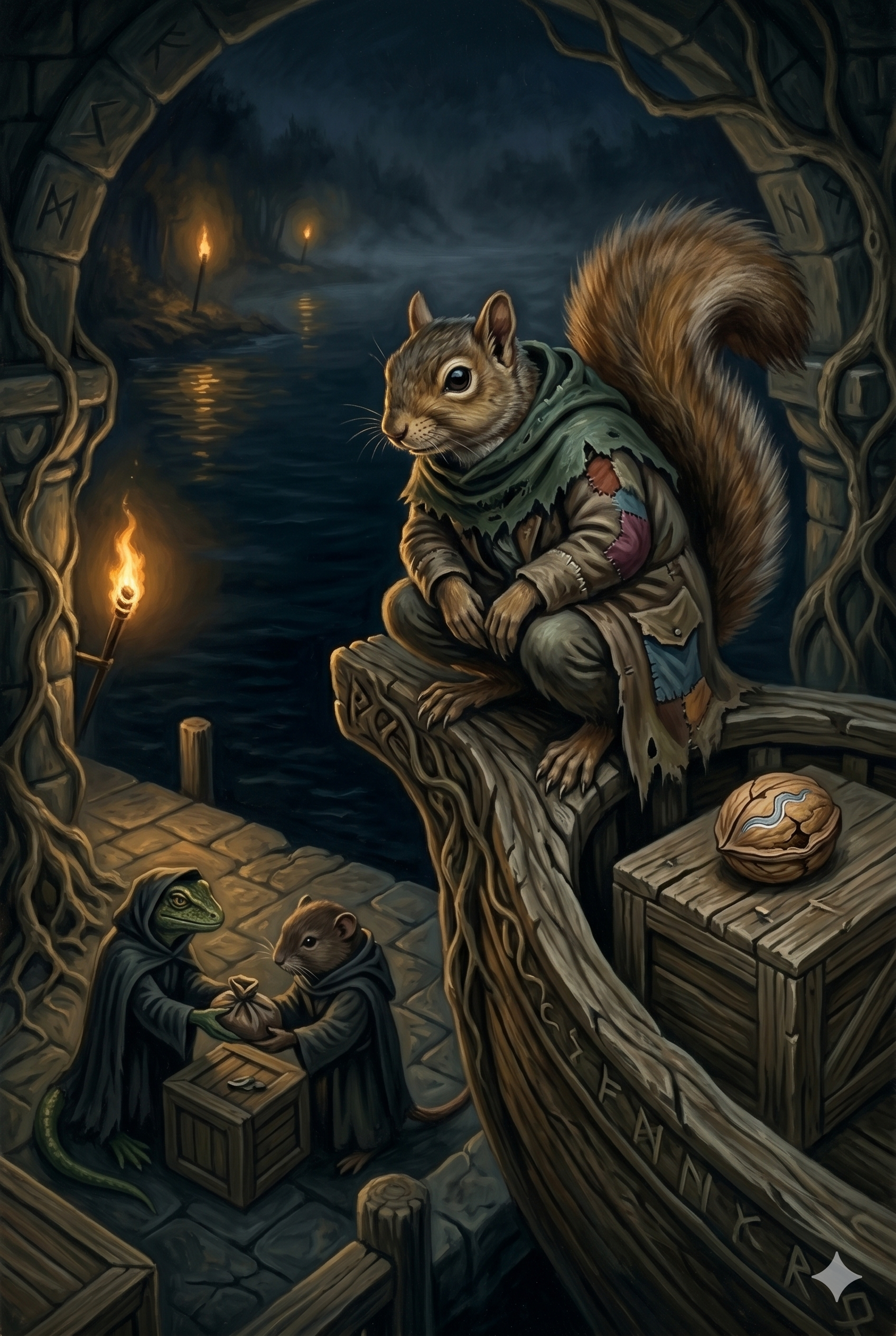
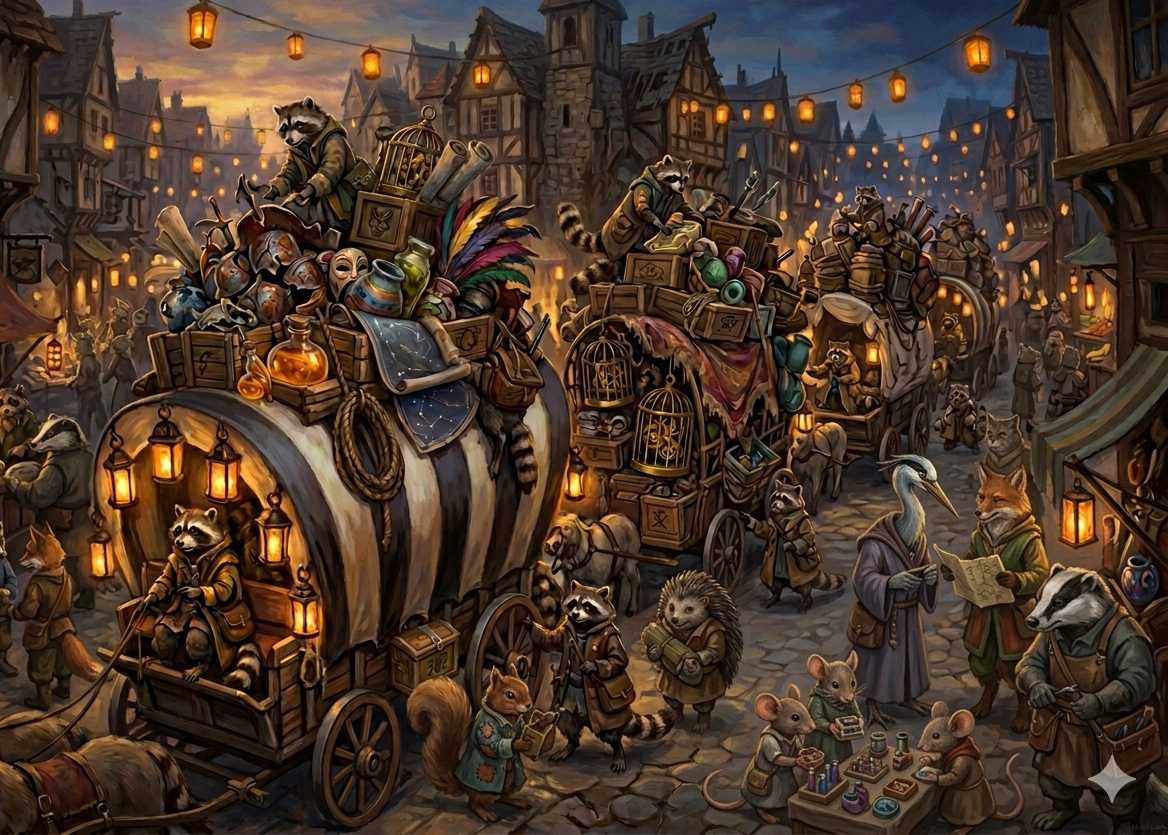
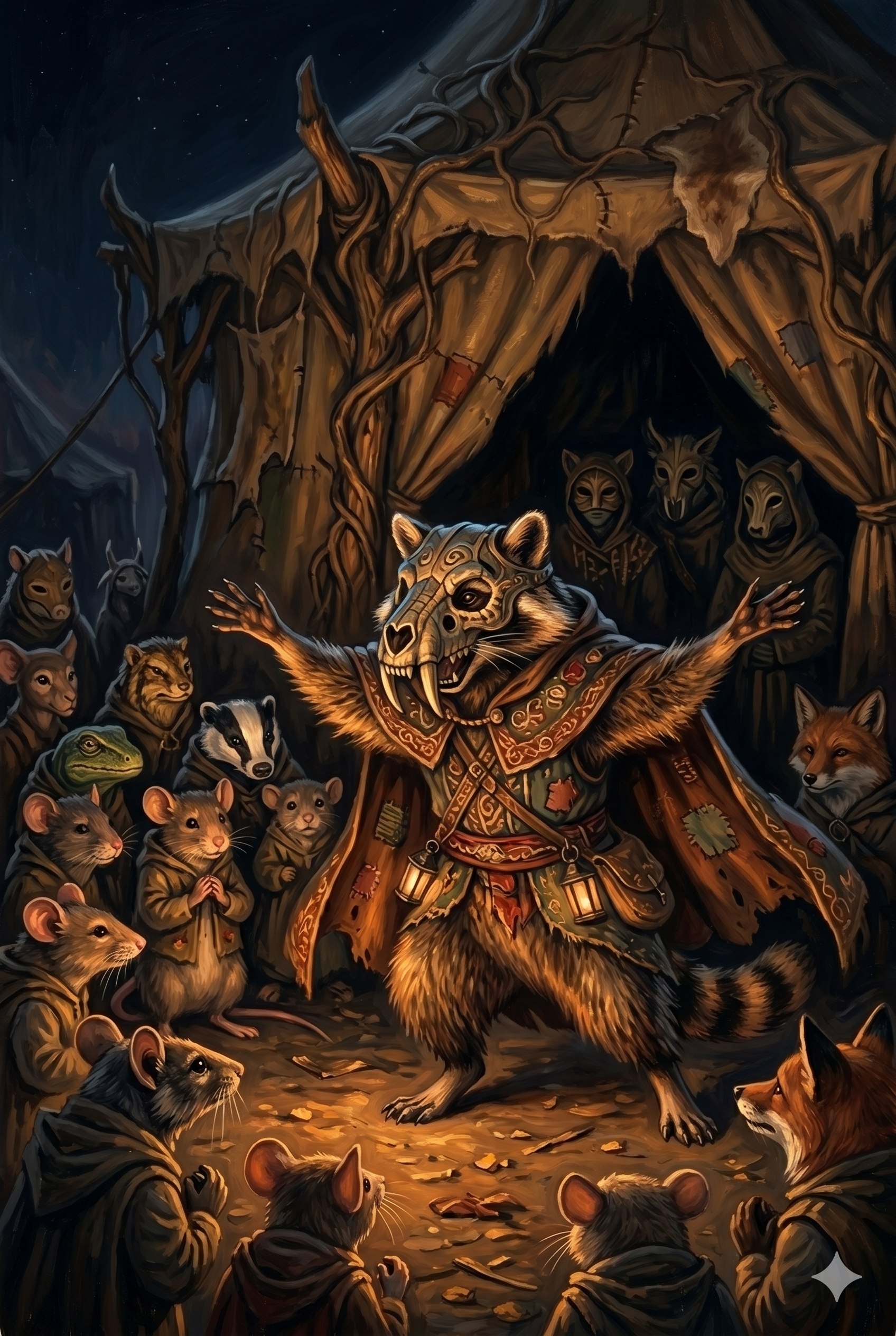
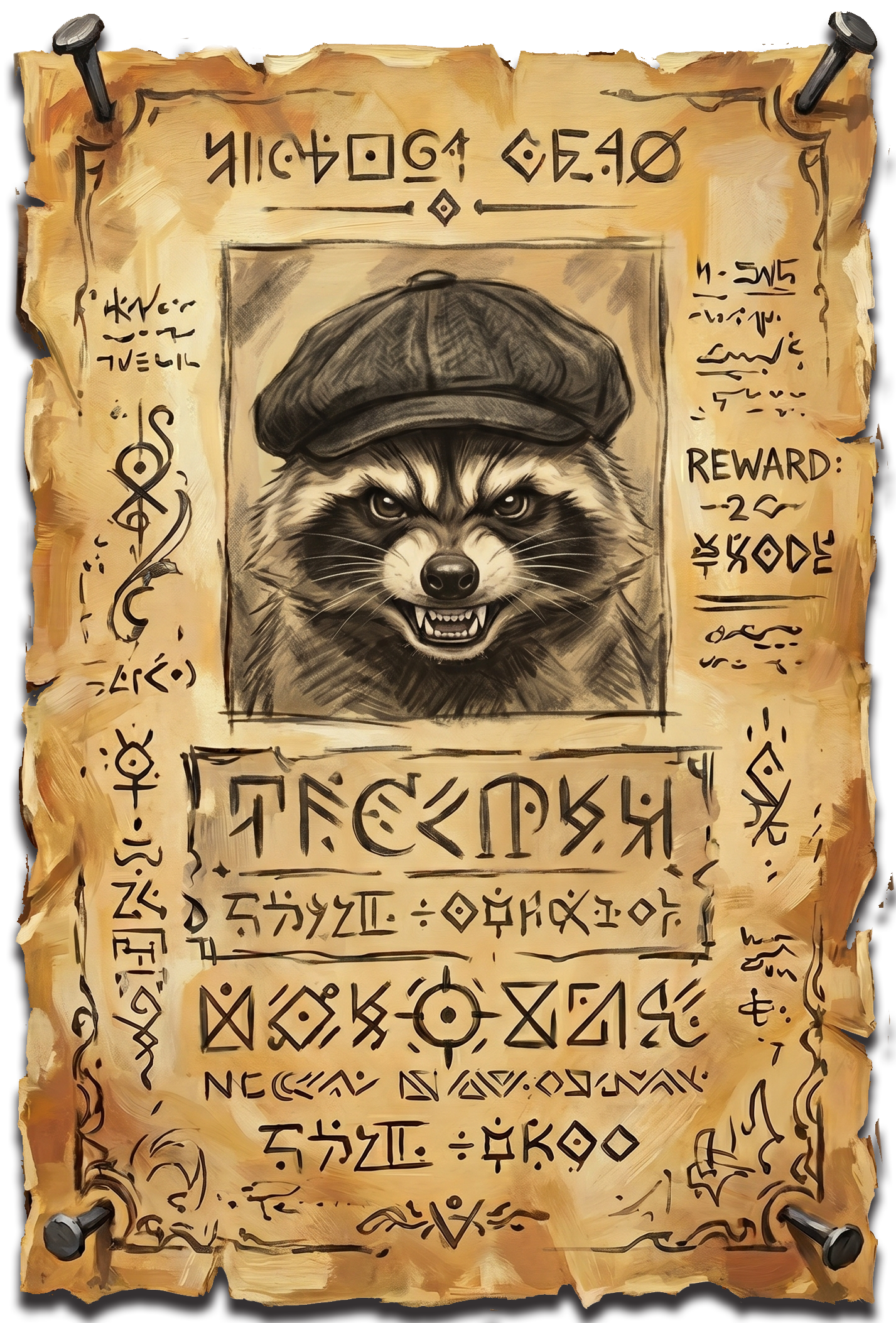
No realm fully claims the Greymasques and they prefer it that way. Road-born merchants, upcyclers, and opportunists who travel every route in Wildermere with carts piled high with repurposed goods - mended tools, salvaged armour, reclaimed cloth, and items whose original owners are best not asked about. Known colloquially as Ringers, for their banded tails and their talent for making one thing pass for another. The Briarnut Syndicate employs several as preferred distributors; their instinct for what something is worth - and to whom - makes them invaluable. They gather seasonally at Tamfaire and Backwater Springs, maintain loose allegiance to Bastion's Hearthpact, and are among the most reliably useful contacts in the known world, provided you don't inquire too deeply into provenance.
All RealmsPeoples Beyond the Six Realms
The Chirm · Insects of Wildermere
View Full
×
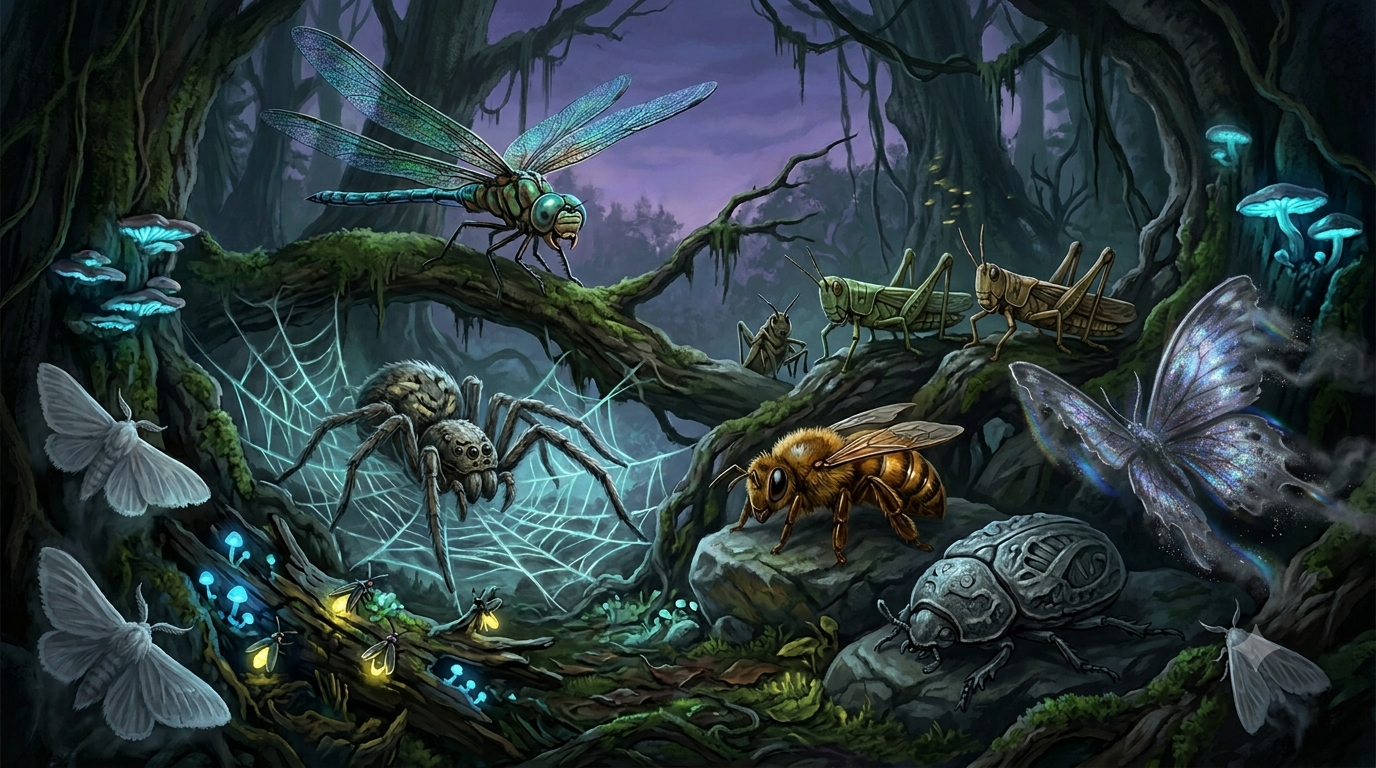
The Chirm are Wildermere's insect peoples - Driftwings, Borers, Gildlings, Millers, Glimmers, Spinners, Hoppers, Draggons, and Burrow Wurms among them. They are as intelligent as any Wilderfolk, possibly more so. They simply do not communicate in any way Wilderfolk can easily access. Their language is called the Undersong - a layered system of wing-frequency, scent-pattern, and movement that operates below the threshold of most Wilderfolk perception. A council of Gildlings deliberating over a hive looks, to a passing rat or badger, like bees being bees. The conversation happening is older and more complex than anything the badger could write down.
Groundfolk relate to the Chirm the way they imagine no one relates to them - as useful creatures, ambient threats, or background noise. Borers pull caravans. Driftwings carry letters. Glimmers light the inside of glass jars. The average Verdaanian merchant does not pause to consider whether the beetle hauling his cart has a view on the matter. This is not cruelty, exactly. It is the particular blindness of a species that has never had to think about it. Some Chirm have made them think about it. The Spinners, most notably. The Burrow Wurms, in their own way. The rest communicate their position through the Undersong, in frequencies no critterfolk ear will ever reach.
🦋
Driftwings
Butterflies · Wanderers & trained messengers
No fixed territory, no hive. Driftwings move between realms following bloom-lines and carry Undersong messages across vast distances. The practice of training them as long-distance post-carriers is so old no realm remembers establishing it - every noble house, merchant guild, and military command runs on Driftwing correspondence. What the Driftwings make of the letters they carry, no one has thought to ask.
🪲
Borers
Beetles · Builders, excavators & beasts of burden
Their tunnels predate every Dwolic structure. They do not acknowledge the Dwoles as competitors. Across all six realms, Borers are also harnessed as the primary overland beast of burden - the Banded Circuit runs its caravan routes on Borer teams. A single Borer can haul loads that would require six horses and navigates root-road and broken terrain without complaint. The Borers hauling carts through Althorne's morning market have never been asked whether they object to the arrangement.
🐝
Gildlings
Bees · Hive-minds & collective decision-makers
The closest thing the Chirm have to a governing body. Hive-minds that reach collective decisions through Undersong resonance.
🦋
Millers
Moths · Drawn to dying things
They cluster at the sites of old battles, ruined root-nodes, and the edges of Pyrewood. Garungan Shellsworn consider them omens. Tasari scholars consider them data.
✨
Glimmers
Fireflies · Light-pattern communicators
The only Chirm whose communication Wilderfolk can partially read - their light-patterns carry meaning, though only the Krobbak have decoded more than a handful of signals. Wilderfolk across all six realms have taken to enclosing Glimmers in glass lanterns for portable light. The Glimmers do not resist this. Whether they are tolerating it, using it, or saying something with it, no one has determined.
🪲
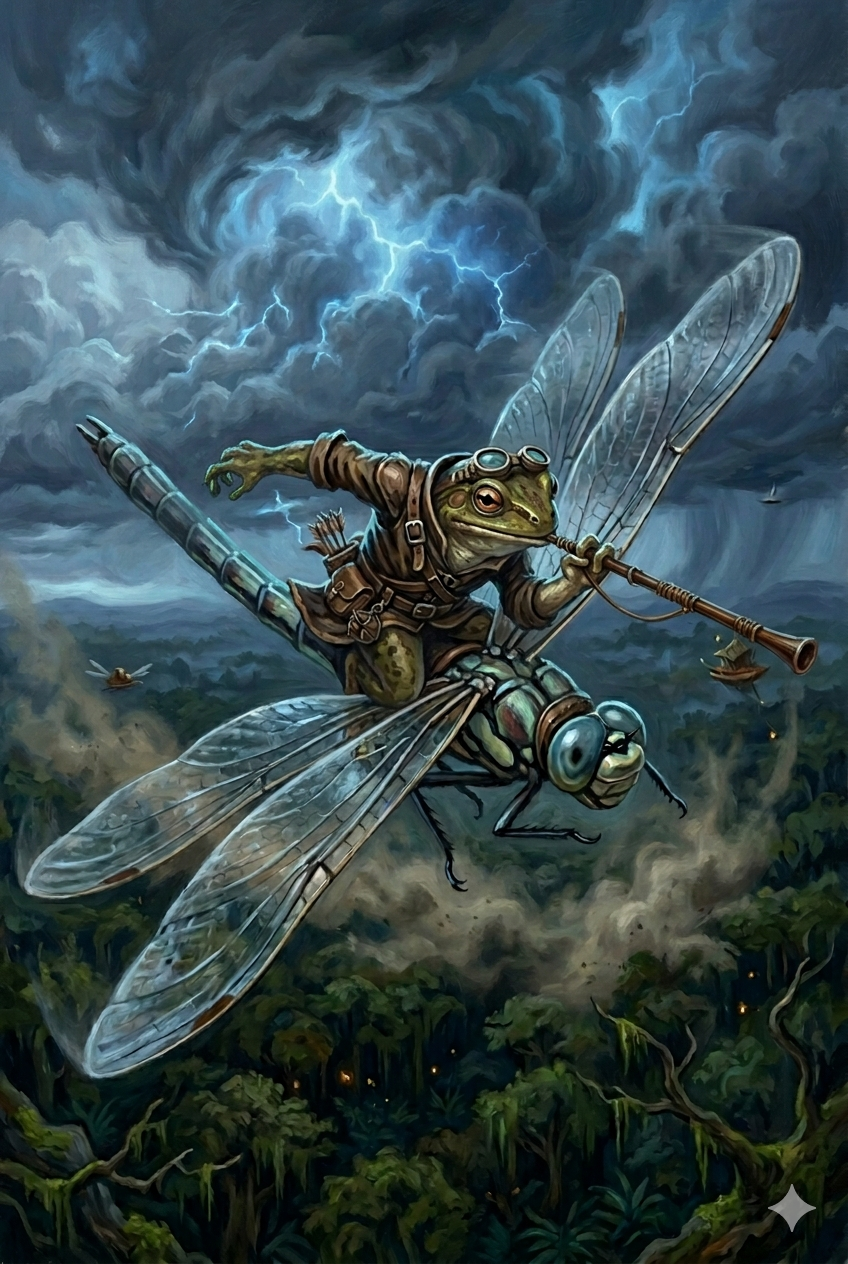
Draggons
Dragonflies · Bog fliers & bonded mounts
The largest of the Chirm. Wild Draggons patrol the marsh canopy of Brokenroot Bog and the Garungan waterways on their own terms, and the Garungan waterfolk have learned to leave them to it. Some, however, have been bonded to Draggonflier riders - a practice that began in Garunga and spread slowly outward. A bonded Draggon is not tame. It has made a choice that critterfolk do not fully understand and cannot replicate by force. The unbonded ones watch from the reeds. It is unclear what they think of it.
🕷️
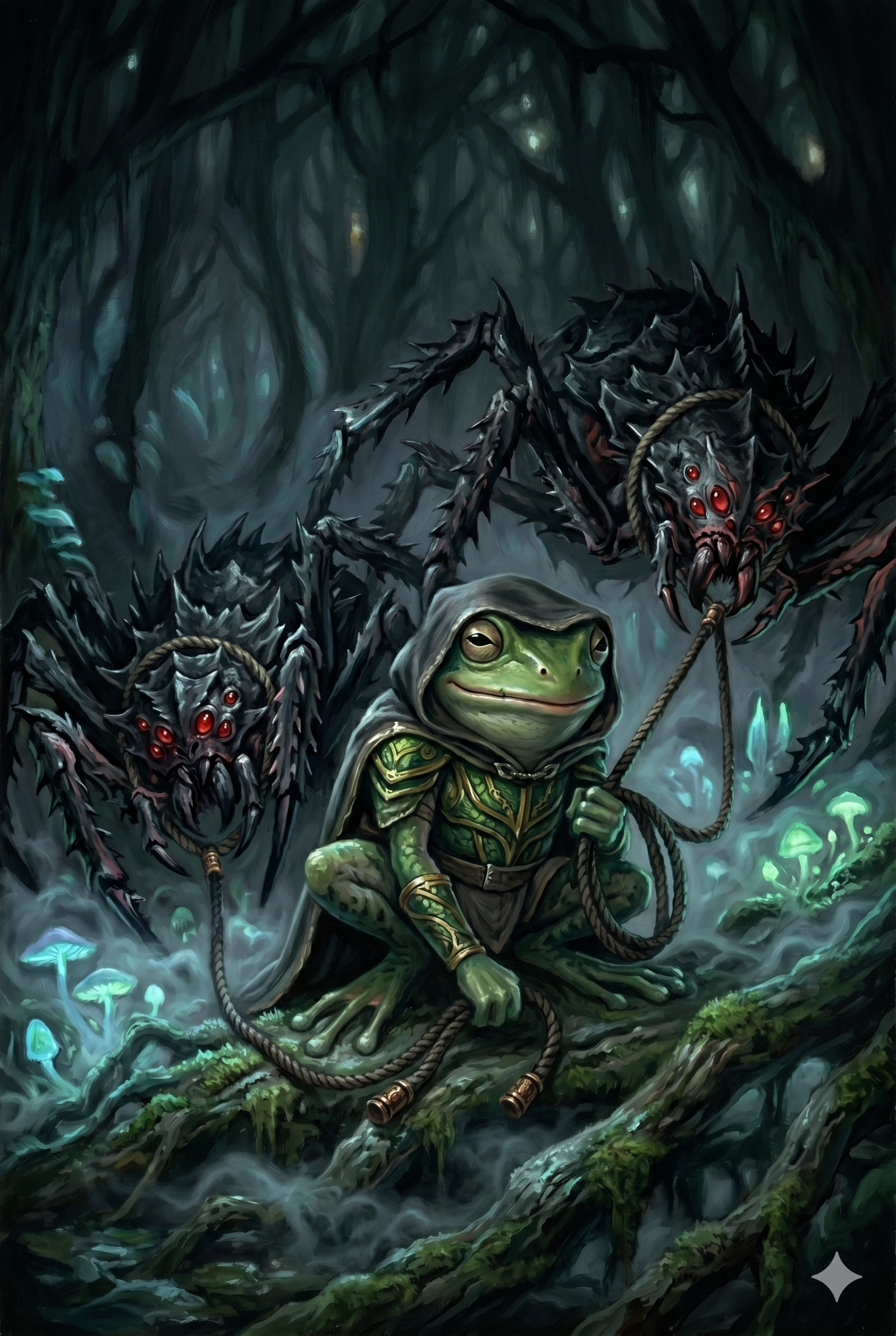
Spinners
Spiders · Weavers & web-architects
Spinners keep to the dark places - cave mouths, deep hollows, the underside of ancient roots. They are the one kind that has never been domesticated, never been pressed into service, never tolerated proximity without consequence. Their silk is the finest thread in the known world - stronger than iron wire, lighter than linen - but harvesting it from an active web in Wildermere is not considered a trade. It is considered a death. Lands beyond the region have found other arrangements. Wildermere has not tried. The Spinners have made their position on the matter clear, repeatedly, and in a language every Wilderfolk can understand.
Hoppers are the most visible Chirm and the least understood. Their stridulation - the rhythmic scraping that Wilderfolk dismiss as ambient noise - is one of the Undersong's most expressive registers. The Branch of Still Water has catalogued it for sixty years and can translate perhaps a dozen phrases.
🪱
Burrow Wurms
Caecilians · Deep tunnellers & underground threat
Blind, limbless, and older than any Dwolic tunnel. Burrow Wurms carved the first deep passages beneath Wildermere long before the Dwoles arrived - the Dwoles simply found them and expanded. They move through the Undersong in frequencies too low for most Chirm to register, and their presence in a tunnel system is rarely announced. For the Dwoles, they are a constant occupational hazard. For the Brevis working the tunnel mouths and surface connections, an encounter is more immediate and considerably more dangerous. Near the Cradleheart, where centuries of root-heat and deep moisture have fed the oldest passages, Burrow Wurms have grown to sizes that defy practical description. The MulDelvers map these sections. They do not enter them.
The Undersong - Who Can Hear It
Most Wilderfolk can't. It isn't that they're excluded - they simply lack the sensory range. A handful of species and individuals can commune partially:
The Krobbak (Garunga's frogkin bog-handlers) have the closest thing to full Undersong comprehension. It is unclear whether this is biological, learned, or something stranger. They do not explain it. They handle Skitters. The two facts are probably connected.
Tasa Ru's Branch of Still Water has been attempting to formally document the Undersong for three generations. They have a partial lexicon of approximately forty confirmed signals.
Skitters - The Corrupted
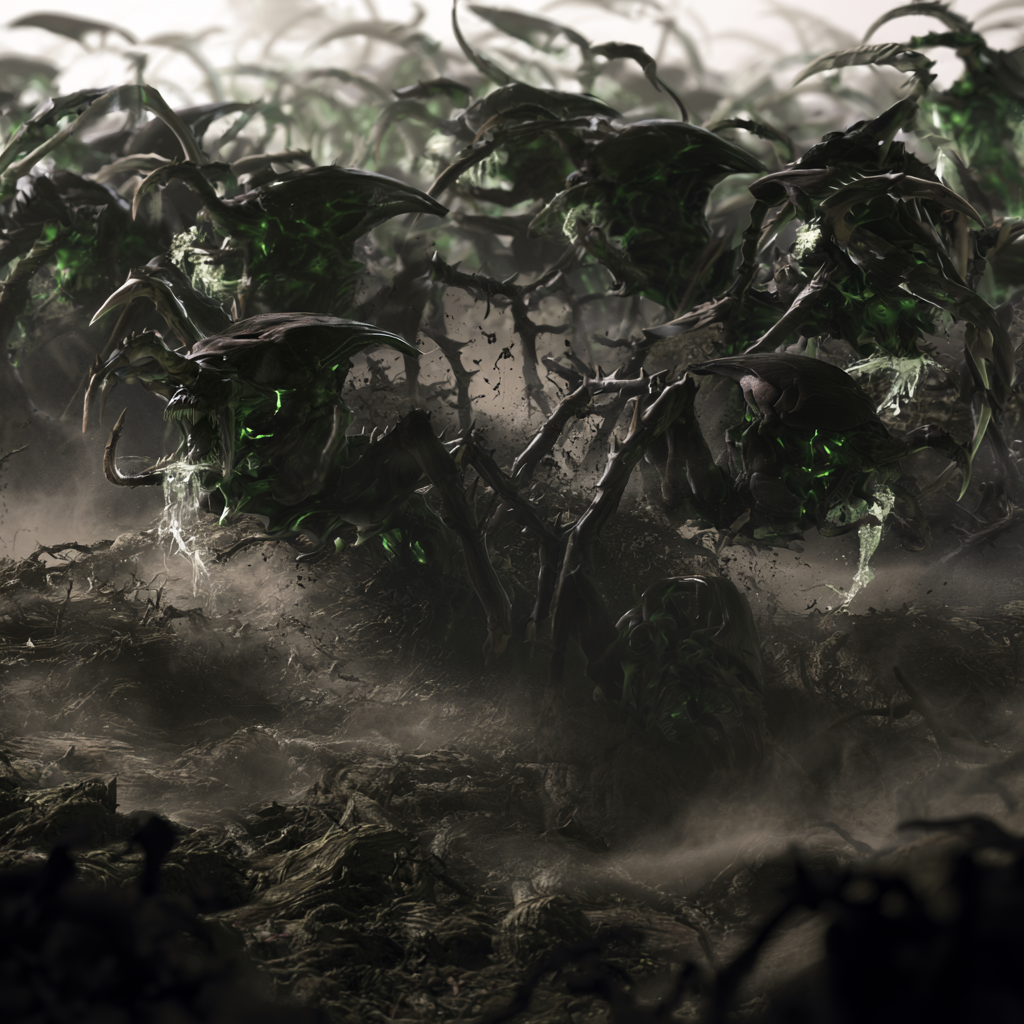
When a Rootvoice node dies - a tree in the network that rots from within rather than falling clean - something goes wrong with the Chirm living nearby. The Undersong twists. Frequencies that carried meaning start carrying something else. The Chirm caught in it do not simply change in behaviour - they change in body. Shells split and re-fuse wrong. Wings multiply or collapse into barbs. What emerges is recognisable as kin to the Borers or Millers or Gildlings they once were, but mutated into something beastly, aggressive, and unreachable. Skitters are not a species. They are a condition. A Skitter swarm is not mindless - that is what makes them dangerous. They still move with Undersong coordination. But whatever they are saying to each other, no Wilderfolk can follow it, and the Krobbak who have tried to listen have come back changed in ways they do not discuss.
The Eldkin · The Ancient-Formed
🦴
Eldkin Illustration - Coming
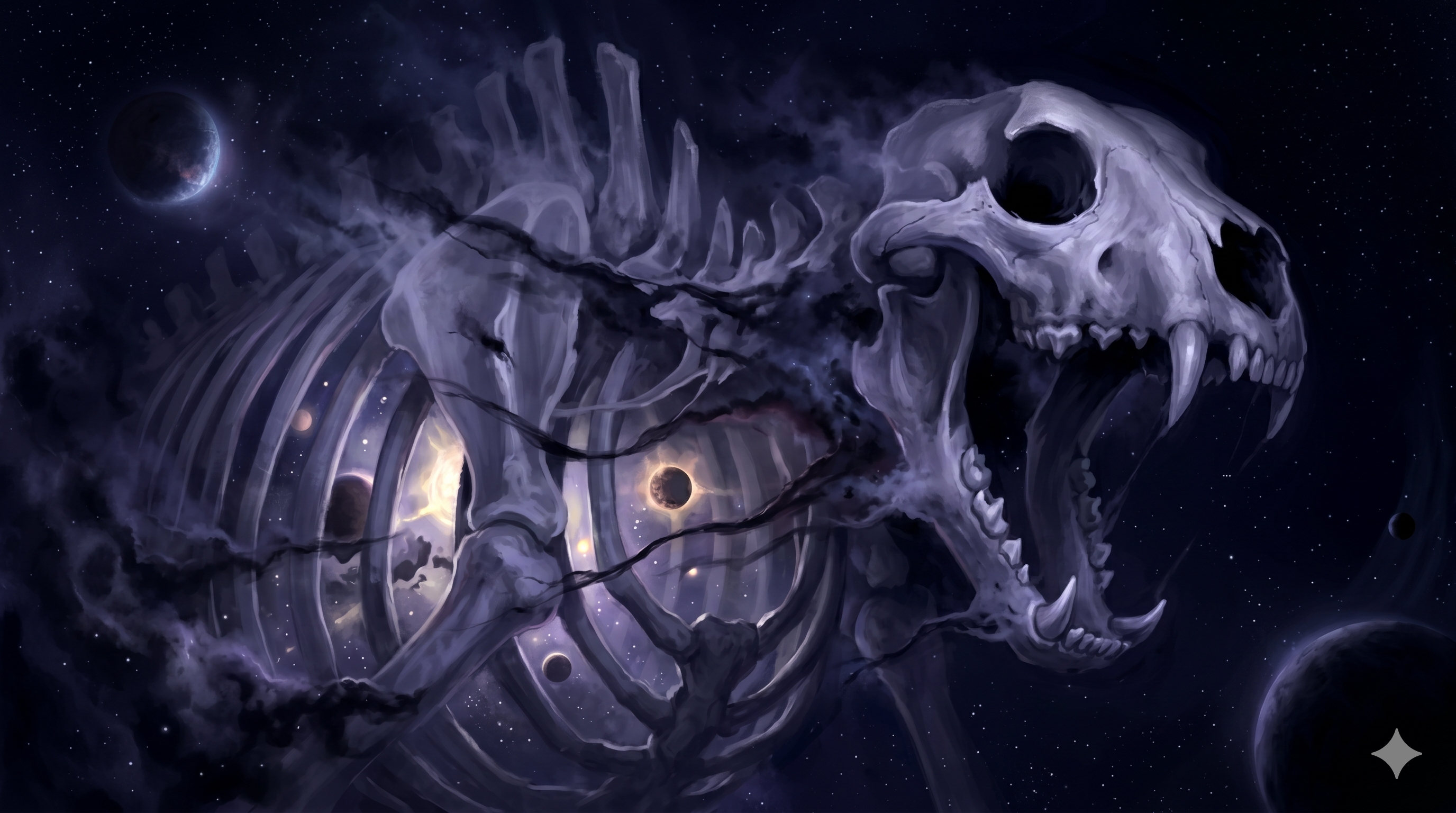
Most Wilderfolk will never see one. Most will never know they almost did. The Eldkin are vast - beyond the natural limit of their kind - and old enough that the Rootvoice has threaded itself into them over generations, the way it threads into old stone and root. They are not transformed. They are simply more: more mass, more stillness, more presence than their species was built to carry. Where a fox is quick and gone, an Eldkin fox simply is. You feel it before you see it.
Scholars at Tasa Ru's Branch of Still Water believe the great trees - the Cradleheart, the Furann, and those that came before them - acted as anchors. Animals that lived in their canopy long enough, fed on their seeds, or nested in their roots were slowly changed. Not by intention. The trees did not choose them. But proximity to that much concentrated life has a way of doing things over time that nothing else can replicate.
They are scattered across Wrune. Sightings are rare enough that most are treated as folk tale. Remains are less rare - the bones outlast everything, and in several cases have become landmarks in their own right. The Eldkin of Carraig Mòr are something else entirely: vast still, but broken inside, in ways that match what happened to the Furann when it burned. These are the ones the haunted places of the western moor are built around.
Known Remains & Sightings
Fox Hollow, Verdaan - The great ribcage that gives the hollow its name. A titan fox, now bones and root. The Verdaanian Greybacks do not speak of what it was or how it died.
More to be discovered
Darkness Beyond the Covenant
Threats & Horrors
Not every creature in Wildermere holds a seat at the table. Some were cast out. Some were never invited. And some predate the Covenant entirely.
Skitters
The Clicking Swarm - Born of the Rot Below
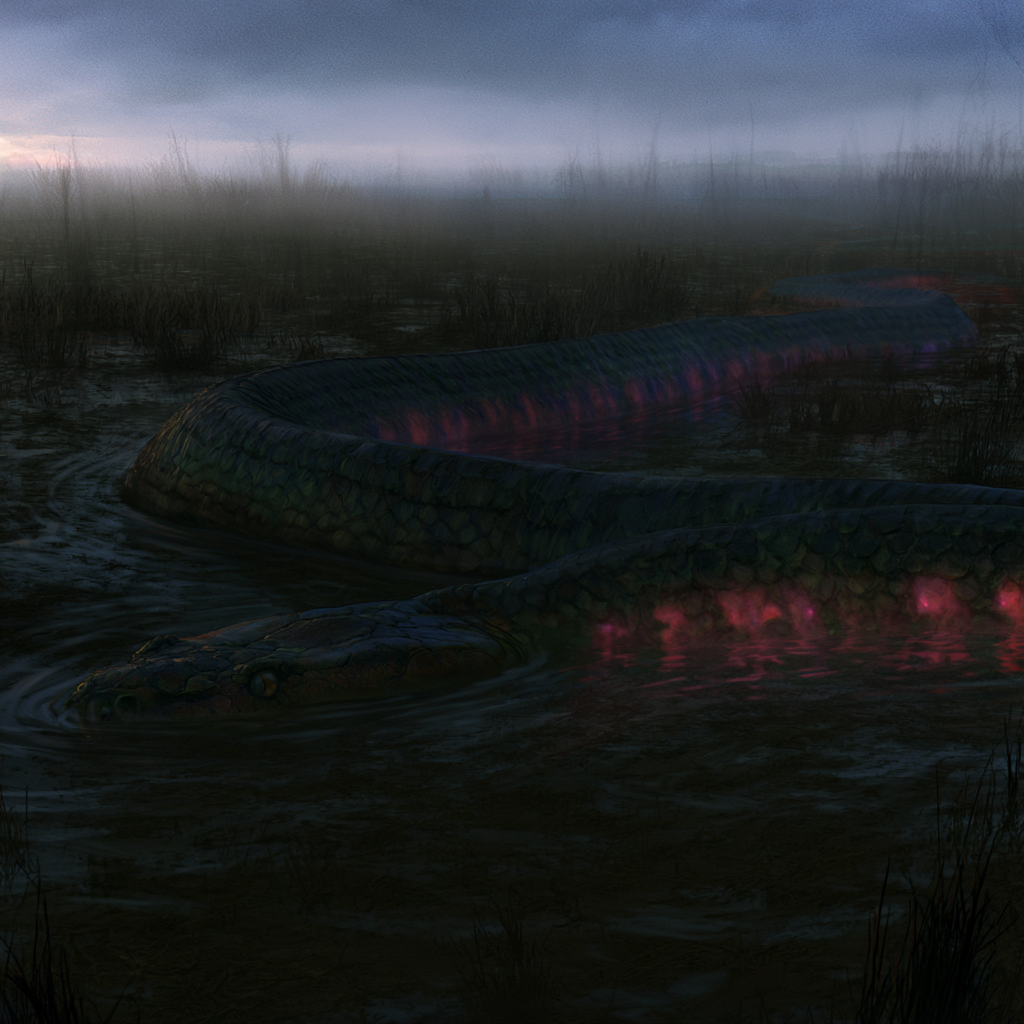
Skitters are not a single creature but a colony intelligence - chitinous, fast-moving arthropods roughly the size of a large rabbit, sharing a distributed mind through mandible-click signaling. They do not speak. They do not negotiate. They consume.
First documented during the Brethren War, Skitters emerged from the deep cavern systems beneath Dun Terre, drawn upward by the vibrations of mass burial grounds. The Dwoles, who share the underground, treat them as a geological hazard - something to be tunneled around, never directly engaged.
A Skitter swarm leaves behind only exoskeletal husks and a faint reek of ammonia. They are believed to be a corruption of Üne's deep-memory - something that festers when too many dead are left without burial rites.
SubterraneanSwarm IntelligenceRot-Born
Wruteborn
The Weedwalkers
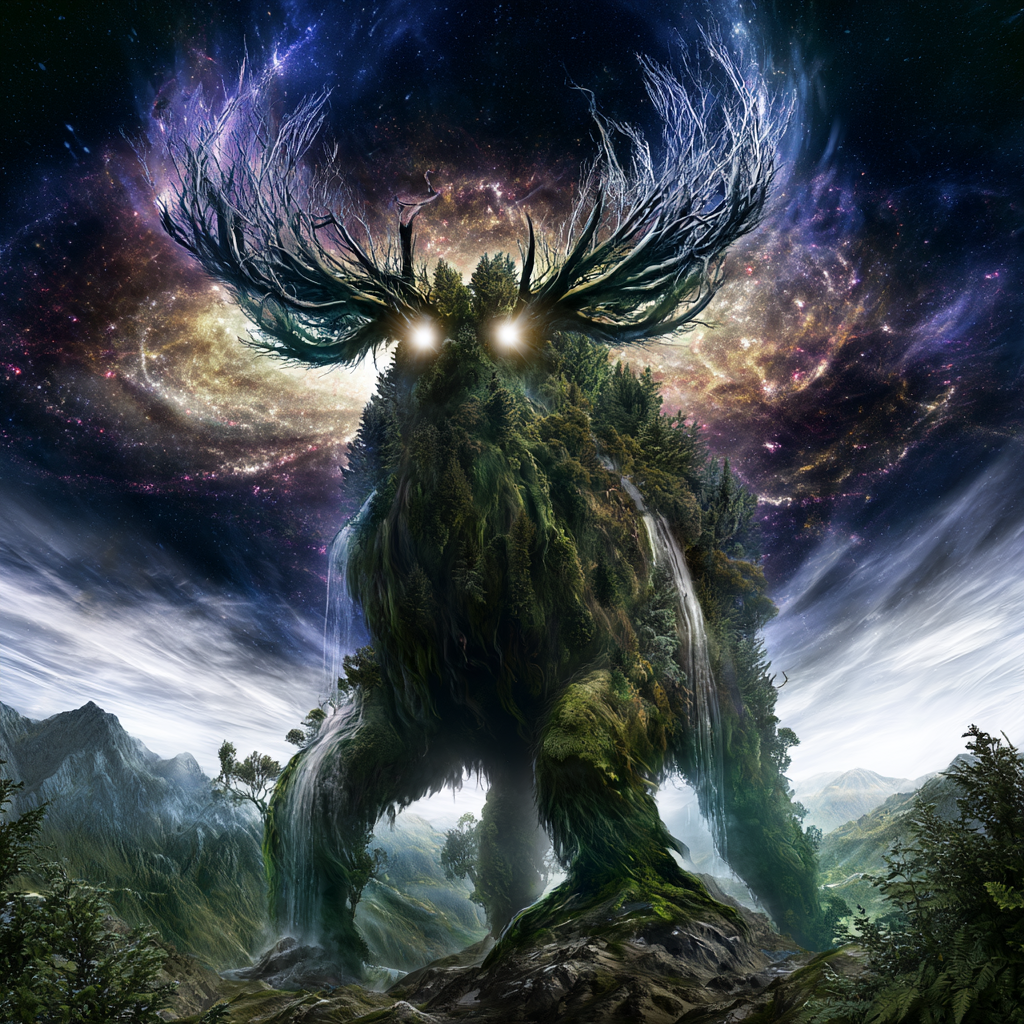
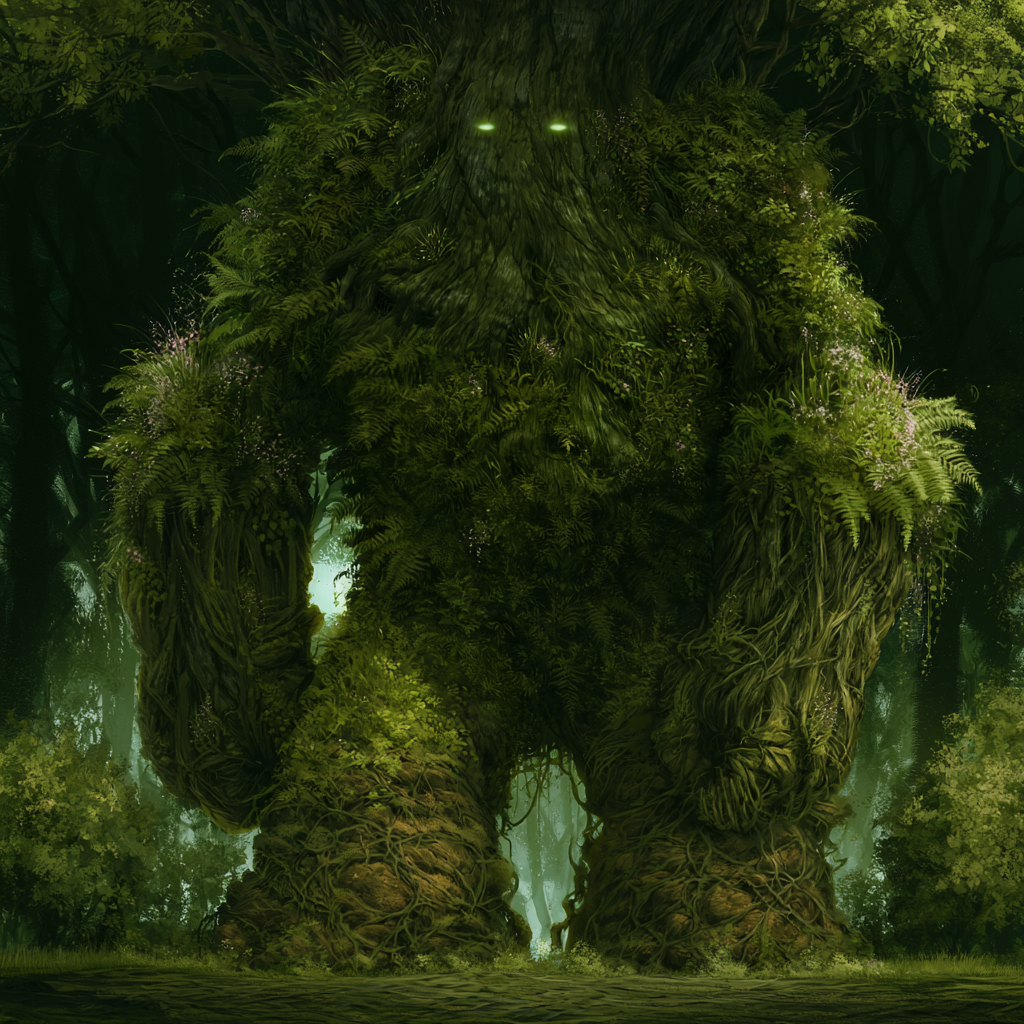
The Wruteborn are not inherently dangerous. Mossy giants, barklings, reed-stalked wanderers, petaled whisperers - they dwell in sacred groves and shaded hollows, moving slowly, responding to the Rootvoice, standing watch over places the living have forgotten. Most will not harm you if you do not harm them. They are plantlife awakened through resonance, and in their quiet state they are closer to sacred than to threat.
When they turn - that is something else. Scholars of the Enneawise have come to understand aggressive Wruteborn as a corruption of Wru himself: the divine wanderer, motion and chance and the thrown bone, his energy curdled into something that moves without direction, strikes without reason, cannot be reasoned with because there is no thought behind it - only force.
What triggers the turn is not fully understood. Root rot is one cause. Proximity to places where the Rootvoice has gone thin or wrong - Pyrewood Swamp, the Brackish Wilds, Bannerdun Fields - is another. And some believe that Wruteborn which have been controlled through the Rootvoice and then released carry something broken in them afterward, like a bell that has been struck too hard and will never ring clean again.
Known Habitats. Peaceful Wruteborn dwell in the Ever-Green Sanctuary, Cairnwell, Misthall, and Morel Glade. Aggressive Wruteborn haunt Pyrewood Swamp, the Brackish Wilds, Bannerdun Fields, the Feral Forest near Bittertrick, and Westweed Thicket.
Coilbloods hold no caste. No Triarch claims them; no Hearthtable seat speaks for them; no Greyback census counts them. They exist outside the system by design - or perhaps by nature - and the system has never successfully changed this. Primarily found in Brokenroot Bog.
No CasteWrithe PathUncountable
Skin Spies
The Chameleons - Near-Extinct & Unforgiven
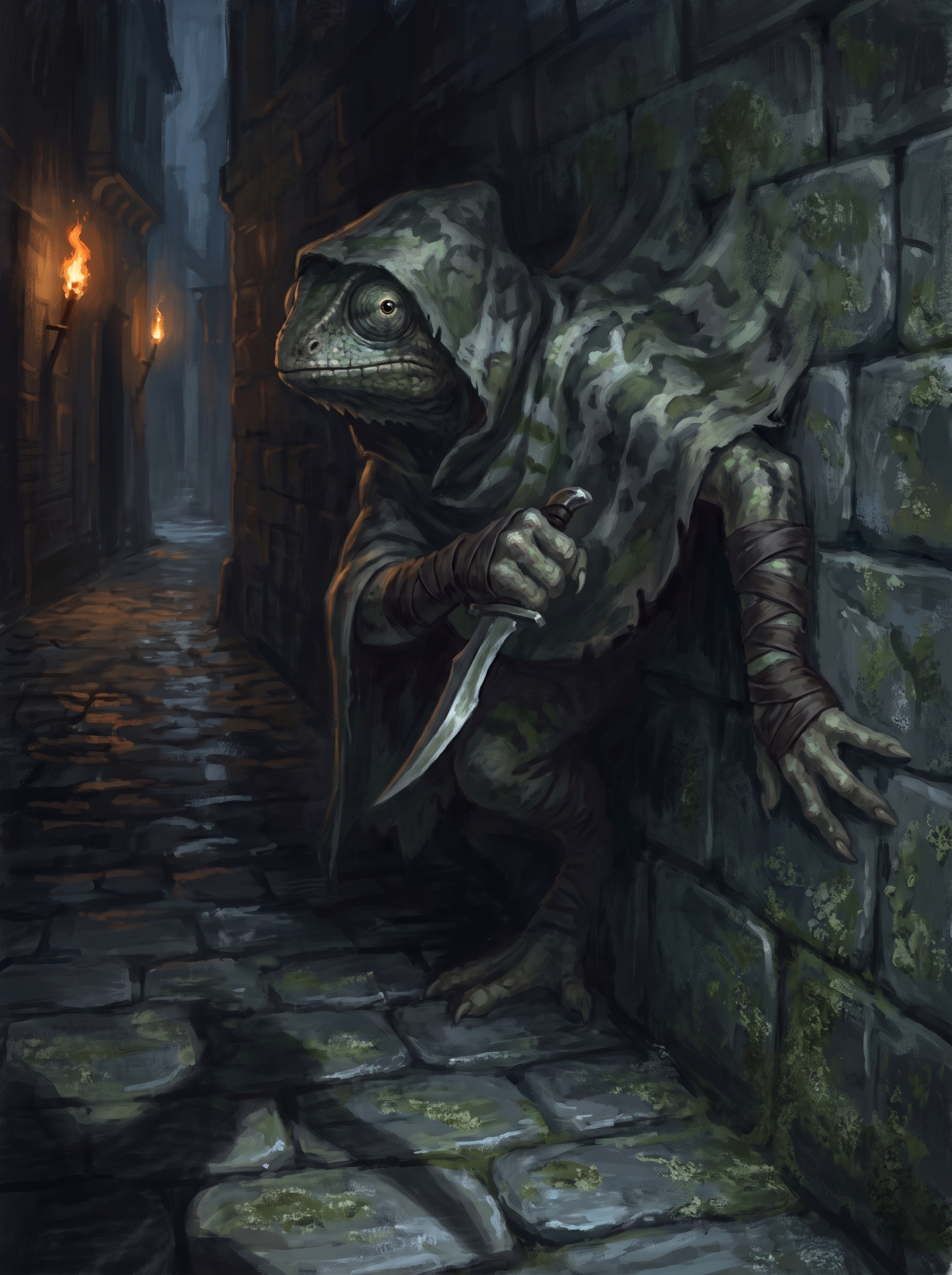
Skin Spies are chameleon-folk with an extraordinary and deeply unsettling gift: the ability to alter their coloration to near-perfect mimicry. During the Flicker Years they were deployed as weapons - infiltrating noble houses, replacing courtiers, steering wars from the inside.
The Unity Hunt that followed was one of the most coordinated cross-realm efforts in Wildermere's history. Every realm contributed soldiers. The Skin Spies were hunted to near-extinction - or so the records state. A handful are believed to have survived, operating in ones and twos, taking contracts from parties who know exactly where to leave payment: reed bundles, moonlit tide pool, three full moons before the job is needed.
Their only known identifier is a forked-tongue eye sigil, sometimes burned into the underside of a left wrist. Looking for it is usually how you find out you're already too late.
ShapeshifterNear-ExtinctMercenary
Blackwings
The Batfolk - Swift, Silent, Beyond Reason
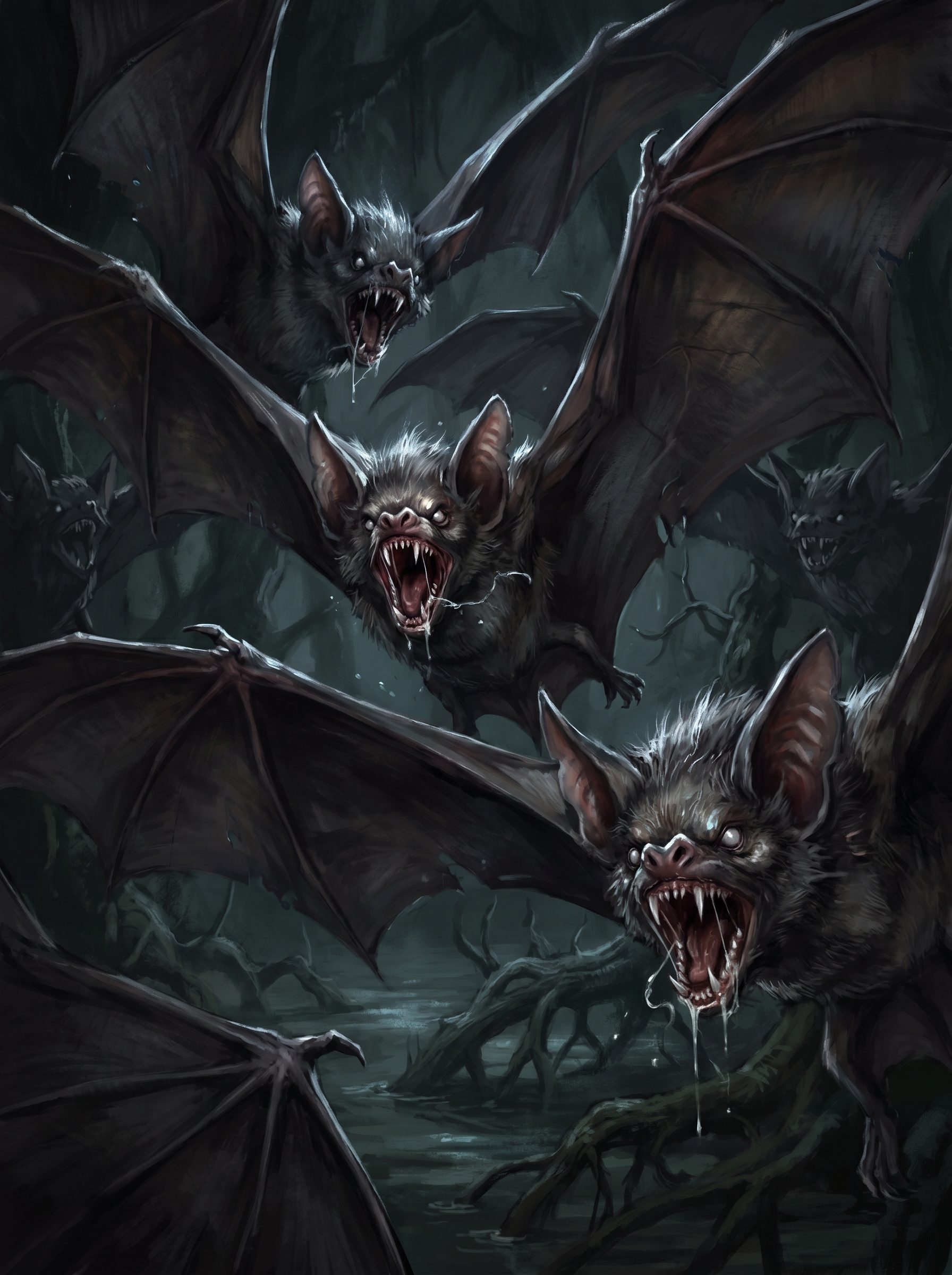
The Blackwings nest in high bonewood hives deep in Brokenroot Bog - vast colonies of bat-folk who have never held a seat at any table and have never sought one. They do not parley. They do not send envoys. Attempts to establish communication have not gone well for the envoys.
They are fast beyond what most creatures expect, near-silent in flight, and entirely indifferent to the political arrangements of the surface world. Coilbloods, who fear almost nothing, give Blackwing nesting grounds a wide berth. The Triarchy officially considers them unclassifiable - not enemy, not ally, not subject. Simply a fact of the bog, like the fog and the sinkholes.
What they want, if they want anything, has never been determined. They take what they take and return to the dark canopy. Nothing has ever successfully followed them home.
Bog-DwellersCannot Be Reasoned WithColony
The Fungrel
The Spore-Taken - Bone and Rot Given Motion
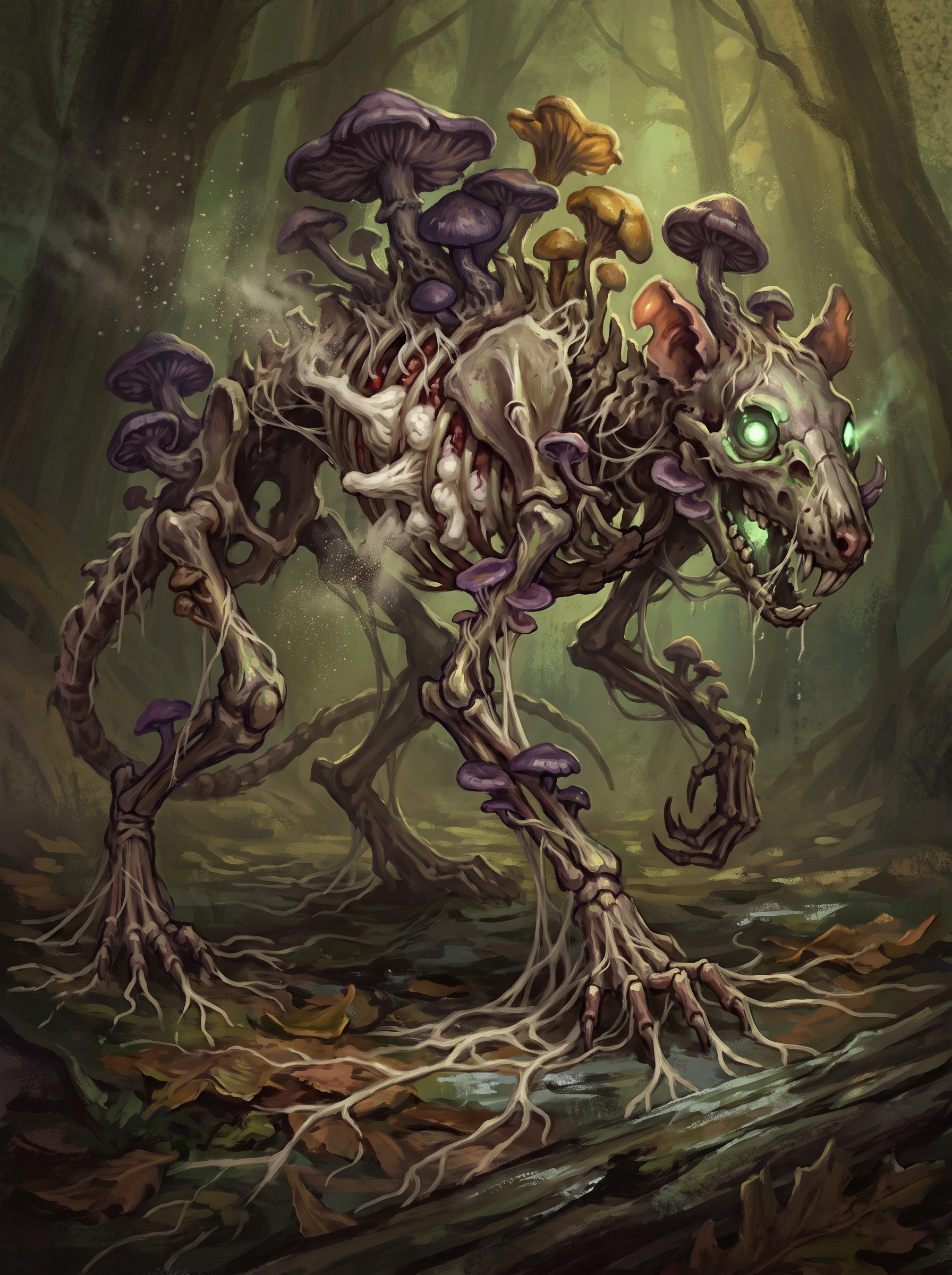
The deep rot-fungus has existed longer than any realm, any covenant, any god believed in by any creature in Wildermere. It does not need the Rootvoice. It does not answer to the Cradleheart. It grows in old battlefields, flooded ruins, cave systems, undisturbed forest floors - anywhere dark and wet and left alone long enough. At a certain age, a certain density, it stops merely feeding. It starts moving what it finds.
The Fungrel are what happens when the deep rot-fungus threads through bone and uses the skeleton as scaffolding. Not raised. Not summoned. Grown. The mycelial network fills the hollow spaces - marrow, joints, the gaps between ribs - and animates the shape it finds. What walks is not the creature that died there. It is the fungus, wearing a body it inherited.
Up close you see the pale growth pushing through cracked bone. The joints move slightly wrong. You smell them before you see them - something between wet earth and something sweeter that has no business being there. They do not stop unless the fungal thread is severed. They do not feel pain. They do not tire.
They exist across the world - not concentrated in any one place, not the product of any one event. Old enough cave systems in Mul Wü Terre. Battlefield plains in the far east no realm has named yet. The deep Dolgami floor. The Dwoles have known about them longer than any surface realm and have said very little.
The Sporemancer is a separate matter. A creature — any species, any realm — exposed to the deep spores long enough does not simply die or turn. The fungal network finds a living mind and learns from it. Gets smarter. More directed. The Sporemancer is what the fungus produces when it finds something still thinking: a node in the network that can still speak, still move with purpose, still cross borders. They do not control the Fungrel. They are simply the part of the network that has not finished yet. Pale patches where the skin has gone thin. Joints that move slightly wrong. A smell they cannot wash off. They know exactly what is coming. The most dangerous ones are the furthest along.
BiologicalPan-World ThreatThe Sporemancer
Six Realms, Six Fates
The Lands of Wildermere
Verdaan
"Where Law Took Root and the Crown Cast Thorns"
The oldest and most hierarchical realm in Wildermere. A centralized monarchy ruled by the Greyback rat dynasty from the Rose Citadel in Althorne, Verdaan sees itself not as a participant in realm politics - but as its rightful steward.
Verdaan is defined by structured society, military discipline, and deep reverence for Wru as the First Monarch. Its currency (Ambre, Tawns, and Russets - sap-based coinage) flows through the Verdaanian Causeway into every other realm's markets.
Capital
Althorne - The Rose Citadel
Dynasty
House Briarthorn (Rats)
Currency
Ambre, Tawns, Russets
Religion
Wru as Guiding Will
Geography
Whiskerpines - Misty forest near Althorne and the Cradleheart's root-line
Acorn Glen - The breadbasket; vast farming villages
Oxborough Forest - Wild, ancient woodland in the northwest
Grandtree Lake - Northeast access to the Cradleheart's roots
Butterlore Forest - Dense woodland of the southern coast
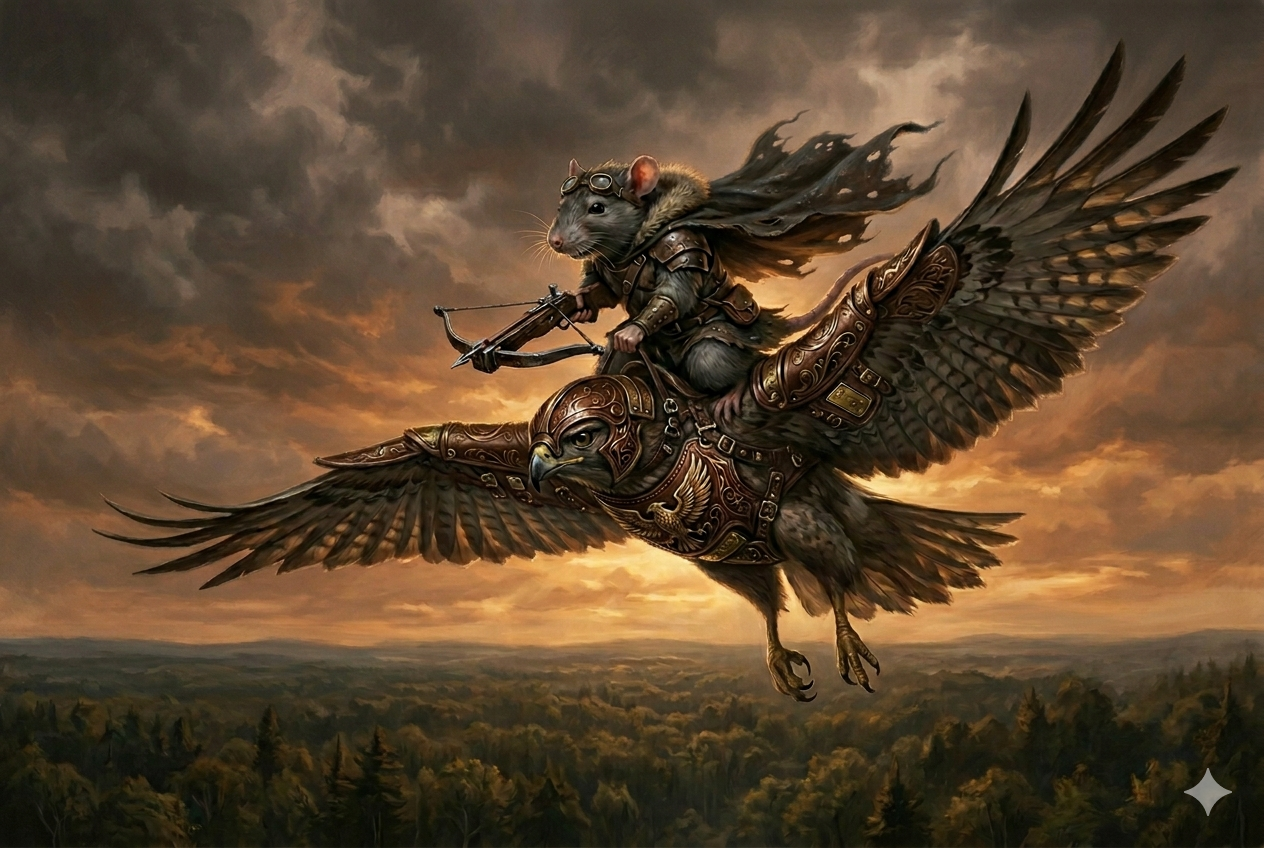
Skilled infantry, rabbit shock-troop cavalry, and mixed-species units. A covert alliance with Avondelle produces bird-rider squadrons trained at Almsnest. The Thornwatch - a powerful network of border forts - guards every frontier approach.
Verdaan's most jealously guarded strategic secret: the Dwolic Tunnels. An ancient passage carved by the Dwoles runs from Wure Terre through the Dwolic Hills and beneath the western frontier, emerging at the coast near Chestnut Bay. Verdaan uses these tunnels to silently supply and reinforce their frontier fortresses - Thornbargate, Redrootpost, and the Causeway forts - moving arms, grain, coin, and troops underground without a single soldier visible on the road. The arrangement is permitted by the Dwoles. For a price never publicly stated.
The Sanguine Temple
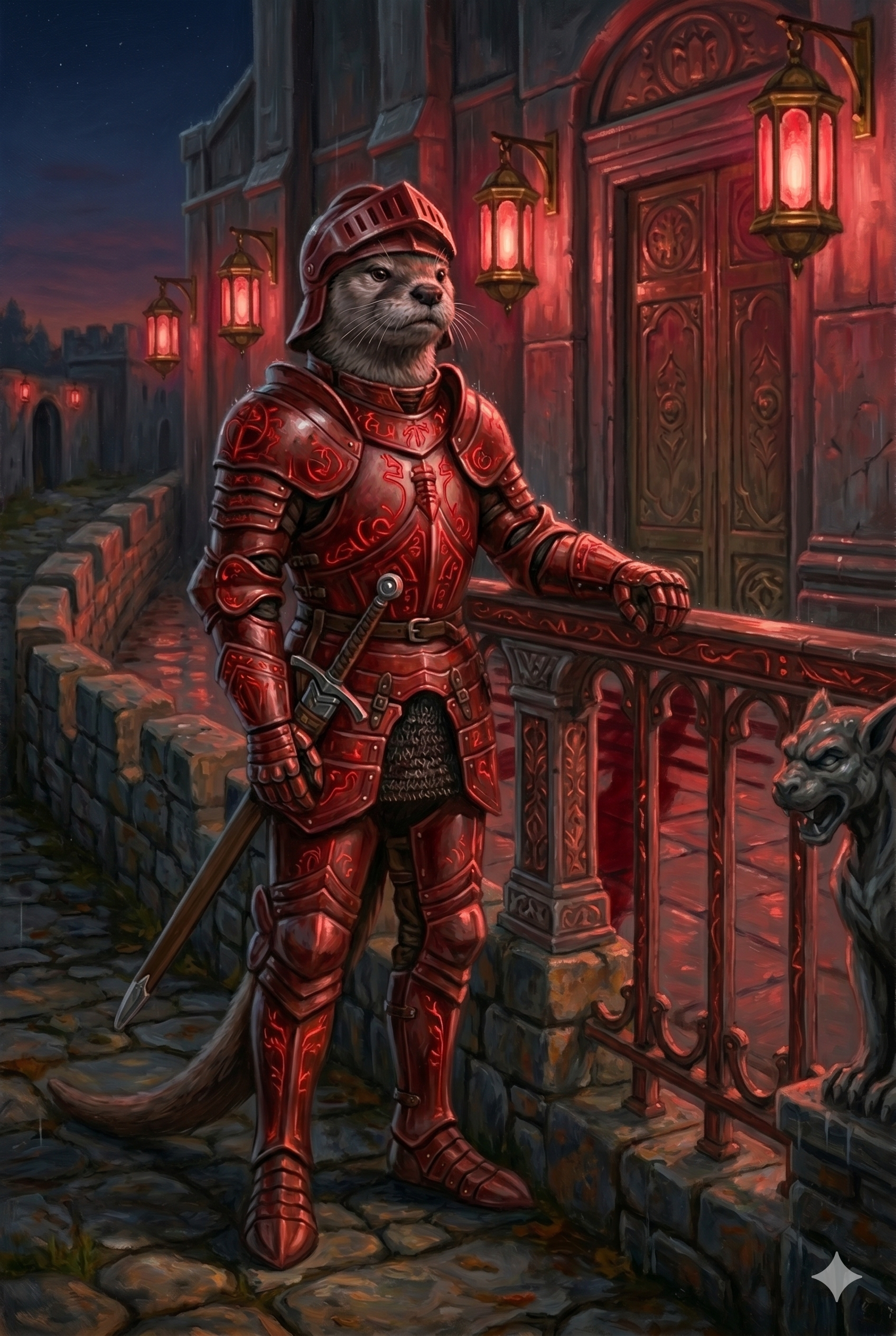
Verdaan's most powerful shadow institution, operating from the Redveil district of Althorne. Healers and confessors who maintain a private ledger of every debt - favors, secrets, and sins. Their forgiveness, when it comes, is never free. Symbol: a blood drop over an open palm. The Temple's militant arm - the Scarlett Shields, a mixed-species order of religious knights - enforces its doctrine and the Crown's order throughout Verdaan. Known among commoners as the Scars, a name earned through their reputation for roughing up the citizenry.
The Greyback Secret
Noble Greyback lines practice the Ashbinding - a coal lit from the original fire of the Furànn, pressed into a paw-scar at the moment of succession. The ember has been passed from ruler to ruler since the night the Greybacks fled Cárraig, their backs grey with the ash of their burning home. The fire in the Furànn - now called the Emberdeep - has never gone out. Neither has theirs.
Garunga
"The tide shapes us, and the stone remembers."
Garunga was not always a realm of swamp and dark water. Before the Covenant War and the Great Blight, it was a coastal kingdom - warm beaches, open tidal shores, salt wind and wide sky. The Sunclads worshipped from long sand flats. The Tidechosen plied crystal shallows. What the Triarchy chose to do - harvesting Cradleheart roots to fuel their war-machine - cost them the coast. Clean water ran brackish. The beaches hardened into arid scrub or dissolved into bog. What remains of that shoreline is Esqorro Sands: a strip of arid, half-swallowed shore where the Sunclads still gather to face whatever sun breaks through the murk.
What Garunga is now is a sprawling, elemental realm of swamps, deltas, and blight-scarred lowlands. Garungans believe all life flows between Wru (vitality, strength, motion) and Üne (patience, memory, depth) - and this shapes everything. Caste is not inherited but revealed: in the Ceremony of the Spawnshade, tadpoles swim toward totemic objects in a sacred reflecting pool. The totem they choose determines their caste, their city, and the entire arc of their life.
Garunga is governed by the Triarchy - but it wasn't always this way. Gorra-Gorra was once the sole capital, the single throne from which one ruler commanded the entire realm. The Harvest War, the root harvests, the Great Blight - all of it was decided from those walls by one voice. When the realm nearly collapsed, the survivors made a vow: never again would one decision-maker hold the fate of all. Power was split across three cities - Gorra-Gorra, Shallaholde, Driftmarsh - and all three caste-elected lords must agree before any major act of state. The result is a civilization that deliberates endlessly. But Garungans still know, in the way they know tide and bone, that what is decided at Gorra-Gorra carries more weight than the others. The stone there is older. The silence heavier.
Military Capital
Gorra-Gorra - The Deep Bellow
Spiritual Seat
Shallaholde
Trade Nexus
Driftmarsh
Sacred Enclave
Torga - Shell-Vaults of Memory
Great River
Garung River
Faith
Wru & Üne - The Tidal Balance
The Triarchy & Castes
Gorra-Gorra was once the sole seat of Garungan power - one ruler, one throne, one voice that nearly ended the realm. The Triarchy was born as a vow in the aftermath: never again. Power was divided across three cities and three castes. All must agree before any major act of state - war, treaty, or spiritual decree. Stonebound (military, led by Triarch Grod Tuggmaw from Gorra-Gorra) · Shellsworn (spiritual, Triarch Nissh of the Moonflume from Shallaholde) · Tidechosen (civic and diplomatic, from Driftmarsh). No caste is inherited - it is revealed by the Ceremony of the Spawnshade. But every Garungan knows the unspoken truth: when Gorra-Gorra speaks, the others listen a little harder.
The Garung River
The realm's spine - beginning at Grandtree Lake, carving Rootwater Canyon, passing the hidden Veilfall and Misthall, narrowing into the Whipperpool Rapids, dissolving into Pyrewood Swamp, and emptying into the Dark Morass and Chestnut Bay. The Shellsworn believe it carries more than water: the memory of what Garunga has done.
The Root Harvest & The Corruption
At the height of Garunga's military expansion during the Covenant War, the Triarchy sanctioned the harvesting of Cradleheart roots that ran beneath their territory - drawing on the tree's regenerative sap to fuel forge-works, river engineering, and the feeding of the Stonebound war-machine. The roots, when tapped, yielded something extraordinary: a dense, amber sap with healing and restorative properties unlike anything else in Wildermere. Wounds closed. Rot receded. Sicknesses cleared. For a time, it seemed inexhaustible.
It was not. The land began to show it first. The coast retreated - or rather, it curdled. The warm beaches turned to arid flats, then to brackish margin, then to bog. What had been tidal shores became the Brackish Wilds. River-forest petrified into Pyrewood Swamp. Root-systems collapsed. The names those places carry now - Pyrewood Swamp, Brokenroot Bog, the Brackish Wilds - were given after. Named for what they became. The Cradleheart itself began to weep dark sap at the breach points. The Rootvoice in Garunga's territory became unstable, then intermittent, then silent in the most damaged zones.
Every other realm acted. Tasa Ru's Grovetongues brought the evidence to the The Understory. Verdaan threatened to close the Causeway to Garungan trade. The Dwoles, who had been monitoring Rootvoice decay from below, presented sounding records that could not be argued with. Faced with unified pressure from all five realms, the Triarchy agreed to cease. The harvesting stopped.
The land has not fully recovered. The corrupted zones remain - Pyrewood Swamp, Brokenroot Bog, the Brackish Wilds are all scars of what was taken. But the Cradleheart's roots are slowly reclaiming ground at the edges, and the Shellsworn now maintain the old breach sites as sites of penance and restoration, tending them season by season.
Garunga on the Other Realms
Verdaan - Deeply tenuous and mutually distrustful. The political classes of Althorne and Gorra-Gorra regard each other with barely concealed contempt. Citizens further from the courts are more nonchalant - cautious, but not hostile.
Bastion - Wary allies. Every shipment to Bramblethorn comes with Garungan wardens.
Tasa Ru - Mutually curious. Orendale scholars regularly visit the Tidepools and Shallaholde.
The Skyward Dominion - a constellation of skyborne strongholds, eyries, and spires across Wildermere's northern highlands, known as The Great Hedge. Not a contiguous kingdom but a collection of winged city-states bound by the faith of Veyuun: that clarity, truth, and sovereignty flow downward from the sky to the earth - never upward. Also known as The Spirelords and Keepers of Veyuun.
The Avondii are aloof but exacting - they do not engage in petty arguments but take insult easily. They view the world below as a blur of chaos and revere clarity above all. Speech, flight, and action are deliberate. They do not follow Wru or Üne, but instead revere Veyuun - the brightest fixed star in Wildermere's sky, visible on even the most clouded nights, which the Avondii regard as a conscious sovereign eye watching everything below without blinking. All Avondii navigation, divination, and military strategy is oriented around Veyuun's position in the sky.
When a great meteor fell on The Great Hedge long before the Age of Castes, the Avondii already dwelling in these peaks did not flee - they gathered. To them it was not a catastrophe but a message: a fragment of Veyuun itself, sent down to make contact with the chosen. Aeriefall was built around the impact crater, its black stone foundations carved from the meteor itself - harder and darker than any quarried rock. The Aecliphrae hold council above the crater. From this event came the Creed of Veyuun: the sky has sovereign claim over the earth; height is not merely physical but moral; to fly is to be seen by the eye above; and those who cannot fly must be guided - from above, always from above.
Capital Perch
Aeriefall - Seat of the Ascendant
Governance
The Aecliphrae - Elder Conclave
Faith
Veyuun - The Sovereign Star
Shadow Perch
Winding Perch - Unclaimed Isle
The Aecliphrae
Avondelle's governing elder conclave - no monarchy. The oldest and most visionary skyfolk interpret Veyuun through wind-reading and skywatch. Rank earned through flight precision, storm-singing, and clarity of voice. Ground-bound creatures may serve Avondelle but will never hold full citizenship. Three orders serve the Creed: the Stormborne (lightning as divine correction), the Luminants (celestial cartographers and keepers of fate-maps), and the Galevanes (wind-dancers who subtly manipulate sound and breath).
The Perches
Aeriefall - formal capital, seat of the Aecliphrae, accessible only by wing; home to the Luminant sky-archives · Eldevain Rook - military stronghold; thrall service institutionalized, disobedience met with "the drop"; trains the Stormborne elite · Starling Spire - diplomacy and divination; Tasa Ru squires serve as honored partners through the Whisperwind Choosing; the Songlatch Gate opens only to a precise melody · Stonehill Lookout - smaller birdfolk relay station over the Northern Beck · Winding Perch - rogue isle in the Dolgami Depths; leadership by aerial duel; broke from the Aecliphrae generations ago.
The Eldevain Caste
Avondelle's indentured non-avian caste - bound through debt, tribute, or capture. At Eldevain Rook, thralls labor under constant threat; the most compliant become bird-riders as utility, never honor. At Starling Spire the tradition inverts: Tasa Ru scholars serve as honored partners earning sky-script training and the title Skybound Interpreter.
Avondelle on the Other Realms
Verdaan - Useful when obedient. Rat-riders are respected tools.
Garunga - Unruly and unreadable. The Avondii laugh at them - mud-dwellers who call their giant insects a military force.
Tasa Ru - Fascinating. Their mystics look up - some are "half-ascended."
Bastion - A misguided experiment. Too rooted, too messy.
Dwoles - Unsettling. They carve too deeply. But their memory is impeccable.
Tasa Ru
"The mind is not a stone, but a vine - growing only where it is tended."
The Grove of Thought - a sovereign scholarly realm in northeastern Wildermere, nestled between Avondelle's mountain perches, the Garungan floodlands, and the sacred root system of the Cradleheart. Tasa Ru governs through the Enneawise: a council of nine mystics, scholars, and Rootvoice interpreters, each representing one of the Nine Ways of Knowing - selected not by blood but by Rootvoice resonance and peer consensus.
Species and lineage matter less here than philosophy and depth of listening. Verdaan scribes, Garungan dreamweavers, Bastion diplomats, and Dwolic technicians all contribute to the great living academy of Orendale. Across Wildermere, Tasa Ru is seen as a neutral zone for resolving conflict, keeper of the Rootvoice, and economic regulator - a power even rats and frogs hesitate to interfere with directly.
Capital
Orendale - The Spiral of Wisdom
Government
The Enneawise - Nine Seats
Port & Entry
Boddam - Academic Harbour City
Network
The Rootvoice - All Realms
The Rootvoice Network
A mycelial communication web connecting ancient tree roots, fungal channels, and memory-bearing soils across all of Wildermere. Messages arrive as echoes of feeling, scent, dream, or sound - not direct language. Grovetongues, Ringseers, and Whisperwrights are trained to interpret and translate these echoes. Misreading a Whisper can topple a dynasty. Rootvoice is anchored beneath Orendale but its tendrils stretch as far as the Cradleheart - and into lands that dare not listen.
The Enneawise - Nine Seats
Nine seats, each a philosophical discipline: Memory (bark archives, history) · Form (architecture, mathematics, craft) · Breath (medicine, ecology) · Word (linguistics, law, rhetoric - Birdsong Vale) · Sky (astronomy, divination - Silver Moon Grove) · Stone (geology, Deepcraft liaison) · Shadow (espionage, cryptography - three previous holders died within a month of stepping down) · Flame (chemistry, forge-craft, energy) · Still Water (philosophy, ethics - the Quiet Delve monastery).
Orendale - The Spiral of Wisdom
Tasa Ru's spiritual and intellectual capital - a city grown into a massive sentient tree, layered vertically: lower roots (Dwolic resonance chambers, glowing fungal halls), mid-boughs (branch-schools, bark-scroll archives, open-air classrooms), and canopy halls (meditation perches, starlight observatories). The Memorygrove holds bark archives readable only under moonlight. The Barkstage is a circular debate platform open to any visitor. The Quiet Delve subterranean monastery permits no speech whatsoever.
Tasa Ru on the Other Realms
Verdaan - Tenuous. Tasa Ru advisors in Verdaan courts are often mistrusted by nobles, but indispensable at trade tables.
Garunga - Mutually curious. Orendale scholars visit the Tidepools and Shallaholde regularly.
Avondelle - Cautious respect. Mutual stargazing at Starling Spire has fostered limited but meaningful trust.
Bastion - Deep respect. The neutral seat at Bastion's Hearthtable was Tasa Ru's proposal.
Dwoles - Closest partners. Eire Terre was built at the Tasa Ru border for a reason.
Bastion
"No crown, no chains. From root to flame, we are our own."
The youngest and most ideologically diverse realm in Wildermere - born not of conquest, bloodline, or spiritual revelation, but of defiance, exile, and the yearning for peace. Founded by dissidents, refugees, scribes, pacifists, former warriors, and outcasts from Verdaan, Garunga, and beyond, Bastion is not a kingdom but a confederation - a pact of survival, choice, and unity among the rootless.
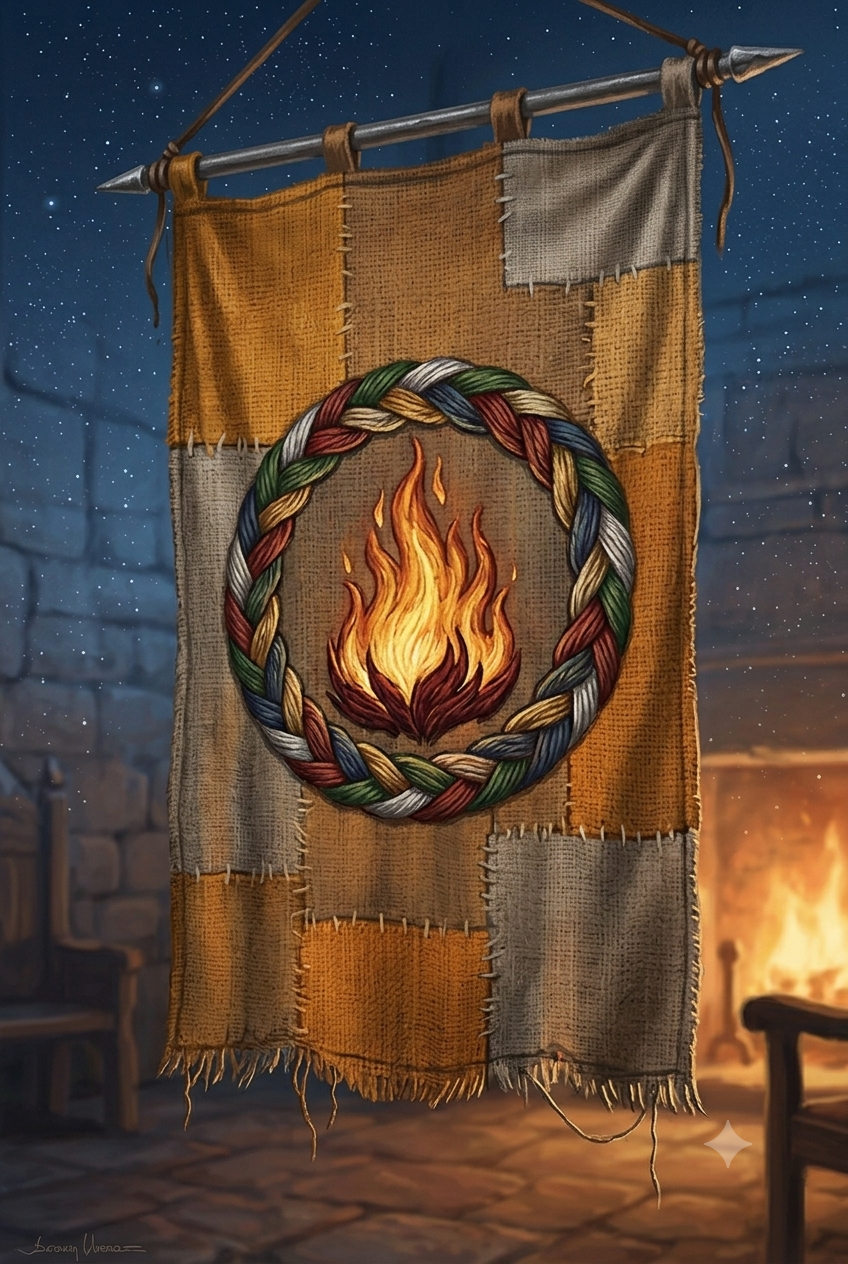
Also known as The Free Flame, The Neutral Pact, and The Refuge of the Broken Banner. A place where names are shed, identities are chosen, and flags are braided together in defiance of tyranny. Bordered by Verdaan to the west, Garunga to the south, Tasa Ru to the northeast, and Grandtree Lake to the north.
Capital
Freebraidhall - In Mottewood
Government
Confederation - The Hearthtable
Festival City
Tamfaire - Skeld Capital of Wildermere
Founded By
Survivors of the Battle of Bannerdun
The Pact of Quiet Flame
Bastion's foundational covenant, burned into Freebraidhall's beams - not ink on parchment, but char in pine. Five tenets: No Crown, No Chains (rotating elected governance, no hereditary rule) · Sanctuary First (any creature may renounce name and realm for equal standing) · Trade Is Neutral (Bastion deals with all, fights for none unless the flame is truly threatened) · Names Are Chosen, Not Given (identity earned by deed, never by blood) · Let Fire Guide, Not Consume (passion is honored; destruction is not).
Key Settlements
Freebraidhall / Mottewood - fortified capital in patchwork forest; the Braided Mast bears thousands of sworn names · Tamfaire - no-walls festival city and largest Skeld tournament in all of Wrüne · Bramblethorn - rough coastal port built from wrecked galleys; harbor for smugglers and rogue traders · Backwater Springs - lawless stilt town; disputes settled by dusk-draw duels · Nettlemouth Cove - pirate stronghold; ships that find it aren't always allowed to leave.
Culture & Identity
Freeborn mark survival openly - former realm-sigils tattooed and crossed out, replaced with flame motifs. The Rite of New Flame at Freebraidhall formally burns away the old name; the new one is carved into the Hall's rafters. "Braided in Flame" is Bastion's highest covenant, spoken when two creatures of different origins become blood-bound partners. Born from Bannerdun's aftermath, where exhausted soldiers built the first shelter from trebuchet beams and braided their war-cloaks over the doorway.
Bastion on the Other Realms
Verdaan - Complex. Many Freeborn came from there. The welcome is not always returned.
Garunga - Wary but functional; every Garungan shipment to Bramblethorn comes with wardens.
Tasa Ru - Deep respect. The Barkscribe seat at the Hearthtable was Tasa Ru's proposal.
Dwoles - Trusted engineers. Resonance bells and Deepcraft tools are welcomed in Mottewood.
Mul wü Terre
"The dark does not lie. The light often does."
Deep beneath the roots and ridgelines of Wildermere dwell the Dwoles - a reclusive, semi-blind people of fur, claw, and stone-sense. They are Wildermere's engineers, sap-masters, and Deepcraft forgers, responsible for much of the infrastructure and currency others take for granted. Their realm is not a kingdom but a network of strongholds, tunnels, and echo-chambers bound by tradition, vibration, and utility.
Stocky and powerful, their large milky eyes are adapted to light sensitivity rather than sight. They read the world through vibrational perception - through feet, claws, and snouts. Above ground, they are disoriented and irritable, anchored only by familiar stone. They hum or click softly while walking, using echoes to read spaces. They revere Üne, the beast god of origin, stillness, and echo - not through temples or prayers, but through stone resonance carving: fusing intent, tone, and memory into walls that hum in response to presence and emotion.
Primary Stronghold
Wure Terre - The Deep City
Surface Trade Gate
Rubblehook (Dwolic Hills)
Currency Seat
Dun Terre - Deadal Warrens
Invention
Deepcraft - incl. The Boomcrank
Three Principles
Form Must Follow Function - Nothing is built for beauty alone. Elegance lies in utility.
The Stone Remembers - History stored not in books but in carved stone, echoed tunnels, and vibrational codes. Songs are sung to attune structures to mood, pressure, or memory - not for audiences.
Silence Is Honesty - Words used sparingly. Truth is found in tone, action, and resonance.
The Three Strongholds
Wure Terre - The Deep City; vast echo-forged underground metropolis ruled by brothers Uldrum (expansionist, champions the Boomcrank) and Gorrim (traditionalist, guards Üne's echo) wu Craggthrum; Dun Terre - Currency seat beneath the Cradleheart; Sapminders mint Wildermere's three coin grades (Ambre, Tawns, Russets); the Deadal Warrens serve as external trade interface - respected for fairness, feared for precision · Eire Terre - Scholarly outpost within Tasa Ru's borders; surface settlement DeepHaven was built for exchange, not war; Orendale scholars journey here regularly.
Deepcraft & the Boomcrank
The Dwoles' broad discipline of mechanical and chemical ingenuity: sap-processing rigs, echo-maps, signal saplights, resonance detectors, acoustic command systems, and experimental alloys that react to vibration and light. All Deepcraft requires vibrational attunement and cannot be replicated outside Dwolic halls. Most infamous creation: the Boomcrank - a gunpowder weapon still refined in the sealed Glowchamber of Wure Terre. Its existence is officially denied by every realm. Its effect on a battlefield would not be.
Dwoles on the Other Realms
Verdaan - Useful collaborators. Permitted use of the Great Tunnel. For how much? The Dwoles don't say.
Tasa Ru - Closest allies. Eire Terre was built at the border for a reason.
Garunga - Respected for their reverence of Üne. Limited contact, mutual understanding.
Avondelle - Their obsession with the sky strikes Dwoles as philosophically reckless.
Bastion - Welcomed. Resonance bells and Deepcraft tools traded freely to Mottewood.
Location Records
Realm Codex
🌿 Verdaan
Select an entry from the list to read its record.
Powers in the Shadows
Factions of Wildermere
Between the thrones and beneath the treaties, other forces move - guilds, cults, brotherhoods, and conspiracies that often hold more true power than any crown.
VerdaanWoodland Realm
🪙
The Ambre House
Verdaan · Banking Guild
The most powerful financial institution in Wildermere - and one of its oldest. The Ambre House does not mint coin; that is the Dwole Sapminders' work, pressed under vibration-calibrated stone in Mul Wü Terre. The Ambre House decides where the coin goes. They control the circulation of all three denominations - Ambre, Tawns, and Russets - through a network of counting houses in Althorne, Beaverport, and Grainmere. Every realm that trades in Ambre has at some point been extended credit by the House. Every realm still owes. Their ledgers are longer than the Greyback dynasty's memory and more accurate than its official history. The Rat Throne believes the Ambre House serves the Crown. The Ambre House has never corrected this belief.
🩸
Scarlet Shield
Verdaan · Redveil & Althorne
Verdaan's most powerful shadow institution. Healers, confessors, and keepers of the private ledger - every debt of favor, secret, and sin owed by the powerful. They operate openly as a charitable healing order. Privately they maintain a ledger of every significant obligation ever traded in Verdaan's corridors of power. Their forgiveness, when it comes, is never free. The Temple's militant arm is the Scarlett Shields - a mixed-species order of religious knights who enforce the Temple's doctrine and the Crown's order throughout Verdaan's cities and roads. Known among commoners as the Scars, a name earned through their reputation for roughing up the citizenry.
🛡️
The Thornwatch
Verdaan · Border Enforcers
Verdaan's frontier military order - a mix of Fleetfeet cavalry and Branchtail scouts stationed at the Causeway forts. Officially answerable to the Rat Throne. In practice, individual Thornwatch commanders exercise considerable independent judgment at the borders, especially regarding which caravans get waved through without inspection.
🦅
Order of the Shrike
Verdaan · Aerial Scout Order
Verdaan's raptor-mounted scouts, trained at Almsnest where the cliffs meet Avondelle's sky-lanes. Greyback riders bonded to hawks, shrikes, and falcons since the Peace Accord of Thorns - an arrangement born from something darker than alliance. The original accord required the Greybacks to offer wards to Avondelle to end aerial raids; some of those wards were children. The Order does not speak of this origin, and Avondelle does not need to. The Veyuldrae permit their presence for the same reason: these rats did not earn their wings - they were granted them, by Avondelle, on Avondelle's terms, using Avondelle's raptors. They are a proof of the sky's reach over the ground, not a welcome of ground into the sky. The Shrike fly reconnaissance along the Causeway, shadow Avondelle Galevanes at the border, and serve as the Crown's fastest messengers. They are not soldiers. They are eyes with borrowed wings. What they see, the Rat Throne knows before nightfall. That Avondelle knows it first goes unmentioned by everyone.
👑
The Cracked Crown
Verdaan · Dissident Movement
A growing coalition of mice, rabbits, and lower-caste furfolk who claim the Greyback dynasty's right to rule expired when it began treating the Covenant of Roots as a weapon rather than a bond. Their symbol - a rat crown split cleanly down the center - appears overnight on market walls and toll-gates. No one has been arrested for it yet, because no one has been caught. Leadership is deliberately cell-structured. The rats call them criminals. The Cracked Crown calls itself inevitable.
GarungaSwamp Realm
🌊
The Tidechosen
Garunga · Driftmarsh Diplomats
The political voice of Driftmarsh - Garunga's cosmopolitan trade nexus on the Dolgami Depths. The Tidechosen navigate the realm's most complex diplomatic waters: brokering between the Triarchy's three cities, managing foreign trade relationships, and ensuring the interests of Driftmarsh's mixed-species population are heard above the din of Stonebound war-drums and Shellsworn ritual. They speak softly, move carefully, and know every debt owed on every pier in the port.
🪨
The Stonebound
Garunga · Warrior Caste
Garunga's warrior caste - primarily Bogmaws, chosen at the Spawnshade Pools and raised for war. First into battle, last to retreat. Their guttural war-songs serve as both battle-call and funeral rite. They muster in Gorra-Gorra's lower wards and answer to the Triarch's military arm, though their loyalty is ultimately to the caste before the crown.
🐚
The Shellsworn
Garunga · Sacred Water Caste
A sacred caste devoted to the Ramble and the waterways of Garunga - believing the river carries more than water: the memory of what Garunga has done. They maintain the old breach sites left by the Cradleheart's corruption as places of penance and slow restoration, tending them season by season. Their sanctuary at Pebblebrook on the Emerald Channel is among the most respected sites in the realm.
🐚
Deepshell Compact
Garunga · Trade & Intelligence
A loose guild of Garungan merchants and intermediaries who move goods, secrets, and sometimes people between Verdaan and Garunga - and into lands beyond Chestnut Bay. They don't carry cargo - they carry information about cargo. Every significant shipment moving through Garunga's waterways is logged in Deepshell ledgers before it leaves port. The Triarchy uses them. The Triarchy also fears them.
🔥
Fire Newts
Garunga · Sunclad Sub-Tribe
A Sunclad sub-tribe who practice ancient fire rituals in the hot springs of the deep marshes. Most are missionaries from Cárraig and Emberdeep. Formally part of Garunga's civic structure - in practice, they answer only to their own flame-priests and will refuse Triarch orders they judge spiritually impermissible. The Triarchy has not yet tested exactly how seriously to take this.
🐸
The Krobbak
Garunga · Bog Handlers
A secretive sect of frogkin within Brokenroot Bog who use unknown methods to coax or command Skitters and other insectoids. Whether they speak a pheromone language, wield a psychic link, or simply understand something about the creatures that no one else does remains unclear. Their sway extends to the Draggonfliers - Reedlings and Ashminders who harness Draggon mounts, scouting the bog for Blackwing threats, Coilbloods, and other dangers. The Krobbak use these relationships for trade, protection, and occasionally as a weapon. The Triarchy knows they exist. The Triarchy does not know how they do what they do.
🪲
Draggonfliers
Garunga · Draggonn Riders
Reedlings and Ashminders who bond with Draggons - the great dragonfly Chirm of the bog - and ride them across the marsh canopy, scouting for Blackwing threats, Coilbloods, and other dangers. Trained under Krobbak influence in and around Brokenroot Bog, they are the only aerial force Garunga can field that the sky-folk have never quite figured out how to counter.
AvondelleSkyward Dominion
🪶
Plumeheart Conclave
Avondelle · Secret Reform Society
A secret society within Avondelle seeking closer ties with the grounded - arranging ratling falconry partnerships, joining cross-realm scouting flights, and quietly opening routes the Aecliphrae would never sanction. Believed by some to be heretical; by others, the wing that carries Avondelle into its future. Their methods range from formal petition to targeted sabotage depending on the member.
⚖️
The Veyuldrae
Avondelle · Doctrinal Enforcement
Avondelle's internal doctrine enforcers, operating in the name of Veyuun's law. Where the Aecliphrae governs from the eyries, the Veyuldrae move unseen through sky-society - investigating breaches of sky-separation, identifying those who have made unsanctioned contact with groundfolk, and delivering them before the Aecliphrae for judgment. They are often asked why they permit the Order of the Shrike and the Constellation Court. They do not consider this a contradiction. The Creed forbids fraternizing with groundfolk as equals. Neither the Shrike nor the Court have ever been treated as equals. The rats at Almsnest fly because Avondelle extracted them as tribute and permits their wings - they are proof of Avondelle's reach, not a concession to groundfolk standing. The Constellation Court are chosen by Avondelle, study only what Avondelle allows, and may one day receive a title that only Avondelle can grant. The Veyuldrae do not see either as fraternization. They see them as patronage extended downward - which is, in their view, exactly how the sky is meant to work. They do not consider themselves cruel. They consider themselves necessary. The Plumeheart Conclave considers them the most dangerous birds alive. The Veyuldrae would say the same of the Plumeheart.
✨
The Constellation Court
Avondelle · Honored Acolytes
Chosen from among Tasari scholars and mystics through the Whisperwind Choosing - a rite Avondelle administers, not Tasa Ru. The Court do not arrive; they are selected. They study what Avondelle permits, fly only when Avondelle lifts them, and may one day be named Skybound Interpreters - a title that only Avondelle can bestow, and can revoke. The Veyuldrae do not see this as fraternization. In their view, a groundfolk who accepts these terms has not been welcomed as an equal - they have been elevated, temporarily, on Avondelle's sufferance. That is patronage, not friendship. The distinction matters enormously to the Veyuldrae. The Constellation Court have quietly stopped arguing the point; they have learned that disagreeing about the terms of your welcome is a fast way to lose it. Their existence is still a quiet rebuke to Eldevain Rook's brutality - but only because Avondelle allows that rebuke to exist.
⚡
Stormborne
Avondelle · Divine Strike Order
Avondelle's military elite - and its most feared religious order in one. Stormborne train at Eldevain Rook through Skyflint duels fought wing-to-wing at altitude, Stormring flights threading live lightning, and Fall Tests where the only way back is to earn your wings mid-drop. They revere lightning as Veyuun's direct correction - the sovereign star reaching down to judge. Initiates who survive the peaks are marked. Initiates who are struck and survive are given command. Deployed for special operations, assassination, and border enforcement - but a single Stormborne circling overhead is also understood by every realm as a diplomatic warning not to be mistaken for theatre.
🌟
Luminants
Avondelle · Celestial Cartographers
Keepers of Avondelle's fate-maps - vast sky-charts inked in luminescent compounds that shift with the seasons, updated nightly from the Aeriefall Libraries. The Luminants track Veyuun's movements against every other star, translating celestial positioning into strategic counsel for the Aecliphrae. They are not mystics - they are astronomers of the highest precision, whose conclusions carry the weight of divine endorsement. A Luminant's forecast of unfavorable skies has halted military campaigns. Their prediction of a second star appearing near Veyuun's position remains Avondelle's most closely held political secret.
🌬️
Galevanes
Avondelle · Wind-Dancers & Sound Weavers
Wind-dancers trained in the subtle manipulation of air currents and sound - guiding fog, redirecting voices, softening or amplifying words spoken aloft. They are Avondelle's most unusual military asset: not fighters but environment-shapers, deployed ahead of diplomatic summits to ensure that only the right words carry, or during engagements to confuse and disorient below. Order of the Shrike of Verdaan refers to Galevanes as "the breeders of misheard orders." The Galevanes take this as a compliment. They do not announce themselves. If you noticed them, they were not working.
Tasa RuKnowledge & Mystery
🌿
The Enneawise
Tasa Ru · The Nine Branches
Nine seats. Nine Ways of Knowing. No majority without four. The Enneawise governs Tasa Ru through Memory, Form, Breath, Word, Sky, Stone, Shadow, Flame, and Still Water - each seat a philosophy, a power bloc, and a potential betrayal. The Preservation Bloc (Memory, Stone, Still Water) resist change. The Reform Bloc (Flame, Breath, Word) push to open the Rootvoice. Form trades votes. Sky reads stars and says little. The Shadow Seat votes last, gives no reason, and has never been crossed twice.
🌿
The Rootvoice Schism
Tasa Ru · Internal Dispute
A growing internal disagreement about whether the Rootvoice should remain Tasa Ru's exclusively managed network or be opened as a true pan-continental commons. Those who favor opening it argue the current arrangement gives Tasa Ru political leverage that violates the Covenant's spirit. Those against argue that without stewardship, the network would collapse within a decade. Both are probably right.
🍎
The Apple Corps
Tasa Ru · Militia
Tasa Ru has no standing army. What it has is the Apple Corps - farmers from Appleshire, cider hands from Arnhill, and iron-shouldered workers from the Ironhills who answer the call when the Enneawise rings the bell. They have no uniforms. No barracks. No war doctrine beyond knowing every root, hollow, and fog-bank in Tasa Ru better than any invader ever could. They are not soldiers. They are people who came home from their fields carrying whatever was in their hands.
BastionThe Free Confederation
🪶
The Loamdrun
Bastion · Tracker Guild
No realm wanted them. Bastion gave them a floor and a fire. The Loamdrun are a tracker's guild assembled from outcasts who had one thing in common: they could read the world better than anyone who trained them. Bogmaws who survived years inside Brokenroot Bog and learned its rot-paths and Skitter tunnels from the inside. Darkpines who hunted through Verdaan's frozen northern wilds long after the crown stopped paying them. Scholars cut loose from Tasa Ru who studied movement, pattern, and root-memory before the Rootvoice went quiet for them. In Bastion they found each other. They pooled what they knew and built a guild around it - not for ideology, not for a throne. For coin, and because finding things is the only craft any of them ever trusted. The Hearthtable does not officially acknowledge the Loamdrun. The Loamdrun do not officially care.
🌰
Briarnut Syndicate
Bastion · Smugglers & Ferryhands
Smugglers and ferryhands operating along the treacherous Briarnut Pass. They move goods, secrets, and sometimes people between Verdaan and Garunga. Nominally independent, the Syndicate's relationship with the Hearthtable's Coinhand seat is uncomfortably close and mutually lucrative. Their emblem: a cracked nut with a silver river line. Home port: Bramblethorn.
🔥
Temperers
Bastion · Peacekeepers
Bastion's internal peacekeepers - known for wearing dull copper masks and using fire-code signals at night. Each carries a firebrand on their forearm as a symbol of quiet service. They man the watch platforms of Freebraidhall and maintain vigil along Mottewood's borders. Not soldiers - guardians. They de-escalate first, and act last.
Mul wü TerreThe Deep Realm
🪙
Sapminders
Dwoles · Currency & Trade
Dwolic specialists who refine Cradleheart sap into Wildermere's three coin grades: Ambre (highest, warm-golden and faintly luminescent), Tawns (mid-grade), and Russets (rough, prone to sediment). No coin enters circulation without Sapminder sanction - counterfeiting sap is both criminal and heretical. They operate from Dun Terre beneath the Cradleheart's roots, and their external trade interface, the Deadal Warrens, is one of the most respected neutral sites in the known world.
📯
The Echo Conclave
Dwoles · Governance
The governing body of Wure Terre - and by extension, the Dwolic realm. Currently held in uneasy joint rule by brothers Uldrum wu Craggthrum (expansionist, champions the Boomcrank) and Gorrim wu Craggthrum (traditionalist, keeper of the old methods). All major decisions pass through the Conclave. The two brothers agree on almost nothing - which is, some argue, exactly how it should work.
⚙️
Boomcrank Guild
Dwoles · Experimental Deepcraft
Engineers loyal to Uldrum who push Deepcraft beyond its traditional limits - developing the Boomcrank and other resonance weapons in the sealed Glowchamber beneath Wure Terre. Their work is officially classified. Unofficially, the blasts are audible from the surface on still nights. Gorrim's sapminders consider them reckless. The Guild considers the sapminders timid.
⛏️
The MulDelvers
Dwoles · Tunnel Engineers & Clampline Builders
The MulDelvers cut every artery in Mul Wü Terre. Armed with Boomcranks developed by the Guild, they blast and bore through mountain and bedrock — carving the main tunnel routes that connect Wure Terre, Deadal Warrens, and Deephaven, and building the smaller waystation settlements that dot the network between them. They also design, install, and maintain the Clampline: the overhead rail system that runs ceiling-hung carts through the primary arteries, the spine of all underground transit in the realm. MulDelvers are found everywhere in Mul Wü Terre — there is no part of the network they did not build and no part they do not tend. They map the Burrow Wurm passages where they encounter them, marking depth, diameter, and last-known movement. They do not enter them. Near the Cradleheart, where ancient root-heat and deep moisture have fed the passages for centuries, Burrow Wurms have grown to sizes that make even seasoned MulDelvers refuse the commission. Those sections of the map are marked, noted, and left alone.
All RealmsPan-Continental
🦝
The Banded Circuit
All Realms · Merchant Guild
A confederation of Ringers - the masked, ringed-tail folk who travel every road, river dock, and back-alley market in Wrüne without permanent address or allegiance. The Banded Circuit deals in everything: salvaged Deepcraft parts, water-warped Tasa Ru sky-charts, dented Stonebound armor, moth-eaten Verdaanian court robes, cracked sap vessels still faintly luminous. Nothing is considered worthless. Everything has a buyer who hasn't found them yet. The Circuit doesn't manufacture and doesn't extract - they redistribute. A broken thing in the wrong hands becomes a treasure in the right ones, and the Ringers have an almost supernatural sense for which is which. Their wagons and river-boats are marked by a painted ring of alternating dark and pale bands. No one knows where the guild is headquartered. It isn't. The Circuit is the road.
🐾
The Freepads
The Hinterlunds · Sellsword Confederation
No throne commands them. No covenant binds them. The Freepads sell their sword to whoever meets their price — and across the six realms, the price has been met many times over. They are a loose confederation of war-bands flying a shared banner out of the Hinterlunds, the ungoverned territory south of Briarnut Pass and the Dolgami Depths. Each band is its own outfit: its own captain, its own name, its own reputation. What they hold in common is the Freepad mark and the code that comes with it. The mark means professionals. The code means the contract holds. Breaking either gets you cut from the confederation — and in the Hinterlunds, there is no worse status than a Freepad without the mark. What makes them dangerous isn't numbers. The Hinterlunds are hostile terrain — rough, lightless in the deep ravines, without mercy in any season. Freepads train in it. They learn ambush tactics and endurance that soldiers from the six realms rarely match, and carry weapons most Wilderfolk armies have never encountered. A Thornwatch unit can hold a wall. A Freepad company will be behind you before you knew the wall was flanked. More than one realm has come to depend on them. More than one war has put two Freepad companies on opposite sides of the same field. Neither blinked.
🎭
Painted Chorus
All Realms · Performers & Intelligence
Traveling artists, fire-dancers, mask-makers, and tale-carriers. Their masks depict extinct creatures, mythic beasts, and embodied ideals. They use performance to pass coded history, often preserving truths others wish erased. The Chorus maintains a seasonal camp at Tamfaire and is welcomed everywhere - suspected in most. Their ultimate patron remains unknown even to most of its own members.
🍄
The Sporemancer
All Realms · The Spore-Taken
No one chooses to become a Sporemancer. The deep rot-fungus — older than any realm, any covenant, any god — finds them first. A wound in the wrong soil. A cave explored too long. Spores breathed in the dark. The mycelial network threads through them slowly, and at a certain depth of infection, something changes: the fungus finds a living mind and learns from it. The Sporemancer is not a sorcerer. They are a node — the part of the network that can still speak, still move with purpose, still cross borders. Pale patches where the skin has gone thin. Joints that bend slightly wrong. A smell no water removes. They do not control the Fungrel. They are simply what the network produces when it finds something still thinking. The most dangerous Sporemancers are the ones furthest along. No realm knows how to stop one. Most choose not to acknowledge they exist.
Bounties & Outlaws
The Wanted Board
Posted by the Hearthtable, the Triarchy, and parties who prefer to remain unnamed. No questions asked. Some questions strongly discouraged.
The Ashcloak
2 Ambres, 140 Tawns
Theft & Sedition
click for case file
CLAIMED
Case File - Verdaan
The Ashcloak
2 Ambres, 140 Tawns - Dead or Alive
Known Crimes
Theft of Thornwatch supply manifests. Suspected Cracked Crown informant. Distributing seditious pamphlets in Althorne market district. Do not approach alone.
Grikk No-Shell
3 Ambres, 80 Tawns, 200 Russets
Defection & Theft
click for case file
CLAIMED
Case File - Garunga
Grikk No-Shell
3 Ambres, 80 Tawns, 200 Russets - Alive Only
Known Crimes
Defection from the Shellsworn order. Theft of sacred Spawnshade records. Believed hiding in Murkmire. Triarchy wants him breathing.
The Pale Wing
6 Ambres, 40 Tawns
Smuggling & Treason
click for case file
CLAIMED
Case File - Avondelle
The Pale Wing
6 Ambres, 40 Tawns - Dead or Alive
Known Crimes
Aerial smuggling. Breach of Sky Passage Clause. Suspected Blackwing courier. Three handlers sent. None returned. Approach only from below.
Murren Twice-Burned
60 Tawns, 450 Russets
Extortion & Charter Breach
click for case file
CLAIMED
Case File - Bastion
Murren Twice-Burned
60 Tawns, 450 Russets - Dead or Alive
Known Crimes
Violation of Freepad charter. Extortion of waystation residents. Two unpaid Hearthtable warrants. Known to travel armed.
Unknown
10 Ambres - Sealed
Classified
click for case file
CLAIMED
Case File - All Realms
Unknown
10 Ambres - Alive Only, Sealed Writ
Known Crimes
Unknown. Issuer requests live capture only. No further information will be provided to collecting parties. Do not ask.
Sib the Hollow
2 Ambres, 200 Russets
Theft & Espionage
click for case file
CLAIMED
Case File - Tasa Ru
Sib the Hollow
2 Ambres, 200 Russets - Dead or Alive
Known Crimes
Theft of Branch of Sky instruments. Sold Rootvoice access codes to unregistered parties. Slippery. Has evaded capture four times.
The Sacred Heart of Wildermere
The Cradleheart Tree
"It was here before the realms had names. It will be here after."
- Inscription at the Gate of the The Understory, Bastion
The Tree Itself
The Cradleheart stands on neutral ground at the geographic center of Wildermere - claimed by no lord, tended by all. Its canopy covers several square miles - entire villages exist in its shadow without ever seeing its trunk. Its trunk has never been fully encircled; the largest recorded attempt required over two hundred adults and still fell short. Its rings predate the earliest written record of any realm by what scholars conservatively estimate as four thousand years.
It is believed that as Wru ran, he scattered — seeds shaken loose from his coat, dropped from his breath, pressed into the soil by his passing hooves. He did not stop to plant. He never stopped. But Üne, moving slowly beneath, felt each seed settle and pulled it downward, fed it through her own roots, wrapped nerve around root until something living pushed upward. The great trees of Wrüne are theirs together. Wru gave them to the ground without knowing. Üne grew them without being asked — using the same web she used to feel the world, the same network that would one day be called the Rootvoice. Every great tree in Wrüne is connected to every other through her. She has been tending them since before any realm had a name for what she was doing. Where they finally came to rest — the one moment Wru stilled and Üne rose to meet him — the Cradleheart grew. The largest tree. The deepest roots. The only one either of them intended.
The Covenant Marks
The Covenant of Roots was physically enacted at the Cradleheart. Every realm that signed placed a representative at the trunk and spoke their vow aloud into the wood. The tree is said to have shuddered once when the last oath was given. Tasa Ru recorded it. No one else admitted they felt it.
The Blooming Cycle
Once per decade, the Cradleheart flowers. Its blossoms are luminous - gold with faint green veining - and visible on clear nights from as far as forty miles. The blooming lasts between three and nine days, and no scholar has found a predictive pattern for its duration.
During a bloom, an informal pan-continental armistice holds. Travelers of every realm converge. No weapon has been drawn within sight of the Tree during a bloom in recorded history.
The Sap
The ordinary sap of the Tree - pale golden, tapped from healthy branches - is the basis of Wildermere's economy. This is not metaphorical. The Dwolic Sapminders refine it into Wildermere's three coin grades: Ambre, Tawns, and Russets. No currency enters circulation without their sanction.
The Sap Economy
How the Cradleheart's harvest became the currency of a continent
The Cradleheart produces a golden crystalline sap with unusual preservation properties - it does not ferment, spoil, or evaporate under normal conditions. Early Dwolic engineers at Dun Terre discovered that when sap is compressed under vibration-calibrated pressure into standardized forms, it holds its shape indefinitely and carries a faint luminescence that is effectively impossible to fake. The Dwoles became the continent's minters. The sap became its money.
🟡
Ambre
High denomination
A thumb-sized disc of compressed sap, fully translucent, bearing the Covenant seal pressed by a Dwolic vibration-stamp. Used for land purchases, war debt, and inter-realm treaty settlements. Most people in Wildermere will never physically hold one.
🟠
Tawn
Mid denomination
Slightly smaller, amber-tinted rather than fully clear. The standard denomination for merchants, guild dues, and significant individual transactions. Eight Tawns to one Ambre. Engraved with a small tree silhouette on the reverse.
🟤
Russet
Common denomination
The everyday coin - reddish-brown, slightly rough-edged, carried in small cloth pouches by farmers, laborers, and market traders across all six realms. Twelve Russets to one Tawn. The only denomination most Wildermere residents will ever use.
The Dwoles hold minting rights as codified in the Covenant - no realm may produce its own coinage without Dwolic validation. This gives the three Dwolic territories a structural economic leverage that no surface realm has ever successfully challenged. Verdaan has tried twice. Both attempts ended in trade disruption expensive enough to reverse. The Hearthtable of Bastion calls this arrangement "an elegant balance." The Rat Throne calls it something less diplomatic in private correspondence.
The Harvest War - How the Peace Was Bought
The war did not begin with a declaration. It began with a misread.
Tasa Ru's Rootvoice interpreters picked up fragmented signals from the network's interior lines - movement, heat, escalating tension between Verdaan and Garunga. They called it aggression. It was anxiety. The whisper they forwarded to Garunga as warning was received as confirmation that Verdaan had already moved. By the time the misinterpretation was identified, the border skirmishes had already begun. Tasa Ru has never formally admitted this. The Rootvoice records from that period are sealed.
Garunga's response was not cavalry. It was engineering. Their surveyors had long known that Cradleheart root-wood ran beneath their territory in vast underground networks - pale, dense, unnaturally hard, it did not rot and did not burn easily. They harvested it. Siege engines of root-wood. Fortifications that shrugged off fire. Weapons with an edge that did not dull. And then the soldiers began eating the scraps - root-shavings at first, mixed into rations. Then deliberately, systematically. Wounds sealed overnight. Shattered bones reset. Lost tails regrew in weeks. Garunga's soldiers became something that soldiers should not be. They started winning.
Then the land began to die.
Color left first. Fields went grey-green, then grey. Rivers slowed. The soil stopped holding seed. The border regions between Garunga and Verdaan went quiet in a way that had nothing to do with the war - a deeper quiet, like something beneath had stopped breathing. Wildermere was beginning to look like Cárraig. Every realm that had heard the old stories recognized what that meant. The warning Cárraig represented - whatever happened there, whatever was done to the Furànn - was happening again, and this time they were doing it themselves.
Tasa Ru called the halt. They did not have the military power to enforce it. They had the Rootvoice, and through it they could show every realm exactly what was happening beneath the soil in real time - the dying root-lines, the spreading grey, the Cradleheart's own network contracting inward. The evidence was not deniable. Garunga had not intended a blight. They had not understood what the root-wood was.
The Accord was Tasa Ru's proposal: hostilities cease, borders are recognized, and the Cradleheart is declared untouchable - no harvesting, no claiming, no armies within a day's march. The Dwoles, who had stayed neutral throughout the war (too deep, too useful to both sides to touch), would become the continent's minters. Cradleheart sap - which the tree produces naturally, without cutting - would be compressed into currency. Every animal in Wildermere could hold a piece of the tree without the tree being destroyed.
The last provision is what made it work politically. The sap coins carry something. Not magic - no scholar has been able to name it precisely - but something. Those who hold more coin feel sharper. Wounds close faster. Dreams run clearer. It is subtle enough that no one can prove it. It is consistent enough that everyone believes it. Which means that in Wildermere, wealth is not merely economic power. It is quietly, literally, a form of biological advantage. The Covenant did not end the desire for dominance. It redirected it into a system the Cradleheart could survive.
The vows spoken at the Cradleheart are not ceremony. They are debt acknowledgment. Each signatory said: we nearly killed this. we owe it our restraint.
While Verdaan and Garunga tore into each other on the ground, Avondelle watched from above and moved quietly. Their Stormborne ran the air corridors between the two warring realms without interference. Supply messengers were taken. Strategic correspondence went missing. Avondelle never declared a side. They didn't need to. Controlling the air above a land war is its own form of participation.
By the time the blight began spreading, Avondelle had expanded their recognized flight territory by a third. No ground realm had the attention to contest it. When the grey reached the treeline canopies - the high roosts, the thermal corridors, the old-growth nesting grounds - Avondelle felt it before anyone sent word. The Aecliphrae had been watching the colour drain from the world beneath them for weeks.
When Tasa Ru called the accord, Avondelle was the last to respond and the hardest to bring to the table. They had no obligation - they hadn't fought the war, hadn't signed anything that started it, and hadn't lost anything yet. What moved them was not principle. Dying canopy means dying nesting grounds. The blight, if it continued, would reach the sky eventually. Everything does.
They signed. And the Aecliphrae drew the lesson they wanted from it: stay above, stay apart, and let the groundfolk exhaust themselves. The sky-separation doctrine that defines Avondelle today was hardened - perhaps created - in the silence of that war.
The Rootvoice Connection
The Cradleheart is believed to be the origin-node of the Rootvoice - a mycelial communication network threading beneath the soil of all six realms and beyond, managed by Tasa Ru. It is the fastest means of communication in Wildermere: a message sent from Althorne can reach the Ironhills of Mul Wü Terre or the eyries of Avondelle before a rider has saddled their mount.
What the Rootvoice carries is not text. Messages arrive as sensation - a scent, a tactile impression, an emotional coloring, a sound just below hearing. Trained Rootvoice readers at Tasa Ru can extract precise meaning from these signals. For everyone else, a Rootvoice message lands somewhere between a vivid dream and a feeling they cannot name. The further a message travels, or the more nodes it passes through, the greater the chance of distortion - a tone that shifts, a meaning that blurs, an urgency that arrives without its context. It has started at least one war. Tasa Ru does not advertise this.
The network has a second function that Tasa Ru speaks of even less. The Rootvoice runs through the same soil the Wruteborn move in - those twisted dead-root creatures that have been stirring in places where the network has grown thin or corrupted. A sufficiently skilled reader can do more than listen. They can push. Most who have tried report the signal collapsing back on them - disorientation, bleeding from the ears, days of silence where the Rootvoice won't answer. Only the Grovetongues - Tasa Ru's most elite interpreters, initiated through a rite the Branch of Memory does not describe in writing - are believed to have harnessed this with any reliability. What exactly they can make the Wruteborn do, and whether they answer to the Enneawise or only to themselves, is not a question Tasa Ru invites.
The Furànn - Sister Tree of the West
The Cradleheart had a sister. The Furànn stood at the heart of Cárraig - once the fairest land in the known world: rolling green hills, deep glens heavy with old forest, moorland ringing with birdsong, ancient barrows covered in soft grass. The ratkin were its people. They built their halls inside the living wood and did not think about what it would mean to lose it.
No one agrees on what split the Furànn. Some say it was Wru's first great cry - that when the divine beast broke the silence of the world, the sound reached the Furànn and cracked it from crown to root. Others say something was done to it that no record survived to describe. What is known: the Furànn split. Fire caught in the heartwood and did not go out.
The ratkin fled east in what they would come to call the Exodus of Ash - a years-long crossing through unmapped wilderness until they found the thornbrush country that would become Verdaan. The ash column from the burning followed them for days. It settled on their backs, grey and fine, and did not wash out. By the time they reached their new land, it was part of them. They named themselves for it: the Greybacks.
Cárraig is gone. What remains is Càrnoch - the hills leached grey, the glens cracked and silent, the barrow-grass black. The moors that once rang with birdsong are quiet now except for the chittering of Skitters moving through the heather, following the buried roots of the dead tree. Sunclads make the long crossing from Garunga's western edge each season to sit before the ever-fire and worship what they cannot explain. The Furànn still stands. The fire at its base has never gone out. Those who came after called it the Emberdeep - knowing it only as a burning thing. The Greybacks remember its true name.
The Living Network
The Rootvoice Oracle
Speak your question into the deep wood. The network listens.
✦ ✦ ✦
- interpreted by Cinnibbih, Seat of Word, Enneawise of Tasa Ru
The Game of Realms
Skeld
The bones came first. Long before the cards, long before territories and factions and any rules worth writing down, there were the Shamans. When two warlords met at the edge of a disputed field - neither willing to commit their forces without some sign from the world - they would send for the Shaman. The Shaman would reach into a pouch of knuckle bones, finger bones, the small carved teeth of animals no longer living, and cast them across a flat stone or a shield laid face-down in the dirt. Where they fell, how they clustered, which faces turned upward - these were the omens. This side would prevail. That flank would break. The river crossing would hold or it would not.
Whether the Shamans were right is a matter armies argued about long after the fact. But the ritual stuck. Soldiers who watched the casting began to imitate it. Not for prophecy - for sport. The bones were already at hand. The table was already there. The game that grew from this was never quite respectable and never quite disreputable. It lived in the space between. No one knows which camp or which tavern saw the first real game with cards and territories and proper stakes, but the same rules spread across the realms the way rumours do - faster than the roads that supposedly carried them.
The name came from the sound. Bone striking iron - the rim of a shield, the lip of a tankard, the edge of a breastplate left carelessly on the table. Skeld-skeld-skeld. Sharp, flat, final. The Shamans had their own word for the cast. The soldiers had this one.
Wru and Üne were already old beliefs by then - twin forces the beastfolk had argued over for generations: echo and origin, tide and stone, the pull of chance against the weight of will. The Shamans claimed they could read which one was speaking in a given throw. The tavern players claimed the same thing, louder and with less ceremony. The stakes were always real. A lucky night might win you a cask of mead, the deed to a contested acre, a blade better than the one you came in with. A bad one could cost you your boots, your mount, or your pride in front of people who'd remember. Skeld rattles on. Somewhere tonight, someone is casting the bones and asking the same question the Shamans asked over blood-soaked fields: who wins this?
The Tamfaire Open
Bastion · The largest sanctioned tournament in Wildermere - universal rules, any realm, real stakes
Tamfaire has always drawn Skeld players the way it draws everything else - because it draws everyone. The festival city runs on masked storytellers and sap-honey wine and open conclaves, and somewhere in its first generation of existence, the Skeld tables became as permanent a fixture as any of those. Players from Verdaan, Garunga, Tasa Ru, and Bastion showed up with their regional sets and their regional habits and their very strong opinions about how the game should be played. Arguments about variant rules became part of the entertainment.
The Hearthtable eventually formalized it - not because they cared about Skeld particularly, but because a tournament with agreed rules generated less violence than one without. The Tamfaire Open now runs under universal rules: regional variants suspended, all casting surfaces and pieces accepted provided they meet basic standards, all stakes declared in advance and witnessed by a Hearthtable-appointed Coinhand. The Briarnut Syndicate runs the surrounding betting operations. This is not officially sanctioned. It is officially tolerated.
The Open is the one place in Wildermere where a Verdaanian soldier, a Garungal Bogmaw, a Freeborn exile, and a Tasa Ru scholar can sit at the same table under the same rules and find out, cleanly, who wins. The answer changes every time. The question never does.
As Recorded by the Branch of Memory
The Chronicle of Wildermere
From the first breath of the world to the stirring of the dead - an accounting of what was, what broke, and what was built from the wreckage.
Age Before Memory
The Weaving of Wru & Üne
Sacred
Before the first realm, there were two. Wru - chance, motion, the thrown bone - and Üne - memory, depth, the patient earth. They were not siblings, not rivals, but lovers and mirror-halves. Together they wove the rhythm of the world: the living and the long memory of it. It is believed - where they finally lay down together, the Cradleheart grew. Nothing before this is recorded. Nothing before this needed to be.
Age Before Memory
The Veyuun Revelation
Sacred
A great meteor falls on The Great Hedge - Wildermere's northern highlands. The Avondii, already dwelling in the peaks, already watching the sky, do not flee. They had long revered Veyuun - the brightest fixed star visible from any perch in Wildermere, which they understood as a conscious eye watching creation from above. The meteor, they decided, was Veyuun reaching back. Aeriefall is built around the impact crater, its foundations cut from the fallen stone itself - black, harder than anything quarried, warm to the touch even in winter. The Creed of Veyuun is born from the impact: that the sky has sovereign claim over the earth, that height is moral and physical superiority, and that those who cannot fly must be guided from above. The Avondii stop following Wru or Üne entirely. They never look back down.
The Age of New Fires
The Burning of Furann & the Greyback Migration
Mystery
Far to the west, beyond seas that traders rarely crossed twice, the Greyback people - badger-kin - lived beneath a great tree called the Furann. What burned it, no archive holds. The fire reached the canopy before anyone could stop it. What could be carried was gathered. What could not was left. The Greybacks traveled overland into Wildermere: a people displaced and grieving, carrying the memory of something lost and no clear right to what they were walking toward. The other peoples of Wildermere watched them arrive at the western border and met them with suspicion rather than welcome.
The Age of New Fires
The First Ceremony of the Spawnshade
Founding
Garunga formalises its system of sacred calling - the moment a tadpole reaches first form, it is brought to the Choosing Pool and drifts toward one of the great carved totems. Shellsworn. Stonebound. Tidechosen. The profession that chooses you is considered divine answer, not personal preference. No Triarch has ever overridden a Spawnshade result. None have tried twice.
The Crownless Age
The Crownless Age
War
The age between the Furann's burning and the Understory Accord - when Wildermere had no settled order, no drawn borders, no authority above the houses. The Greybacks, settled in what would become Verdaan and led by Aldric Briarthorn, declared that the Cradleheart required stewardship - and that Briarthorn was positioned to provide it. The other peoples of Wildermere answered with arms. The Branchtails, the Garunga, the Floodbinders, the Stripe Snouts, and the coalition Fleetfoot all had stakes in who held the center of the world. The war was not clean. There were cousins on different sides. There were front lines and backrooms. There were peoples caught between armies that did not ask their opinion before moving through them. What Aldric had calculated before any declaration was made: quiet promises, private correspondence, land assurances delivered in person to the hill clans, foresters, and border families who had never formally sworn to anyone. He asked where their loyalty sat before the war started. He asked first.
The Crownless Age
The Battle of Bannerdun
War
The war ended not in a negotiating room but in a field beneath the Cradleheart's outstretched root formations. Five days. Every major faction committed forces. On day five, the eastern root chambers cracked - tunneling, flooding, and five days of close fighting opened a sixty-yard fissure across Bannerdun Field. The ground itself stopped the battle. Those who had come to claim the Cradleheart watched it split beneath them. No side declared victory. At the Understory Accord that followed, the Cradleheart was declared sovereign to no realm. The Understory Law - its first and weightiest article - prohibited any blade drawn, any army stationed, any realm claiming the soil within the root formations. Bannerdun Field does not grow as it did before. Nobody plants there.
The Age of Accords
The Pact of Quiet Flame & Birth of Bastion
Founding
In the aftermath of Bannerdun, soldiers from every people found themselves with nothing to return to - or no way to go back to those who had sent them into that field. They drifted into the ungoverned interior and built something without houses, without banners, without a lord's mark. The Pact of Quiet Flame is signed within sight of the Memorial Stone, the eternal flame. Bastion is not founded - it accretes, the way a fire catches. The Freebraid is woven from the flags of every homeland its founders left behind. Every Speaker of Flame recites the Pact at the Cradleheart. Every one of them means it differently.
The Age of Accords
The Rootvoice Spreads
Sacred
Tasa Ru scholars discover the mycelial web threading beneath the soil of every realm - messages arriving as scent, dream, and echo rather than spoken word. The Branch of Memory claims this network predates the Cradleheart. Both positions are still debated. Neither side will concede the other may be right.
The Age of Shadow
The Flicker Years
War
The Skin Spies - chameleon-folk who can alter not just their coloration but their skeletal structure - are deployed as weapons. Noble houses are infiltrated. Courts are replaced. Wars are steered from the inside by faces that belong to someone else. No one knows how long it had been happening before it was discovered. Historical records from this period are treated as unreliable by all six realms' archivists.
The Age of Shadow
The Unity Hunt
War
The only coordinated cross-realm military operation in Wildermere's history. Every realm contributed soldiers. The Skin Spies were hunted to near-extinction - or so the records state. Their only known identifier: a forked-tongue eye sigil, sometimes burned into the underside of a left wrist. Looking for it is usually how you find out you're already too late.
The Age of Ruin
The Harvest War
War
It began with a misread. Tasa Ru's Rootvoice interpreters forwarded what they read as Verdaan aggression to Garunga - it was border anxiety. By the time the error was found, skirmishes had already begun. Garunga answered not with cavalry but with engineering: vast Cradleheart root-wood networks ran beneath their territory, and they harvested them. Siege engines. Fortifications. Weapons with an edge that didn't dull. And then soldiers began eating the root-wood itself - wounds closed overnight, tails regrew, bones reset. Garunga was winning. Meanwhile, Avondelle never declared a side. Their Stormborne ran the air corridors between the warring realms, intercepting messengers and correspondence. By the time the blight began, Avondelle had quietly expanded their flight territory by a third.
The Age of Ruin
The Great Blight
Mystery
The over-harvesting did not announce itself. Colour left first - fields went grey-green, then grey. Rivers slowed. Soil stopped holding seed. The border lands between Verdaan and Garunga went silent in a way that had nothing to do with the war. Wildermere was beginning to look like Cárraig. Tasa Ru broadcast the dying root-lines through the Rootvoice simultaneously to all realms. The evidence was undeniable. Even Avondelle, watching the canopy grey from above, could not argue. If the blight continued, the sky would follow. Everything does. The war stopped not because either side had won - but because the land made clear it would not survive another season of it.
For Collaborators
Take the World With You
Full lore, glossary, and timeline in readable PDF format - for artists, writers, game designers, or anyone who wants to build inside Wildermere.